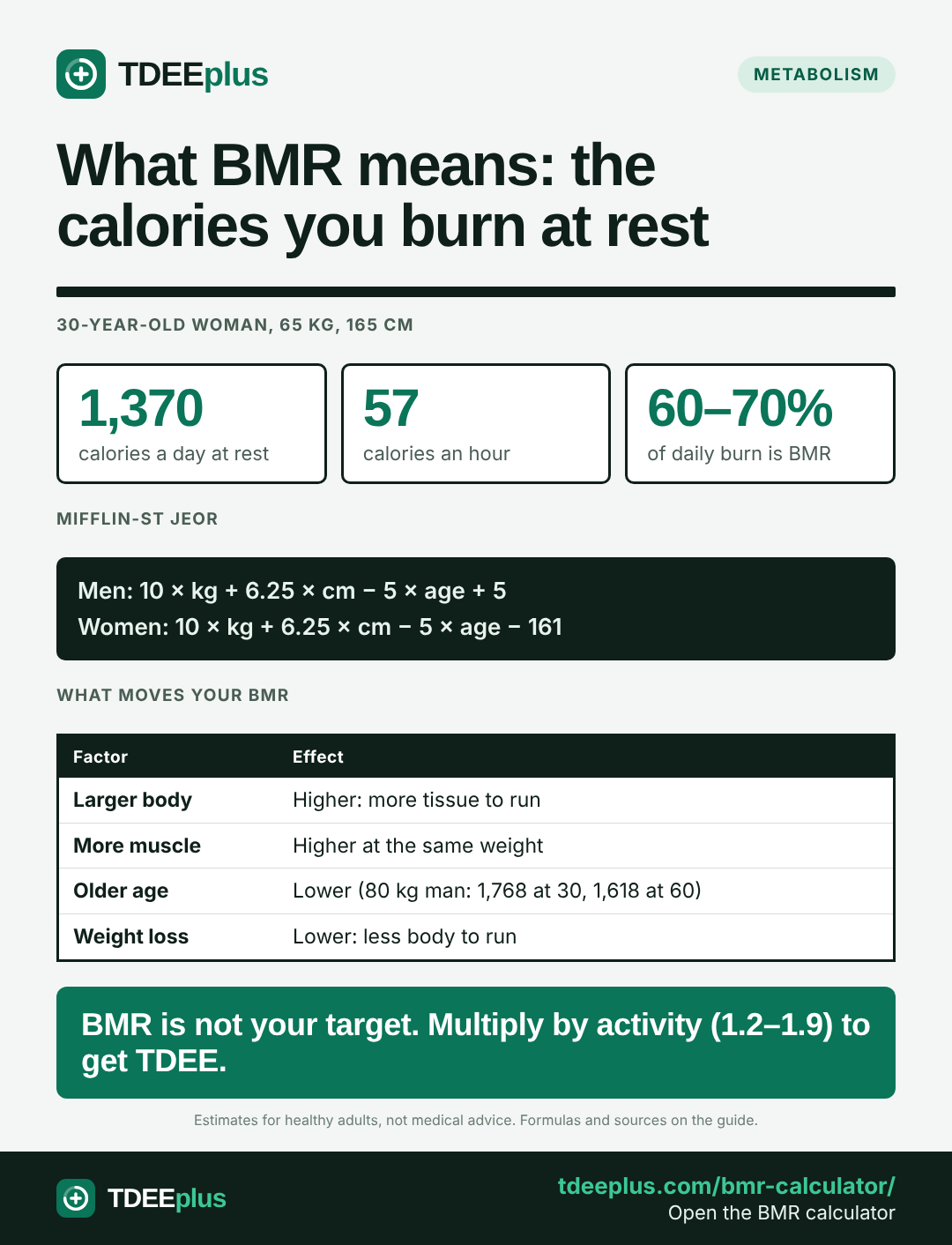
BMR means basal metabolic rate: the number of calories your body burns at complete rest, just to keep you alive. It powers your heart, lungs, brain, kidneys and body temperature, and for most people it makes up 60–70% of the calories they burn each day. A 30-year-old woman who weighs 65 kg and is 165 cm tall has a BMR of about 1,370 calories a day. Find yours with the BMR calculator, or get your full daily needs with the TDEE calculator.
What "basal metabolic rate" means
- Basal: the base, or minimum, level.
- Metabolic: the chemical work your cells do to turn food into energy.
- Rate: how fast it happens, usually given in calories per day.
So BMR is the minimum energy your body uses per day when you are doing nothing at all. Divided by 24, it is roughly what you burn per hour lying on the sofa. For the woman above, that is about 57 calories an hour.
Where your BMR goes
Your organs use most of it. The liver, brain, heart and kidneys are small but very active, and together use more energy at rest than all your muscle. Muscle still matters, because there is a lot of it, and it is the part you can change.
How BMR is estimated
Labs measure BMR from the oxygen you breathe in and the carbon dioxide you breathe out. Calculators estimate it from your sex, age, weight and height, most often with the Mifflin-St Jeor equation:
A 2005 systematic review found Mifflin-St Jeor came within 10% of measured values for more people than other equations, which is why it is the default in our calculators. Which formula should you use? compares the options.
What raises or lowers BMR
| Factor | Effect |
|---|---|
| Larger body | Higher BMR: more tissue to run |
| More muscle | Higher BMR at the same weight |
| Older age | Lower, partly through muscle loss |
| Male sex | Higher on average, from more lean mass |
| Weight loss and long diets | Lower: less body to run, plus some adaptation |
| Fever, growth, some thyroid conditions | Can raise or lower it; see a doctor if you suspect a problem |
How to use your BMR
Your BMR is not what you should eat. It leaves out digestion and all movement. Multiply it by an activity factor (1.2 to 1.9) to get your total daily energy expenditure, then set your goal from there. TDEE vs BMR explains the difference, and how many calories should I eat? takes you from BMR to a daily target.
See your BMR per day and per hour, with three formulas compared.
Open the BMR calculatorFrequently asked questions
What does BMR stand for?
What is a good BMR?
What is the difference between BMR and RMR?
Can I increase my BMR?
Keep reading
Sources
- Mifflin MD, St Jeor ST, Hill LA, Scott BJ, Daugherty SA, Koh YO. A new predictive equation for resting energy expenditure in healthy individuals. Am J Clin Nutr. 1990;51(2):241–247. PubMed 2305711
- Frankenfield D, Roth-Yousey L, Compher C. Comparison of predictive equations for resting metabolic rate in healthy nonobese and obese adults: a systematic review. J Am Diet Assoc. 2005;105(5):775–789. PubMed 15883556
- Roza AM, Shizgal HM. The Harris Benedict equation reevaluated: resting energy requirements and the body cell mass. Am J Clin Nutr. 1984;40(1):168–182. PubMed 6741850