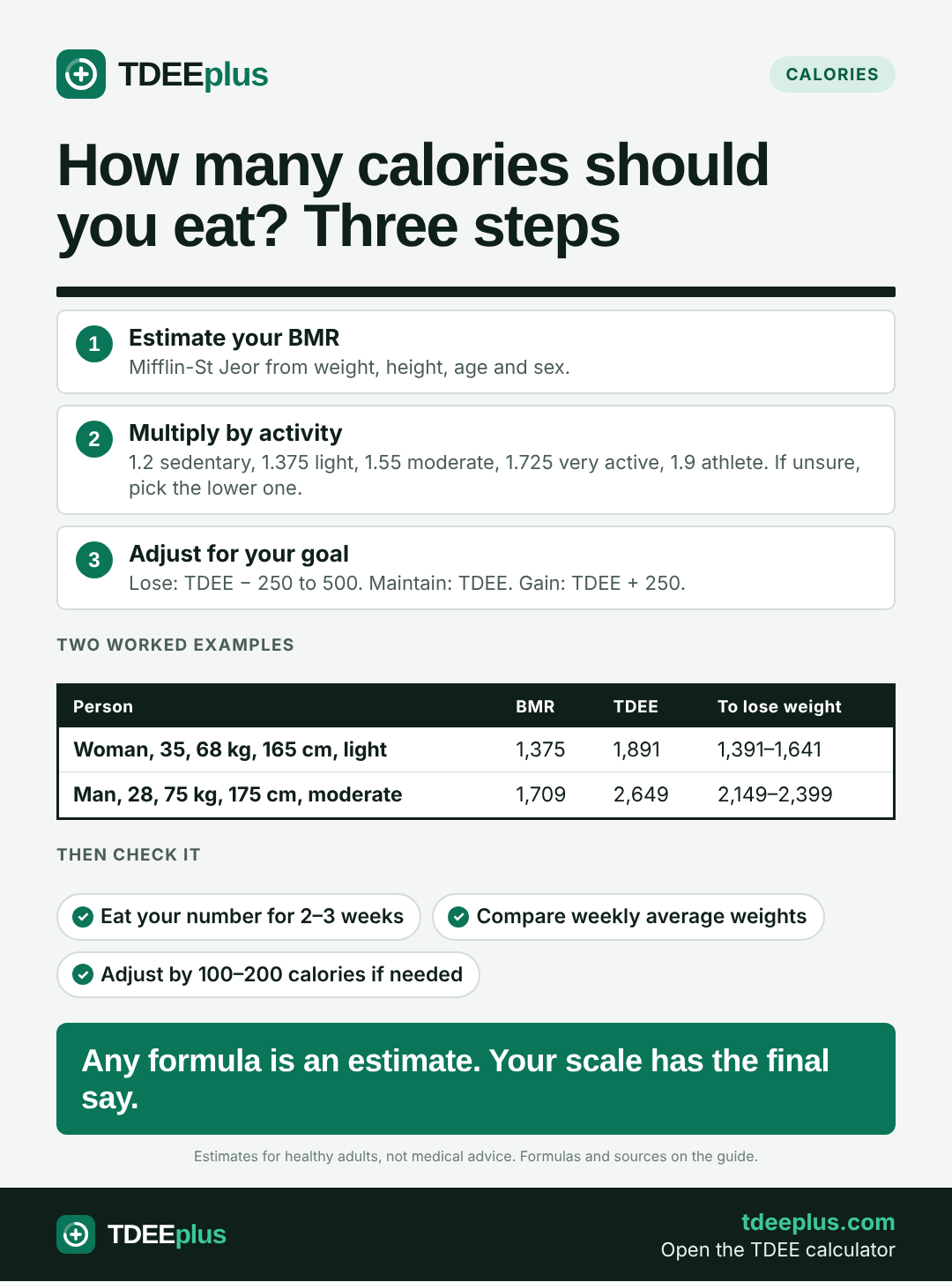
The number of calories you should eat a day is your TDEE (the calories you burn) adjusted for your goal: about the same to maintain, 250–500 less to lose weight, and 250–500 more to gain. For a 35-year-old woman who is 165 cm, weighs 68 kg and is lightly active, that is about 1,890 to maintain and 1,390–1,640 to lose. Get your own number in under a minute with the TDEE calculator. Averages by age and sex are in daily calorie intake, but your own number is more useful.
Step 1: Estimate your BMR
Your basal metabolic rate is what you burn at rest. Use the Mifflin-St Jeor equation, or the BMR calculator:
Step 2: Multiply by your activity level
| Activity level | Factor | Typical week |
|---|---|---|
| Sedentary | 1.2 | Desk job, little exercise |
| Light | 1.375 | Exercise 1–3 days a week |
| Moderate | 1.55 | Exercise 3–5 days a week |
| Very active | 1.725 | Hard exercise 6–7 days a week |
| Athlete | 1.9 | Physical job plus training, or twice-daily training |
This is the step most people get wrong, almost always by choosing too high. If you're unsure, choose the lower level. How to choose your activity level has examples.
Step 3: Adjust for your goal
| Goal | Daily calories | Expected change |
|---|---|---|
| Lose weight | TDEE − 500 | About 0.5 kg (1 lb) a week at first |
| Lose slowly | TDEE − 250 | About 0.25 kg (0.5 lb) a week |
| Maintain | TDEE | Stable |
| Gain slowly (lean bulk) | TDEE + 250 | About 0.25 kg a week |
Worked examples
Check it against real life
Any formula is an estimate, and it can be 10% or more off for you. Eat your number for 2–3 weeks, weigh yourself most mornings and compare weekly averages. If your weight isn't moving the way you expect, adjust by 100–200 calories. How to find your real maintenance calories gives the full method.
Where the calories come from
Calories decide whether you lose or gain weight; protein decides how much of that is muscle. Aim for about 1.6 g of protein per kg if you're losing weight and training. The macro calculator splits your calories into protein, carbs and fat. For an example of what about 1,600 calories looks like as real meals, see the 7-day diet plan.
Get your personal calorie target for every goal.
Open the TDEE calculatorFrequently asked questions
How many calories should I have a day?
How many calories should I eat to lose weight?
Is 1,200 calories a day enough?
Should I eat the same calories every day?
How often should I recalculate?
Keep reading
Sources
- Mifflin MD, St Jeor ST, Hill LA, Scott BJ, Daugherty SA, Koh YO. A new predictive equation for resting energy expenditure in healthy individuals. Am J Clin Nutr. 1990;51(2):241–247. PubMed 2305711
- Frankenfield D, Roth-Yousey L, Compher C. Comparison of predictive equations for resting metabolic rate in healthy nonobese and obese adults: a systematic review. J Am Diet Assoc. 2005;105(5):775–789. PubMed 15883556
- Hall KD, Sacks G, Chandramohan D, et al. Quantification of the effect of energy imbalance on bodyweight. Lancet. 2011;378(9793):826–837. PubMed 21872751
- U.S. Department of Agriculture and U.S. Department of Health and Human Services. Dietary Guidelines for Americans, 2020–2025. Appendix 2: Estimated calorie needs per day, by age, sex and physical activity level. dietaryguidelines.gov