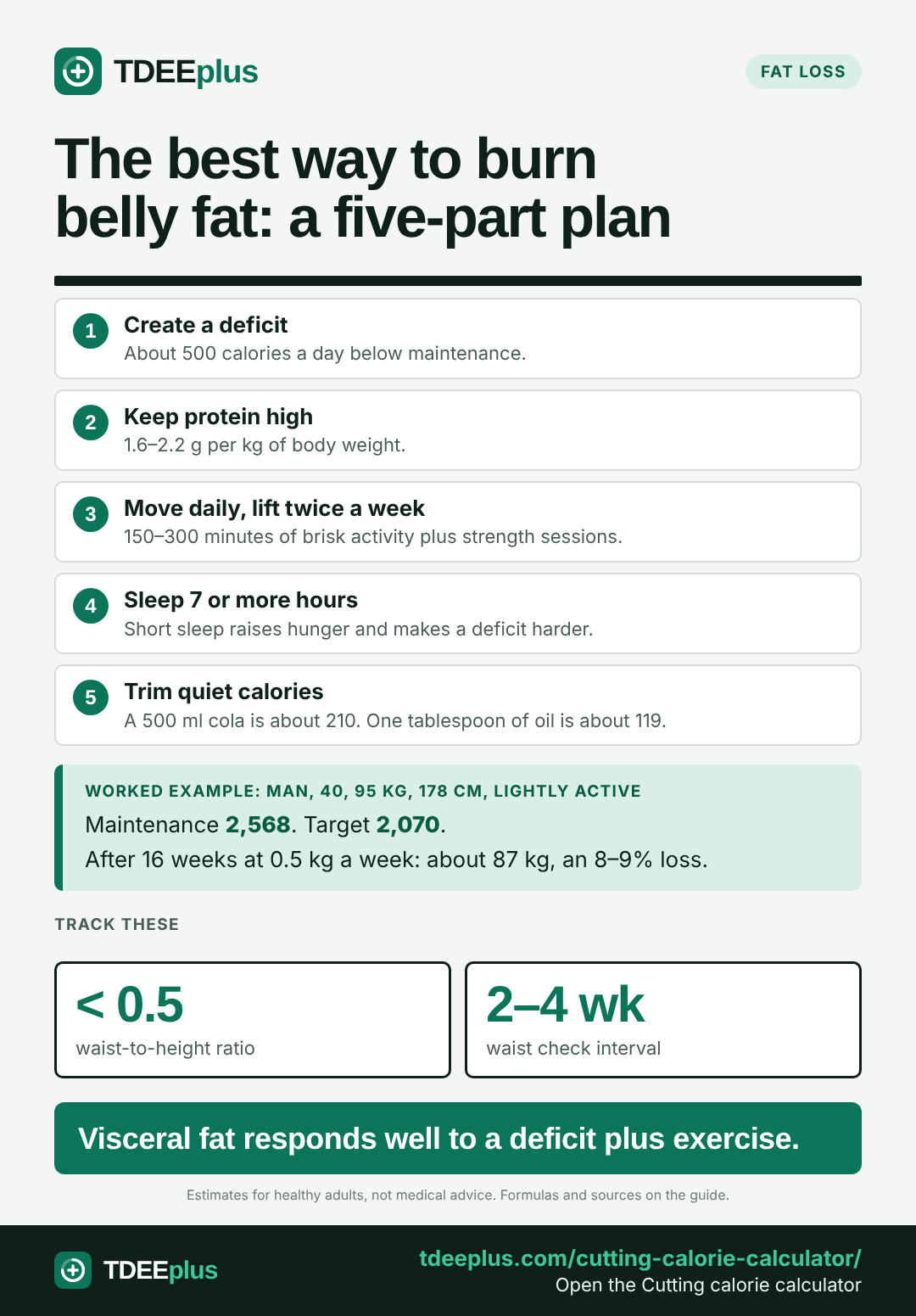
The best way to burn belly fat is to lose fat overall: eat about 500 calories a day below your maintenance, keep protein high, do regular aerobic exercise plus strength training, and sleep 7 or more hours. Belly fat, especially the deep visceral fat around your organs, responds well to this combination. Start by finding your calorie target with the cutting calorie calculator, built on the TDEE calculator.
Two kinds of belly fat
- Subcutaneous fat sits under the skin. It's the part you can pinch.
- Visceral fat sits deeper, around the liver and intestines. It is more closely linked with type 2 diabetes and heart disease.
The good news: visceral fat tends to fall quickly when you start eating less and moving more.
1. Create a calorie deficit
Fat only comes off when you use more energy than you eat. For most people, about 500 calories a day under maintenance is the right size: big enough to see progress, small enough to keep.
More on picking a deficit in calories to lose weight.
2. Keep protein high
About 1.6–2.2 g of protein per kg of body weight a day helps you feel full and keep muscle. For a 95 kg man that is about 150–210 g. The macro calculator works out your split.
3. Move every day, train twice a week
Aerobic exercise has the strongest evidence for cutting visceral fat, and a 2016 review found it reduced visceral fat even with little weight loss. Strength training protects muscle. A practical target is 150–300 minutes a week of brisk walking or similar, plus two or three strength sessions. The best exercises for belly fat has a sample week. Crunches don't burn belly fat: a 2011 trial found six weeks of ab exercises changed belly fat no more than doing nothing.
4. Sleep and stress
The CDC recommends 7 or more hours of sleep for adults. Short sleep increases hunger and makes it harder to keep a deficit. Chronic stress works the same way. Neither cancels out energy balance, but both make the plan harder to follow.
5. Cut back on what adds up quietly
- Sugary drinks: a 500 ml cola has about 210 calories.
- Alcohol: calorie-dense and it often leads to extra eating.
- Cooking oil: 1 tablespoon is about 119 calories.
Track the right numbers
Measure your waist every 2–4 weeks and track your weight as a percentage of where you started. The BMI calculator shows your waist-to-height ratio (aim for under 0.5), and the weight loss percentage calculator shows your progress against health milestones.
Set a fat-loss calorie target with protein included.
Open the cutting calculatorFrequently asked questions
What is the fastest way to lose belly fat?
Can you lose belly fat in a week?
Is belly fat harder to lose?
Does stress cause belly fat?
How do I know if I'm losing belly fat?
Keep reading
Sources
- Verheggen RJ, Maessen MF, Green DJ, Hermus AR, Hopman MT, Thijssen DH. A systematic review and meta-analysis on the effects of exercise training versus hypocaloric diet: distinct effects on body weight and visceral adipose tissue. Obes Rev. 2016;17(8):664–690. LJMU Research Online
- Ismail I, Keating SE, Baker MK, Johnson NA. A systematic review and meta-analysis of the effect of aerobic vs. resistance exercise training on visceral fat. Obes Rev. 2012;13(1):68–91. PMC3568069
- Vispute SS, Smith JD, LeCheminant JD, Hurley KS. The effect of abdominal exercise on abdominal fat. J Strength Cond Res. 2011;25(9):2559–2564. PubMed 21804427
- Jensen MD, Ryan DH, Apovian CM, et al. 2013 AHA/ACC/TOS guideline for the management of overweight and obesity in adults. Circulation. 2014;129(25 Suppl 2):S102–S138. PubMed 24222017
- Centers for Disease Control and Prevention. About sleep: adults need 7 or more hours per night. cdc.gov.