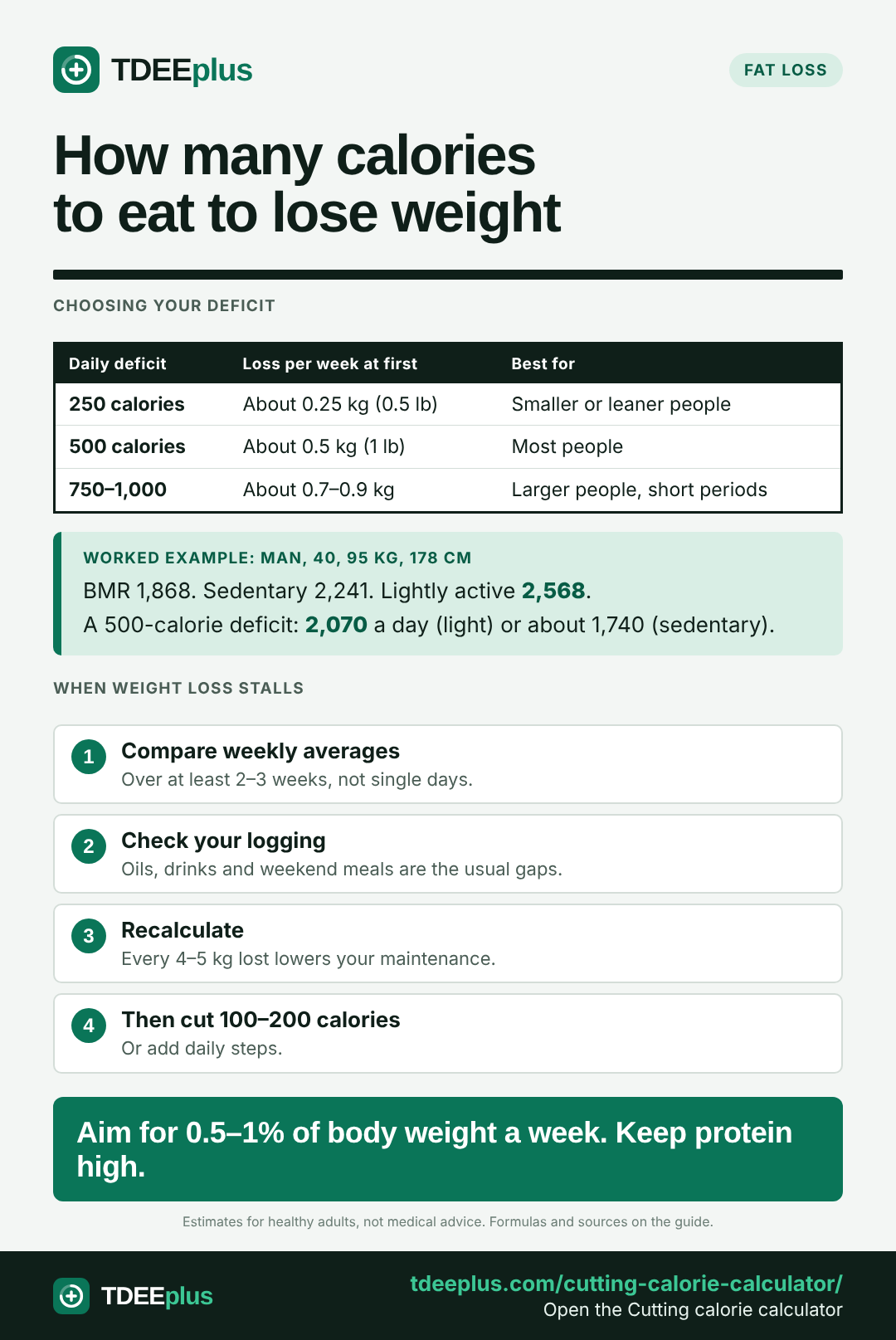
To lose weight, eat about 250–500 calories a day less than your maintenance calories (TDEE). A 500-calorie deficit typically gives about 0.5 kg (1 lb) of weight loss a week at first. For a 40-year-old man who weighs 95 kg, is 178 cm tall and is lightly active, maintenance is about 2,570 calories, so his weight-loss target is about 2,070. Set your own deficit with the cutting calorie calculator, or start with the TDEE calculator.
Choosing your deficit
| Daily deficit | Rough weekly loss at first | Best for |
|---|---|---|
| 250 calories | About 0.25 kg (0.5 lb) | Smaller or leaner people, or anyone who wants it easy to stick to |
| 500 calories | About 0.5 kg (1 lb) | Most people |
| 750–1,000 calories | About 0.7–0.9 kg (1.5–2 lb) | Larger people with a high maintenance; short periods only |
A useful rule of thumb is a weekly loss of 0.5–1% of your body weight. Faster than that for long periods tends to cost muscle and makes the diet harder to keep. How big should your calorie deficit be? goes deeper.
Worked examples
What to expect week by week
- Week 1: often a bigger drop, much of it water and stored carbohydrate.
- Weeks 2–8: a steadier rate close to your deficit.
- Later: slower, because a smaller body burns fewer calories. Research by Kevin Hall at the US National Institutes of Health showed weight loss follows a curve, not a straight line.
Track progress as a percentage of your starting weight with the weight loss percentage calculator. A sustained loss of 3–5% already brings measurable health benefits.
Protect your muscle
Keep protein high, about 1.6–2.2 g per kg of body weight, and keep strength training. Both help most of what you lose come from fat. How much protein do you need? has the numbers.
When weight loss stalls
- Compare weekly averages over at least 2–3 weeks, not single days.
- Check your logging: oils, drinks and weekend meals are the usual gaps.
- Recalculate with your new weight. Every 4–5 kg lost lowers your maintenance.
- If all else is right, reduce by 100–200 calories, or add daily steps.
Why your TDEE drops as you lose weight explains the plateau in detail.
Pick a deficit and see your daily calories and macros.
Open the cutting calculatorFrequently asked questions
How many calories should I eat to lose 1 lb a week?
How many calories do I need to lose 2 lb a week?
What is the minimum I should eat?
Why have I stopped losing weight?
Keep reading
Sources
- Hall KD, Sacks G, Chandramohan D, et al. Quantification of the effect of energy imbalance on bodyweight. Lancet. 2011;378(9793):826–837. PubMed 21872751
- Jensen MD, Ryan DH, Apovian CM, et al. 2013 AHA/ACC/TOS guideline for the management of overweight and obesity in adults. Circulation. 2014;129(25 Suppl 2):S102–S138. PubMed 24222017
- Helms ER, Aragon AA, Fitschen PJ. Evidence-based recommendations for natural bodybuilding contest preparation: nutrition and supplementation. J Int Soc Sports Nutr. 2014;11:20. PubMed 24864135
- Centers for Disease Control and Prevention. Losing Weight: gradual, steady weight loss of about 1 to 2 pounds per week. cdc.gov.