Body mass index (BMI) is your weight in kilograms divided by your height in metres squared. For adults, 18.5 to 24.9 is the healthy range, 25 to 29.9 is overweight and 30 or more is obesity. It is a fast screening number, not a measure of body fat. Check yours with the BMI calculator, which also shows your healthy weight range and waist-to-height ratio, or go to the TDEE calculator if you want calories.
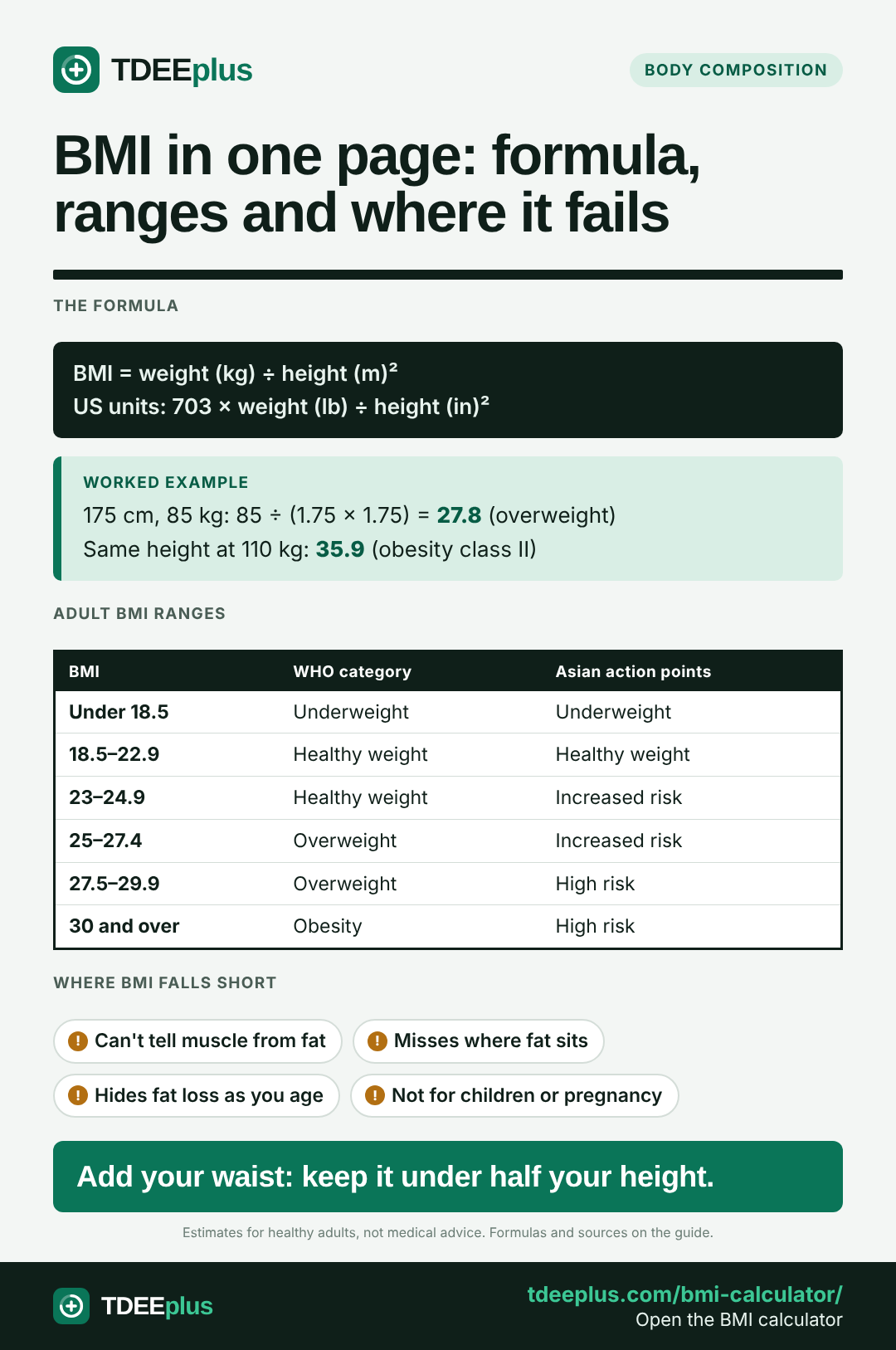
The BMI formula
BMI ranges for adults
| BMI | WHO category | Asian action points |
|---|---|---|
| Under 18.5 | Underweight | Underweight |
| 18.5–22.9 | Healthy weight | Healthy weight |
| 23–24.9 | Healthy weight | Increased risk |
| 25–27.4 | Overweight | Increased risk |
| 27.5–29.9 | Overweight | High risk |
| 30–34.9 | Obesity class I | High risk |
| 35–39.9 | Obesity class II | High risk |
| 40 or more | Obesity class III | High risk |
The ranges are the same for men and women. The Asian action points come from a 2004 WHO expert consultation, which found that many Asian populations face higher risk of type 2 diabetes and heart disease at lower BMIs.
Where BMI came from
In the 1830s the Belgian statistician Adolphe Quetelet noticed that, in adults, weight rises roughly with the square of height. His ratio was used for population statistics for more than a century. In 1972 the American physiologist Ancel Keys compared several weight-for-height indices, found this one tracked body fat best, and named it the body mass index. It was designed to compare groups, which explains most of its limits for individuals.
BMI Prime and healthy weight range
BMI Prime is your BMI divided by 25. A result of 1.00 means you are at the top of the healthy range; 1.10 means 10% above it. Turning BMI around also gives a healthy weight range for any height: multiply your height in metres squared by 18.5 and by 24.9.
When BMI gets it wrong
- Muscular people. A 92 kg, 180 cm man who lifts weights has a BMI of 28.4 ("overweight") even with little fat.
- Older adults. Muscle loss with age means the same BMI can hide more fat.
- Fat distribution. Fat around the waist carries more risk than fat on the hips. BMI can't see where fat sits.
- Children and pregnancy. Children need age-specific percentiles; BMI doesn't apply during pregnancy.
For a better picture, add your waist. The UK's NICE advises keeping your waist to less than half your height. To measure fat directly with a tape, use the body fat calculator, or see how muscular you are with the FFMI calculator.
What to do with your number
If your BMI is above 25 and your waist is more than half your height, a modest weight loss is worthwhile: even 5% of body weight improves blood sugar and blood fats. Find a sensible calorie target in calories to lose weight. If your BMI is high but your waist is small and you train, you probably carry more muscle than average, and the number matters less.
Get your BMI, healthy weight range and waist-to-height ratio.
Open the BMI calculatorFrequently asked questions
What is a normal body mass index?
Who invented BMI?
Is BMI accurate?
What BMI is considered obese?
Keep reading
Sources
- World Health Organization. Obesity: preventing and managing the global epidemic. WHO Technical Report Series 894. Geneva: WHO; 2000. iris.who.int
- WHO Expert Consultation. Appropriate body-mass index for Asian populations and its implications for policy and intervention strategies. Lancet. 2004;363(9403):157–163. PubMed 14726171
- National Institute for Health and Care Excellence. Obesity: identification, assessment and management (CG189), waist-to-height ratio recommendations, 2022 update. nice.org.uk
- Jensen MD, Ryan DH, Apovian CM, et al. 2013 AHA/ACC/TOS guideline for the management of overweight and obesity in adults. Circulation. 2014;129(25 Suppl 2):S102–S138. PubMed 24222017