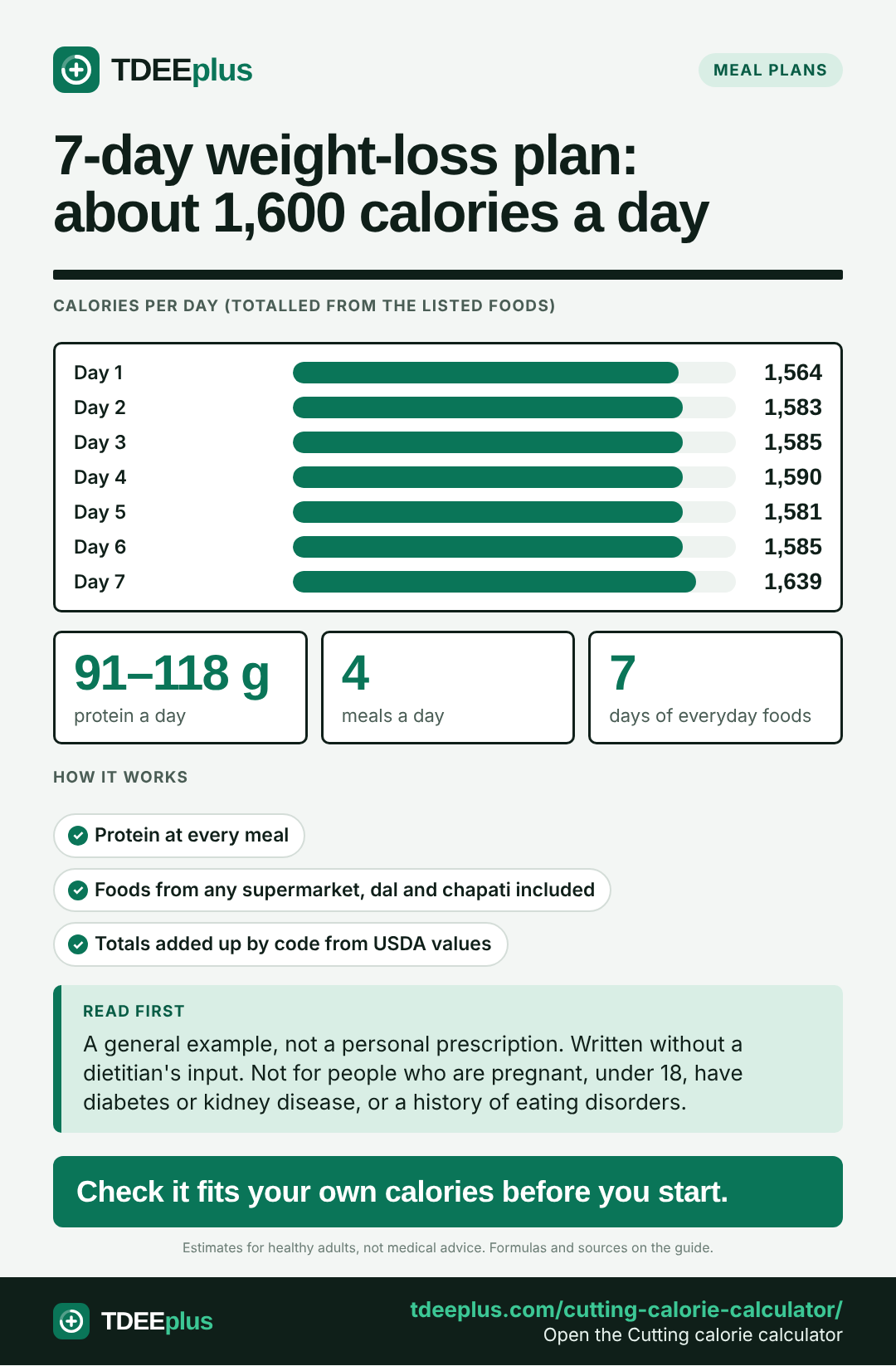
This 7-day diet plan for weight loss gives about 1,560–1,640 calories a day (an average of 1,590), with 91–118 g of protein. That suits many people whose maintenance is around 2,000–2,200 calories, giving a deficit of about 400–600 a day. Check that it fits you first with the cutting calorie calculator, which starts from your TDEE.
How the plan works
- Four meals a day: breakfast, lunch, a snack and dinner.
- Protein at every meal, to help with hunger and keep muscle.
- Everyday foods you can find in most supermarkets, including dal and chapati.
- Every total was added up by code from standard nutrition values, so the numbers match the foods listed.
The 7-day plan
Day 1 · 1,564 calories · 111 g protein · 178 g carbs · 47 g fat
- Breakfast (334 cal): 40 g rolled oats, 250 ml 2% milk, 100 g blueberries
- Lunch (463 cal): 120 g cooked chicken breast, 150 g cooked brown rice, 100 g mixed salad leaves and cucumber, ½ tbsp olive oil
- Snack (311 cal): 170 g plain nonfat Greek yogurt, 1 medium apple, 20 g almonds
- Dinner (456 cal): 120 g cooked salmon, 200 g boiled potatoes, 100 g broccoli
Day 2 · 1,583 calories · 108 g protein · 184 g carbs · 51 g fat
- Breakfast (327 cal): 2 large eggs, 2 slices wholemeal bread, 100 g spinach
- Lunch (441 cal): 1 can tuna in water, drained (120 g), 1 wholemeal wrap, 100 g mixed salad leaves and cucumber, ½ avocado (70 g)
- Snack (283 cal): 1 orange, 20 g almonds, 1 medium banana
- Dinner (532 cal): 200 g cooked lentils (dal), ½ tbsp olive oil, 1 wholewheat chapati, 100 g mixed salad leaves and cucumber, 170 g plain nonfat Greek yogurt
Day 3 · 1,585 calories · 93 g protein · 212 g carbs · 45 g fat
- Breakfast (309 cal): 170 g plain nonfat Greek yogurt, 100 g blueberries, 40 g rolled oats
- Lunch (630 cal): 150 g cooked chickpeas, 150 g cooked quinoa, 100 g spinach, 30 g cheddar, ½ tbsp olive oil
- Snack (186 cal): 100 g carrot sticks, 30 g hummus, 1 medium apple
- Dinner (460 cal): 100 g cooked 5% fat beef mince, 150 g cooked wholewheat pasta, 100 g tomato passata, 100 g mixed salad leaves and cucumber, ½ tbsp olive oil
Day 4 · 1,590 calories · 116 g protein · 183 g carbs · 48 g fat
- Breakfast (382 cal): 40 g rolled oats, 250 ml 2% milk, 1 medium banana
- Lunch (438 cal): 120 g cooked chicken breast, 1 wholemeal wrap, 100 g mixed salad leaves and cucumber, 30 g hummus
- Snack (299 cal): 150 g low-fat cottage cheese, 100 g blueberries, 20 g almonds
- Dinner (471 cal): 150 g firm tofu, 200 g stir-fry vegetables, 150 g cooked brown rice
Day 5 · 1,581 calories · 99 g protein · 171 g carbs · 59 g fat
- Breakfast (398 cal): 2 large eggs, 1 slice wholemeal bread, ½ avocado (70 g), 1 orange
- Lunch (372 cal): 200 g cooked lentils (dal), 100 g mixed salad leaves and cucumber, 1 wholewheat chapati
- Snack (289 cal): 170 g plain nonfat Greek yogurt, 1 tbsp peanut butter, 1 medium apple
- Dinner (522 cal): 120 g cooked salmon, 150 g cooked quinoa, 100 g broccoli, ½ tbsp olive oil
Day 6 · 1,585 calories · 118 g protein · 186 g carbs · 46 g fat
- Breakfast (301 cal): 150 g low-fat cottage cheese, 1 medium banana, 2 rice cakes
- Lunch (393 cal): 1 can tuna in water, drained (120 g), 200 g boiled potatoes, 100 g mixed salad leaves and cucumber, ½ tbsp olive oil
- Snack (273 cal): 1 medium apple, 20 g almonds, 1 orange
- Dinner (618 cal): 120 g cooked chicken breast, 150 g cooked wholewheat pasta, 100 g tomato passata, 100 g spinach, 30 g cheddar, ½ tbsp olive oil
Day 7 · 1,639 calories · 91 g protein · 229 g carbs · 43 g fat
- Breakfast (371 cal): 40 g rolled oats, 250 ml 2% milk, 1 tbsp peanut butter
- Lunch (507 cal): 150 g cooked chickpeas, 1 wholemeal wrap, 100 g carrot sticks, 30 g hummus
- Snack (252 cal): 170 g plain nonfat Greek yogurt, 100 g blueberries, 1 medium apple
- Dinner (509 cal): 100 g cooked 5% fat beef mince, 150 g cooked brown rice, 200 g stir-fry vegetables, 15 g dark chocolate (70%)
Calories and macros are rounded from typical USDA FoodData Central values. Brands differ, so check labels for packaged foods. Vegetables are cooked without extra oil unless oil is listed.
Adjust it to your calories
| Your target | What to change |
|---|---|
| About 1,400 | Drop the snack on most days, or halve the rice, pasta or potato portions |
| About 1,800 | Add a second snack: an apple and 20 g almonds (211 cal) or Greek yogurt and berries (157 cal) |
| About 2,000 | Add the snack above and increase rice, pasta or potato portions by half |
Shopping and prep tips
- Cook a batch of brown rice, lentils and chicken on day 1 and day 4.
- Measure oil with a spoon. It is the easiest place for hidden calories.
- Weigh starchy foods for the first week until you can judge portions by eye.
- Drink water, tea or coffee without sugar; drinks are not included in the totals.
After the first week
Repeat the week, swap meals you like, and weigh yourself most mornings. Compare your weekly average after two to three weeks. If you're losing more than 1% of your body weight a week, add food; if nothing has changed, reduce by 100–200 calories. Track progress with the weight loss percentage calculator, and read how to track and adjust your calories.
Check this plan fits your calories before you start.
Open the cutting calculatorFrequently asked questions
Is 1,600 calories a day enough to lose weight?
Can I swap meals between days?
How much weight will I lose on this plan?
Is this plan suitable for vegetarians?
Keep reading
Sources
- U.S. Department of Agriculture and U.S. Department of Health and Human Services. Dietary Guidelines for Americans, 2020–2025. Appendix 2: Estimated calorie needs per day, by age, sex and physical activity level. dietaryguidelines.gov
- Jäger R, Kerksick CM, Campbell BI, et al. International Society of Sports Nutrition Position Stand: protein and exercise. J Int Soc Sports Nutr. 2017;14:20. PubMed 28642676
- Hall KD, Sacks G, Chandramohan D, et al. Quantification of the effect of energy imbalance on bodyweight. Lancet. 2011;378(9793):826–837. PubMed 21872751
- Jensen MD, Ryan DH, Apovian CM, et al. 2013 AHA/ACC/TOS guideline for the management of overweight and obesity in adults. Circulation. 2014;129(25 Suppl 2):S102–S138. PubMed 24222017