The recommended daily calorie intake for adults is about 1,600–2,400 calories for women and 2,000–3,000 calories for men, according to the Dietary Guidelines for Americans 2020–2025. Where you fall depends on your age and how active you are. These are averages for maintaining weight; your own need can be several hundred calories different. Get a personal figure with the maintenance calories calculator or the TDEE calculator.
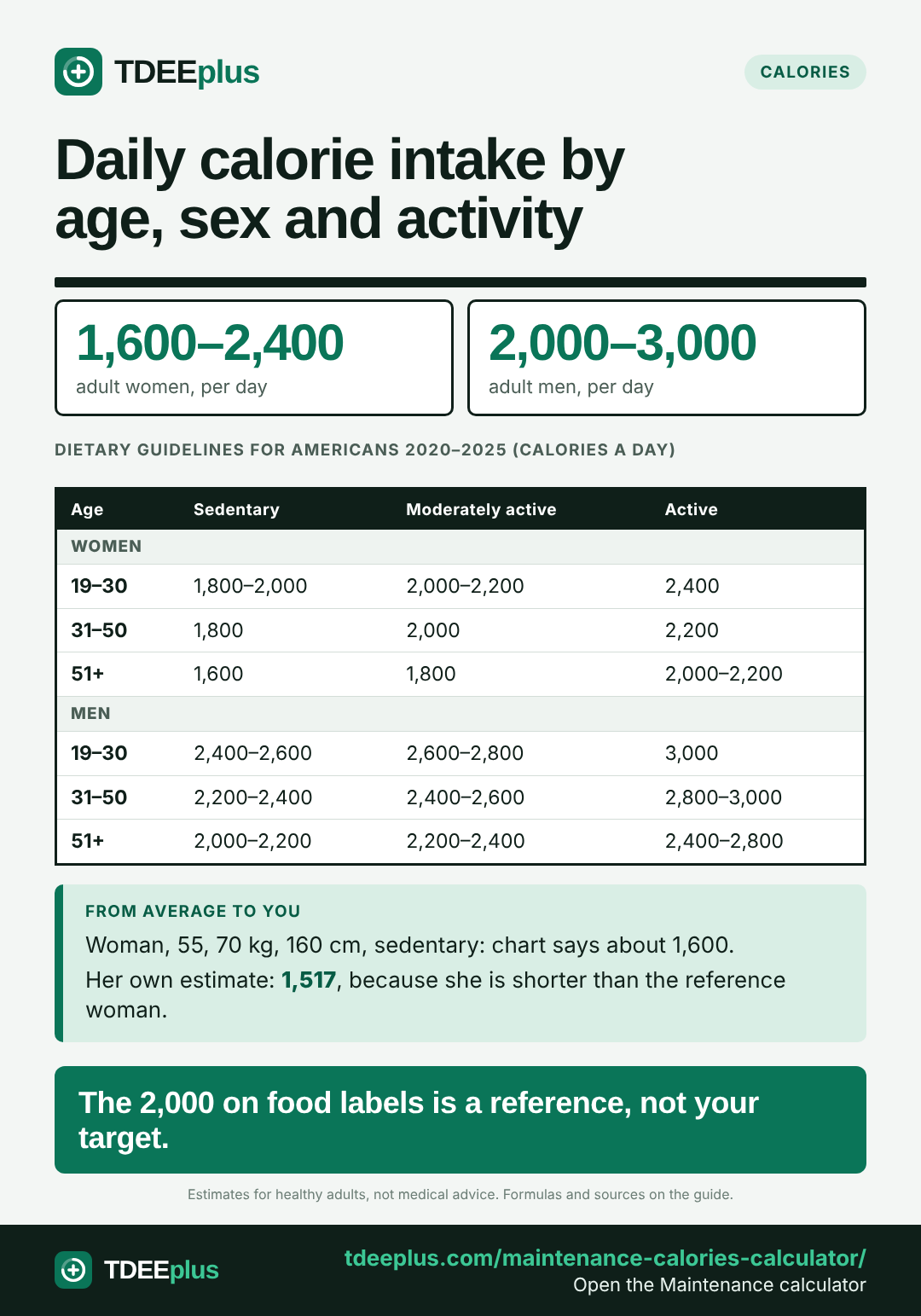
Daily calorie intake chart
| Age | Sedentary | Moderately active | Active |
|---|---|---|---|
| Women | |||
| 19–30 | 1,800–2,000 | 2,000–2,200 | 2,400 |
| 31–50 | 1,800 | 2,000 | 2,200 |
| 51+ | 1,600 | 1,800 | 2,000–2,200 |
| Men | |||
| 19–30 | 2,400–2,600 | 2,600–2,800 | 3,000 |
| 31–50 | 2,200–2,400 | 2,400–2,600 | 2,800–3,000 |
| 51+ | 2,000–2,200 | 2,200–2,400 | 2,400–2,800 |
Source: Dietary Guidelines for Americans 2020–2025, Appendix 2. Values are for adults of average height and a healthy weight, and are not for pregnant or breastfeeding women.
What the activity levels mean
- Sedentary: only the light activity of daily life.
- Moderately active: daily life plus the equivalent of walking about 1.5–3 miles (2.4–4.8 km) a day at 3–4 mph.
- Active: daily life plus the equivalent of walking more than 3 miles (4.8 km) a day at 3–4 mph.
Not sure how far you walk? The walking calorie calculator turns your steps into distance.
The 2,000-calorie label
The "based on a 2,000 calorie diet" line on nutrition labels is a reference for comparing foods, not a target. A small, sedentary woman over 50 may need about 1,600; a tall, active young man may need 3,000 or more.
From averages to your number
The chart assumes average height and weight. If you are taller, heavier or more muscular than average, you'll need more; if you're smaller, less. A calculator uses your actual size.
Calorie intake for weight loss or gain
The chart is for maintaining weight. To lose weight, start from your own maintenance and subtract 250–500 calories; to gain, add 250–500. How many calories should I eat? walks through the steps, and calories to lose weight covers deficits in detail.
See your own maintenance calories at every activity level.
Open the maintenance calculatorFrequently asked questions
What is the recommended daily calorie intake?
Why do food labels use 2,000 calories?
Do calorie needs drop with age?
Are these numbers for weight loss?
Keep reading
Sources
- U.S. Department of Agriculture and U.S. Department of Health and Human Services. Dietary Guidelines for Americans, 2020–2025. Appendix 2: Estimated calorie needs per day, by age, sex and physical activity level. dietaryguidelines.gov
- Mifflin MD, St Jeor ST, Hill LA, Scott BJ, Daugherty SA, Koh YO. A new predictive equation for resting energy expenditure in healthy individuals. Am J Clin Nutr. 1990;51(2):241–247. PubMed 2305711