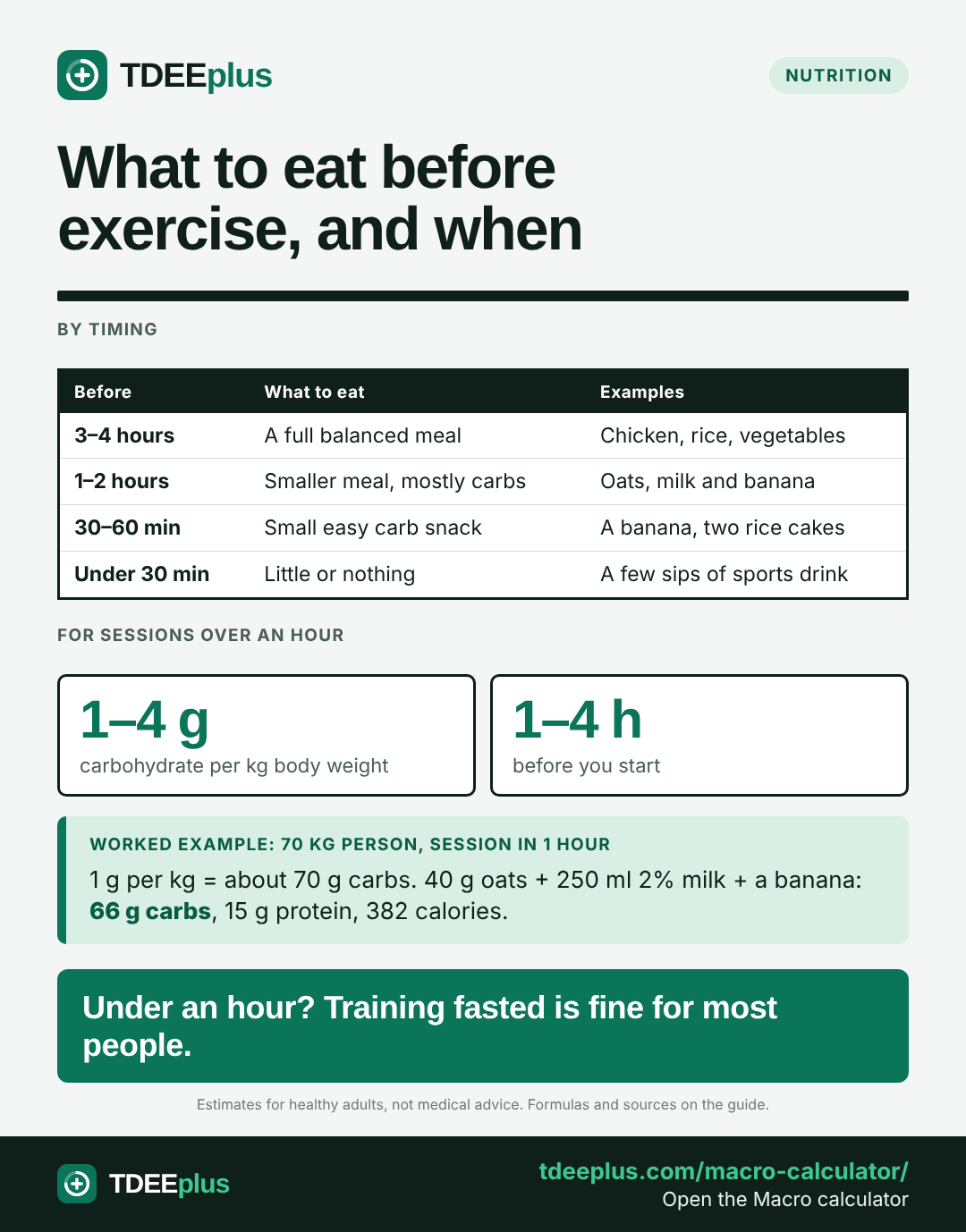
Before exercise, eat mostly carbohydrate with some protein, and keep fat and fibre low close to the session. A balanced meal 2–4 hours before, or a small carb snack like a banana 30–60 minutes before, works for most people. For sessions over an hour, sports nutrition guidelines suggest 1–4 g of carbohydrate per kg of body weight in the 1–4 hours before. To fit pre-workout food into your day, set your totals with the macro calculator or the TDEE calculator.
Why it matters
Carbohydrate is your muscles' main fuel during hard or long exercise. Eating some before a session tops up your stores and blood sugar, so you can train harder for longer. Protein before training gives your muscles amino acids to start repair. Fat and fibre digest slowly, so large amounts right before can cause stomach upset.
What to eat, by timing
| Time before | What to eat | Examples |
|---|---|---|
| 3–4 hours | A full balanced meal | Chicken, rice and vegetables; pasta with lean mince |
| 1–2 hours | A smaller meal, mostly carbs plus some protein | Oats with milk and banana; Greek yogurt with berries; a turkey sandwich |
| 30–60 minutes | A small, easy carb snack | A banana; two rice cakes with honey; a small fruit juice |
| Under 30 minutes | Little or nothing, or a few sips of a sports drink | Only if you feel low on energy |
How much carbohydrate
For long or intense sessions (over 60 minutes), the general guideline is 1–4 g of carbohydrate per kg of body weight, eaten 1–4 hours before. Use the low end when you eat closer to the session.
For a 30–45 minute workout, you don't need this much. A normal meal earlier in the day is usually enough.
Protein before exercise
The International Society of Sports Nutrition position stand on nutrient timing notes that 20–40 g of protein in the hours around exercise supports muscle repair and growth. Whether you eat it before or after matters less than your total for the day, so a pre-workout meal with yogurt, milk, eggs or chicken counts. See how much protein you need.
Can you train on an empty stomach?
Yes, for most people and most sessions under an hour, especially early-morning cardio. Fasted cardio doesn't lead to more fat loss over time when total calories are equal; the deficit is what matters. If you feel dizzy, weak or train poorly fasted, eat something small first.
Fitting it into your goal
Pre-workout food counts toward your daily calories. If you are cutting, plan it into your target rather than adding it on top; the cutting calorie calculator gives you a daily number to work within. For long walks or hikes, the walking calorie calculator shows roughly how much energy you'll use.
Get your daily protein, carbs and fat so pre-workout meals fit.
Open the macro calculatorFrequently asked questions
Should I eat before a workout?
What should I eat 30 minutes before a workout?
Is it OK to work out on an empty stomach?
Should I have protein before a workout?
Keep reading
Sources
- Kerksick CM, Arent S, Schoenfeld BJ, et al. International Society of Sports Nutrition position stand: nutrient timing. J Int Soc Sports Nutr. 2017;14:33. PMC5596471
- Thomas DT, Erdman KA, Burke LM. American College of Sports Medicine joint position statement: nutrition and athletic performance. Med Sci Sports Exerc. 2016;48(3):543–568. PubMed 26891166
- Jäger R, Kerksick CM, Campbell BI, et al. International Society of Sports Nutrition Position Stand: protein and exercise. J Int Soc Sports Nutr. 2017;14:20. PubMed 28642676