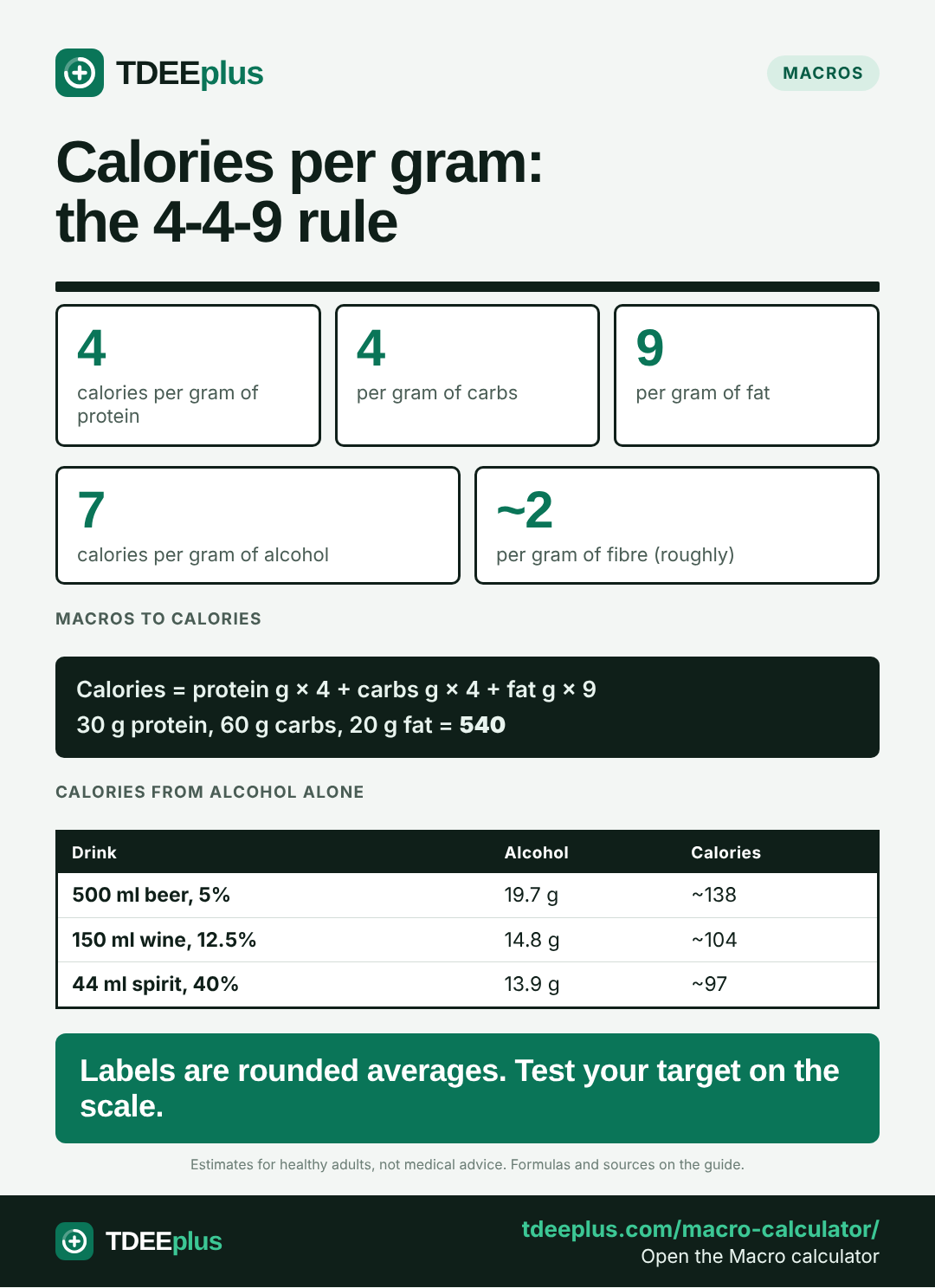
Protein has about 4 calories per gram, carbohydrate about 4, fat about 9 and alcohol about 7. Multiply the grams of each by those numbers and add them up to get a food's calories. These are called Atwater factors, and they are the basis of every nutrition label and macro calculator. Skip the maths with the macro calculator.
The numbers at a glance
| Nutrient | Calories per gram | Kilojoules per gram | Share used in digestion (thermic effect) |
|---|---|---|---|
| Protein | 4 | 17 | About 20–30% |
| Carbohydrate | 4 | 17 | About 5–10% |
| Fat | 9 | 37 | About 0–3% |
| Alcohol | 7 | 29 | Varies |
| Fibre | Roughly 2 | Roughly 8 | n/a |
The thermic effect is the energy your body spends on digesting and processing food, so a gram of protein "costs" a bit more to use than a gram of fat. It does not change the label, but it is one reason high-protein diets can be slightly more forgiving.
Turn macros into calories
You can go the other way too. If your target is 1,800 calories and you want 140 g of protein, that is 140 × 4 = 560 calories, or 31 percent of the day. For protein by body weight see how much protein you really need, and for percentages versus grams see macro splits explained. The macro calculator converts everything for you.
Where alcohol fits
Alcohol is not a macronutrient, but it carries 7 calories a gram, almost as many as fat. Calories from drinks add up fast because they rarely feel filling.
| Drink | Alcohol | Calories from alcohol alone |
|---|---|---|
| 500 ml beer at 5% | about 19.7 g | about 138 (plus carbs in the beer) |
| 150 ml wine at 12.5% | about 14.8 g | about 104 |
| 44 ml spirit at 40% | about 13.9 g | about 97 |
Alcohol grams = volume in ml × strength (as a fraction) × 0.789. Mixers, sugar and carbs add more. If you drink, log it: unlogged drinks are one of the common tracking slips.
Why fat has more than twice the calories
Fat molecules are long chains of carbon and hydrogen with very little oxygen attached. Your body gets energy by combining those atoms with oxygen, so a molecule that starts with fewer oxygen atoms has more left to "burn". Carbohydrate and protein already carry more oxygen or nitrogen, so they yield less energy per gram. That is why a tablespoon of oil (about 14 g) has roughly the energy of three tablespoons of sugar by weight.
A whole meal, checked
Fibre, sugar alcohols and rounding
Dietary fibre is only partly digested, so it supplies far fewer calories than other carbs, often counted as about 2 per gram. Sugar alcohols such as xylitol and erythritol also contribute fewer calories than sugar, and the exact figure depends on the compound. Labels round to the nearest 5 or 10 calories and may use net carbs, so your own sum can differ a little. None of this changes a plan in a meaningful way, but it explains why two apps can show slightly different numbers for the same food.
Using the numbers in real life
- Spot calorie-dense foods. Fat is 9 per gram, so oils, nuts and cheese pack in energy. A thumb of nut butter is about 94 calories. See portion control for weight loss.
- Sanity-check labels. If the macros do not add up to the calories, look for fibre, sugar alcohols or a typo.
- Split your day. Start from your TDEE (TDEE calculator), set protein by body weight first, fat at a sensible minimum, and fill the rest with carbs.
- Remember they are estimates. Your body does not absorb every calorie exactly as the label says. Test your target against your scale (track and adjust).
Turn your calorie target into grams of protein, carbs and fat.
Open the macro calculatorFrequently asked questions
How many calories are in a gram of protein?
Why does fat have more than twice the calories of protein and carbs?
How do I turn macros into calories?
Do the 4-4-9 numbers match food labels exactly?
Are the calories in protein all absorbed?
Keep reading
Sources
- U.S. Food and Drug Administration. Nutrition labeling of food, 21 CFR 101.9(c)(1): general calorie conversion factors of 4 (protein), 4 (carbohydrate) and 9 (fat) per gram, based on the work of Atwater. Alcohol: about 7 calories per gram (USDA).
- Halton TL, Hu FB. The effects of high protein diets on thermogenesis, satiety and weight loss: a critical review. J Am Coll Nutr. 2004;23(5):373–385.
- U.S. Department of Agriculture. FoodData Central: typical entries for milk and olive oil (values rounded).
- Jäger R, Kerksick CM, Campbell BI, et al. International Society of Sports Nutrition Position Stand: protein and exercise. J Int Soc Sports Nutr. 2017;14:20. PubMed 28642676