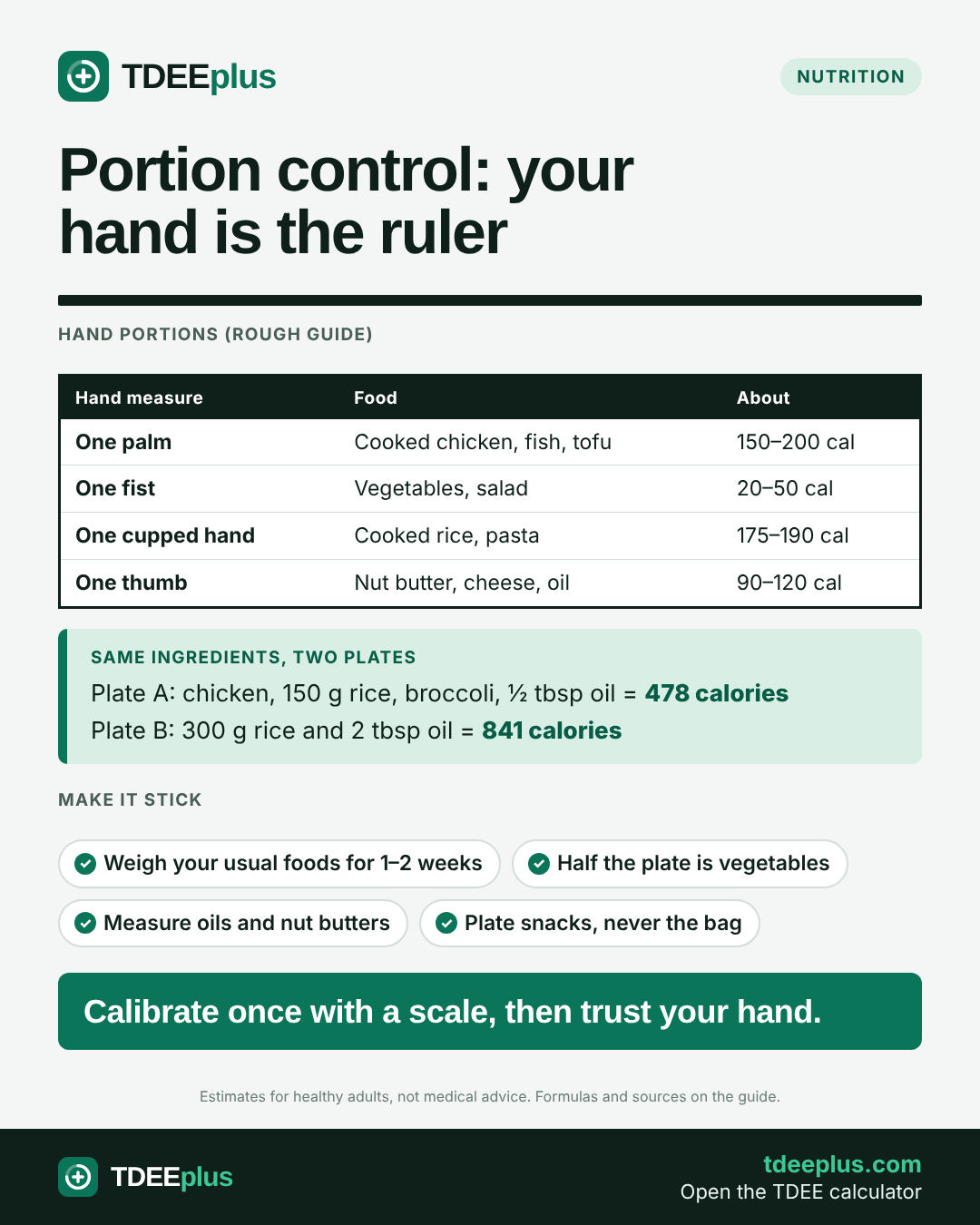
Portion control means choosing how much of each food goes on your plate so your meals add up to your calorie target. The simplest way is a palm of protein, a fist of vegetables, a cupped hand of carbs and a thumb of fat, checked once against a scale. Pair it with your daily number from the TDEE calculator and you have a plan that works without logging every bite.
Why portion size matters
Most of us eat what is served. A Cochrane review of 58 studies and 6,603 people found that larger portions, packs and tableware led people to eat more, with a small-to-moderate effect that was larger in adults than in children. The authors estimated that cutting back on very large sizes could lower daily intake by roughly 144 to 228 calories. That figure is a modelled projection, not a measured result, but it shows why plate size is worth a few minutes of thought.
Method 1: Use your hand as a ruler
Your hand scales with your body, which is why this method suits most people. Treat the sizes below as rough guides and calibrate them once (see Method 3).
| Hand measure | Food | Typical amount | About |
|---|---|---|---|
| One palm (thickness and width) | Cooked chicken, fish, tofu | 100–120 g | 150–200 calories |
| One fist | Vegetables, salad | 100–150 g | 20–50 calories |
| One cupped hand | Cooked rice, pasta, potato | about 150 g | 175–190 calories |
| One thumb | Nut butter, cheese, oil | about 1 tablespoon nut butter, 30 g cheese or 2 teaspoons oil | 90–120 calories |
A typical lunch for a woman might be one palm, one fist, one cupped hand and one thumb. A larger or more active person might double the carbs and protein. Calories above come from standard food values; the amounts in your own hand will differ a little.
Method 2: The plate method
Picture your plate divided into sections. Fill half with non-starchy vegetables or salad, a quarter with lean protein and a quarter with starchy carbs, then add a small amount of fat. The vegetables add volume and fibre for few calories, which helps you feel full. This layout matches the plate guides published by the US government (MyPlate) and Harvard, and it works at home, in a canteen and at restaurants because you only need your eyes.
Method 3: Weigh it once to calibrate
- For one or two weeks, weigh the cooked foods you eat most: rice, chicken, pasta, potatoes, oil.
- Note what a palm, fist and cupped hand actually hold for you.
- Return to hands and plates, and re-check every few weeks. Portions creep up without us noticing.
This is the same idea as the calibration step in tracking and adjusting your calories week by week. If you would like an app for the weighing weeks, see our review of the best free calorie counter apps.
Connect portions to a calorie target
Portions only lead to weight loss if the total sits below what you burn. Start from your TDEE, choose a deficit (how big should your calorie deficit be?), and split the result across your meals. A 1,600-calorie day is three meals of about 450 and two snacks of about 125. Check the protein side with how much protein you need or the macro calculator, and see the whole thing laid out day by day in our 7-day diet plan.
Everyday tips that make portions easier
- Serve from the stove, not the table. Second helpings take effort, and effort helps.
- Plate your snack. Eating from the bag hides the amount. A small bowl shows it.
- Measure the fats. Oil, butter, nuts and dressings are the easiest calories to under-count. One tablespoon of olive oil is about 119 calories.
- Start with the vegetables and protein. Eat them first, then decide whether you still want the extra carbs.
- Check restaurant plates against your hand. If the rice is three cupped hands, box two for tomorrow.
- Ignore "serving size" claims on packs. They are set by the maker and a bag marked "2 servings" is often eaten in one go.
Find the calorie target your portions should add up to.
Open the TDEE calculatorFrequently asked questions
How do I control portions without weighing food?
Do smaller plates help you lose weight?
How many calories should one meal be?
Is portion control the same as calorie counting?
Keep reading
More guides on this topic
- Green tea for weight loss: what the evidence shows
- Calories per gram of protein, carbs, fat and alcohol
Sources
- Hollands GJ, Shemilt I, Marteau TM, et al. Portion, package or tableware size for changing selection and consumption of food, alcohol and tobacco. Cochrane Database Syst Rev. 2015;(9):CD011045. doi:10.1002/14651858.CD011045.pub2
- U.S. Department of Agriculture. MyPlate: start simple with MyPlate (plate proportions). myplate.gov.
- Harvard T.H. Chan School of Public Health. Healthy Eating Plate. Nutrition Source.
- Calories per portion are rounded standard values (USDA FoodData Central typical entries) for cooked weights.