At 12 percent body fat a man typically looks lean and defined, often with an outline of the upper abs in good light. For women, 12 percent is at the very bottom of the essential-fat range and is below what most women can keep up without health costs. It means different things for men and women, and it is not a universal goal. Estimate yours with the body fat calculator.
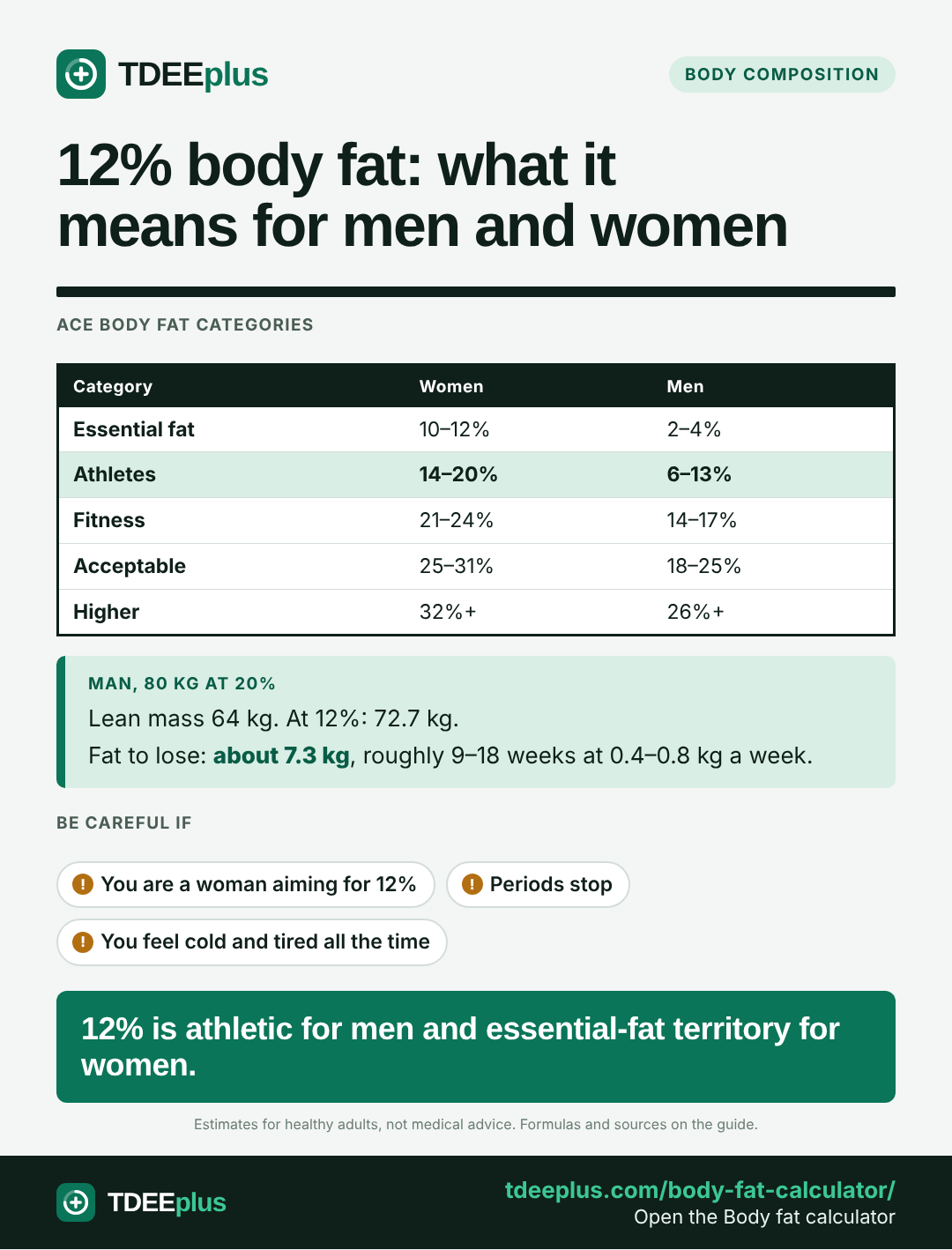
Body fat ranges for men and women
These are the American Council on Exercise categories, reprinted in the Garmin owner's manual. They are guides for adults, not medical diagnoses.
| Category | Women | Men |
|---|---|---|
| Essential fat | 10–12% | 2–4% |
| Athletes | 14–20% | 6–13% |
| Fitness | 21–24% | 14–17% |
| Acceptable | 25–31% | 18–25% |
| Higher | 32% and above | 26% and above |
Age-based ranges that link body fat to a healthy BMI are higher: about 21 to 33 percent for women aged 20 to 39 (see normal body fat percentage for women by age). Those are health ranges for the general population. The ACE ranges describe leanness levels.
12% body fat for men
This sits inside the athlete range. Most men at 12 percent see a flat stomach, defined shoulders and arms, and some vein visibility. The top abs often show faintly; clear lower abs are more likely nearer 8 to 10 percent. Where you store fat, your muscle size, your height and the lighting all change the picture, so treat any "this is what 12 percent looks like" photo with caution.
- Healthy? Generally yes, if you got there with enough food and sleep and feel well.
- Sustainable? Possible but takes effort for many men. Many hold a few points higher year-round.
12% body fat for women
For women, 12 percent is the top of ACE's essential-fat range. Essential fat is the minimum needed for hormones, organs and nerve function. Very low body fat in women is linked with missed periods, bone loss and low energy, a pattern sports medicine calls relative energy deficiency in sport (RED-S). A woman at 12 percent will look very lean, but it is rarely a healthy long-term target. If you are a woman who wants to look lean, the athlete range of 14 to 20 percent is a better ceiling for most.
How much fat do you need to lose?
Lean mass stays the same in this calculation, which is the best case.
To plan the calories, find your TDEE first with the TDEE calculator and choose a moderate deficit (how to lower your body fat percentage without losing muscle). The FFMI calculator shows how much lean mass you are carrying.
How to measure it
| Method | Pros | Cons |
|---|---|---|
| DEXA scan | Detailed, widely used as a reference | Cost, access, hydration and the machine itself change results |
| Bioimpedance scale | Convenient | Swings with hydration, food and the time of day |
| Skinfold calipers | Cheap | Depends on the skill of the person measuring |
| Tape-measure (US Navy) | Free, repeatable | An estimate that suits average builds best |
Different methods can disagree by several percentage points, so pick one and use it the same way each time. Start with the body fat calculator, and see how it feeds into a more precise formula in the Katch-McArdle calculator.
Should you aim for 12%?
Choose a goal for health and performance, not a number from a photo. Many people feel and perform best a few points higher. If you do aim for it, lose slowly, lift weights, keep protein up and watch for the warning signs above. How to burn visceral fat is a useful companion if your main concern is health rather than looks.
Estimate your own body fat with a tape measure.
Open the body fat calculatorFrequently asked questions
What does 12 percent body fat look like on a man?
Is 12 percent body fat healthy?
How long does it take to get to 12 percent body fat?
Can a woman have 12 percent body fat?
How accurate are body fat measurements?
Keep reading
Sources
- American Council on Exercise (ACE). Body fat percentage categories for adults, as reprinted in the Garmin owner's manual, "Body Fat Percentage Status".
- Gallagher D, Heymsfield SB, Heo M, et al. Healthy percentage body fat ranges: an approach for developing guidelines based on body mass index. Am J Clin Nutr. 2000;72(3):694–701. PubMed 10966886
- Mountjoy M, Sundgot-Borgen JK, Burke LM, et al. IOC consensus statement on relative energy deficiency in sport (RED-S): 2018 update. Br J Sports Med. 2018;52(11):687–697.