Visceral fat is the fat stored deep in your abdomen, around organs such as the liver and intestines. You reduce it the same way you lose fat overall: a moderate calorie deficit, regular moderate-to-vigorous aerobic exercise, strength training, enough sleep and patience. It tends to respond faster than the fat under your skin, and you can track it with a tape measure. Estimate your body fat with the body fat calculator as a starting point.
Visceral fat versus subcutaneous fat
| Subcutaneous fat | Visceral fat | |
|---|---|---|
| Where | Under the skin, where you can pinch it | Inside the abdomen, around organs |
| Can you see it? | Yes | No. A firm, round belly can be a clue |
| Health link | Less strongly linked to disease | More closely linked with type 2 diabetes and heart disease |
| Response to a deficit | Slower, with stubborn areas | Often responds quickly |
Everyone has some visceral fat. The concern is a lot of it, and the risk is an association, not a guarantee. If you want a deeper look at where fat sits on women's bodies, see normal body fat percentage for women by age.
How to check yours at home
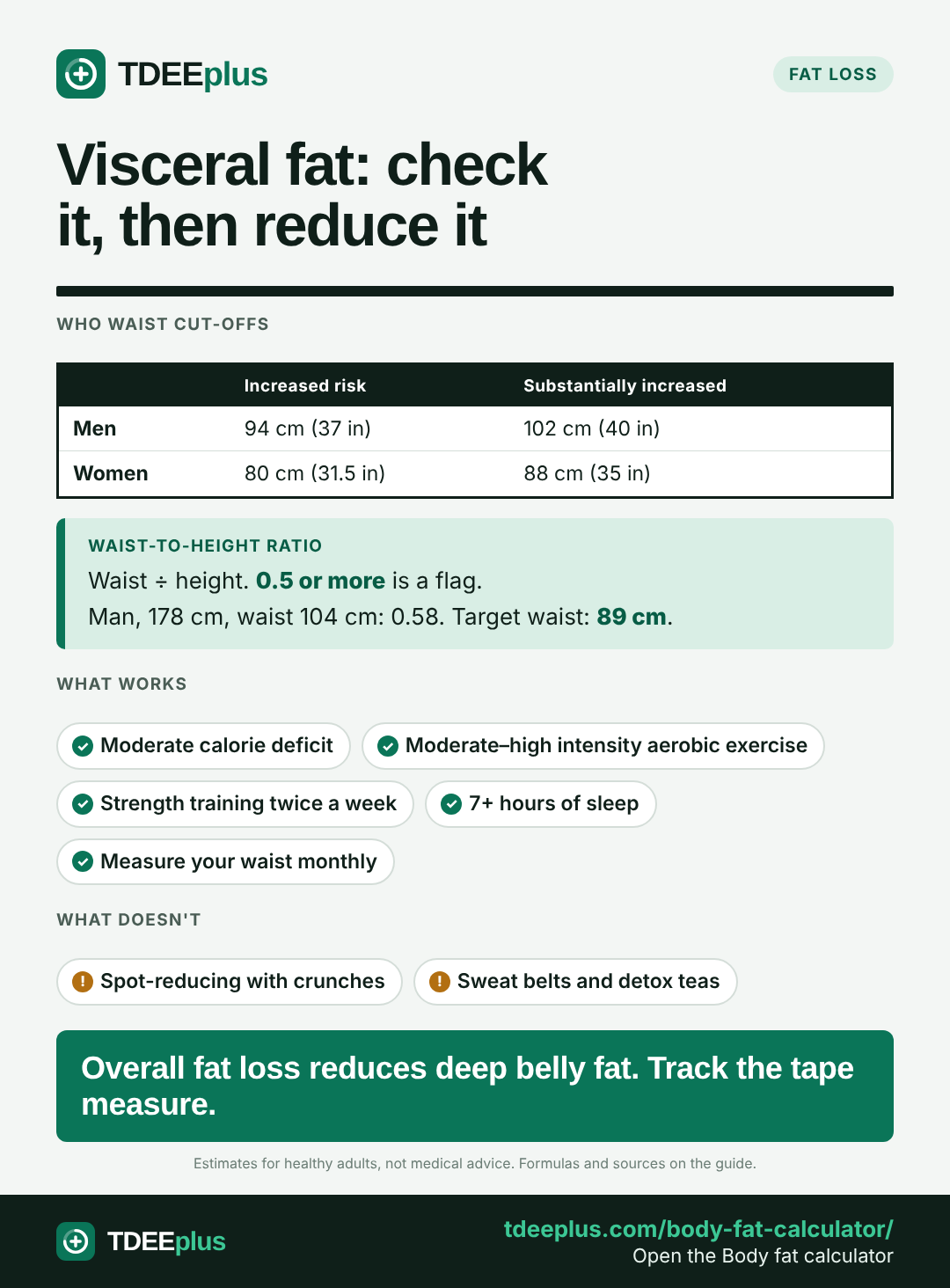
- Waist circumference. Measure midway between your lowest rib and your hip bone, after breathing out. WHO cut-offs for increased risk are 94 cm (37 in) for men and 80 cm (31.5 in) for women, and substantially increased risk at 102 cm (40 in) and 88 cm (35 in).
- Waist-to-height ratio. Divide your waist by your height. A value of 0.5 or more is a flag; NICE uses it in its obesity guidance. Example: waist 92 cm and height 170 cm gives 0.54.
- BMI. A quick screen, but it misses where fat sits: BMI calculator and BMI explained.
- Body fat. Estimate with a tape measure using the body fat calculator.
- Scans. A DEXA, CT or MRI measures visceral fat directly. Consumer scale ratings are rough guesses.
1. Eat in a moderate deficit
Visceral fat falls with overall fat loss. A deficit of 250 to 500 calories below your TDEE is enough for most people. Find your number with the TDEE calculator and size it using how big your deficit should be. The best way to burn belly fat gives the full plan, including what to eat.
2. Do aerobic exercise at moderate or high intensity
A 2013 meta-analysis of 15 studies and 852 people found that exercise without calorie restriction reduced visceral fat, with moderate and high intensity aerobic training working best. A 2012 meta-analysis found aerobic exercise reduced visceral fat, while resistance training alone did not reach significance. Aim for 150 to 300 minutes a week of brisk walking, cycling or swimming (see stationary bike workouts and swimming workouts). Add one or two harder sessions once you are comfortable.
3. Lift weights too
Strength training does not move visceral fat as much on its own, but it protects muscle, which keeps your metabolism from dropping more than it needs to. Two or three full-body sessions a week are enough. Keep protein near 1.6 to 2 g/kg.
4. Sleep and stress
The CDC advises adults to sleep seven or more hours a night. Short sleep is linked with higher hunger and poorer food choices, which makes a deficit harder to keep. A short walk after meals and a regular bedtime help more than they sound.
5. Track your waist, not just the scale
Measure every two to four weeks, in the same place, at the same time of day. The tape often shows progress before the scale does, because muscle can hold steady while fat falls.
Things that do not work
- Spot-reducing with crunches. See the best exercises for belly fat.
- Sweat belts, detox teas and "belly fat burner" pills. There is no good evidence they reduce fat.
- Very low calorie diets without supervision. They lose muscle and rarely last.
If your waist is well above the cut-offs, or you have high blood pressure, high blood sugar or a family history of heart disease, talk to a doctor. They can check your risk directly.
Estimate your body fat with just a tape measure.
Open the body fat calculatorFrequently asked questions
How do I know if I have visceral fat?
Does visceral fat go away faster than other fat?
Can I burn visceral fat with ab exercises?
What is the best exercise for visceral fat?
How long does it take to reduce visceral fat?
Keep reading
Sources
- Vissers D, Hens W, Taeymans J, Baeyens JP, Poortmans J, Van Gaal L. The effect of exercise on visceral adipose tissue in overweight adults: a systematic review and meta-analysis. PLoS One. 2013;8(2):e56415. doi:10.1371/journal.pone.0056415
- Ismail I, Keating SE, Baker MK, Johnson NA. A systematic review and meta-analysis of the effect of aerobic vs. resistance exercise training on visceral fat. Obes Rev. 2012;13(1):68–91. PMC3568069
- Verheggen RJ, Maessen MF, Green DJ, Hermus AR, Hopman MT, Thijssen DH. A systematic review and meta-analysis on the effects of exercise training versus hypocaloric diet: distinct effects on body weight and visceral adipose tissue. Obes Rev. 2016;17(8):664–690. LJMU Research Online
- National Institute for Health and Care Excellence. Obesity: identification, assessment and management (CG189), waist-to-height ratio recommendations, 2022 update. nice.org.uk
- Centers for Disease Control and Prevention. About sleep: adults need 7 or more hours per night. cdc.gov.
- World Health Organization. Waist circumference and waist–hip ratio: report of a WHO expert consultation, Geneva, 8–11 December 2008. Geneva: WHO; 2011.