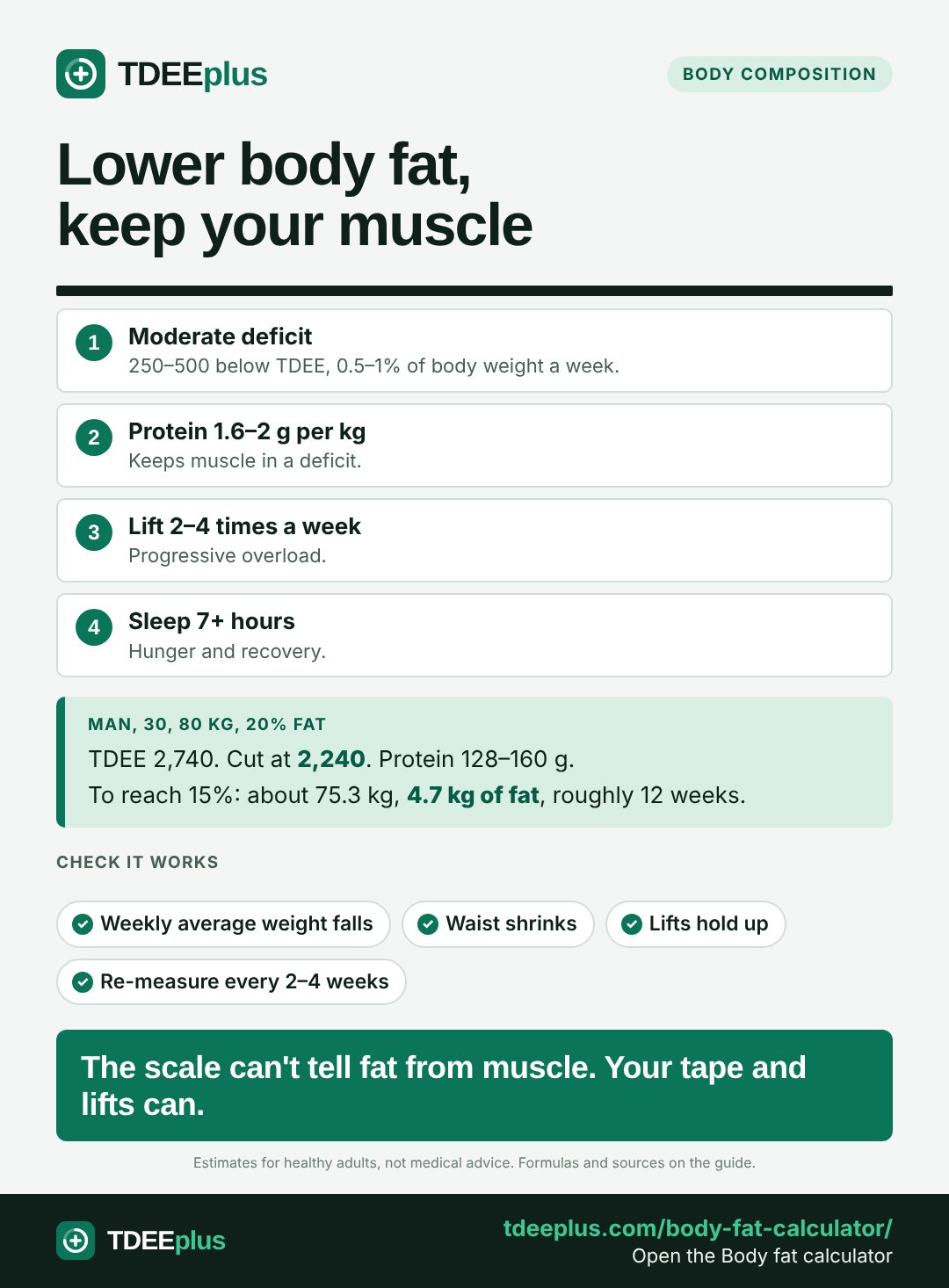
To lower your body fat percentage without losing muscle, eat in a moderate calorie deficit, keep protein around 1.6 to 2 g per kg, lift weights two to four times a week, sleep seven or more hours and lose weight slowly, about 0.5 to 1 percent of body weight a week. Then measure your waist and body fat every few weeks to check you are losing fat, not just weight. Get your calorie number from the TDEE calculator.
Why it matters
The scale can't tell fat from muscle. Two people can lose the same weight and finish with very different body fat percentages. If a lot of the weight you lose is muscle, you end up lighter but not much leaner, and your metabolism falls more. The aim is to make the loss come from fat.
Lever 1: A moderate deficit
A big deficit costs muscle. In a study of elite athletes, those who lost weight more slowly (about 0.7 percent of body weight a week) gained lean mass and strength, while those who lost faster (about 1.4 percent) did not. Aim for 250 to 500 calories below your TDEE. See how big your deficit should be.
Use the TDEE calculator for your number, or the cutting calorie calculator to get macros and a safety check.
Lever 2: Protein
Protein gives muscle the raw material to stay. A practical range is 1.6 to 2 g/kg, so 128 to 160 g for our 80 kg man. In a 4-week trial of 40 young men on a 40 percent calorie deficit with hard training, those eating about 2.4 g/kg gained 1.2 kg of lean mass and lost 4.8 kg of fat, compared with 0.1 kg and 3.5 kg on about 1.2 g/kg. Most people don't need to go that high, but the message is clear: more protein helps in a deficit. Read how much protein you need and use the macro calculator.
Lever 3: Strength training
Lifting tells your body that the muscle is needed. Train each muscle group about twice a week with progressive overload: try to add a little weight or a rep over time. If your lifts hold or rise while the scale falls, you are on track. Add walking or cycling for calories (stationary bike workouts).
Lever 4: Sleep and recovery
Aim for seven or more hours a night. Sleep loss makes a deficit harder: hunger goes up and training quality goes down. Keep rest days, and eat enough on hard training days.
How to check it is working
- Weekly average weight. It should fall about 0.5 to 1 percent a week (track and adjust).
- Waist every 2–4 weeks. It should shrink.
- Body fat every 2–4 weeks with the body fat calculator, using the same method.
- Your lifts. If they are falling fast, your deficit may be too big.
If your weight stops falling, follow the plateau checklist. If you are already lean and wondering whether to cut or build, read bulking vs cutting. To see how much lean mass you carry, use the FFMI calculator.
What to avoid
- Cutting below 1,200 (women) or 1,500 (men) calories without medical supervision.
- Doing hours of cardio instead of lifting.
- Chasing a very low body fat. See what 12% body fat looks like.
Estimate your current body fat with a tape measure.
Open the body fat calculatorFrequently asked questions
How fast can I lower my body fat percentage?
Can I lose fat and keep muscle?
How much protein do I need to keep muscle on a diet?
Is cardio or weights better for lowering body fat?
How often should I measure body fat?
Keep reading
More guides on this topic
Sources
- Longland TM, Oikawa SY, Mitchell CJ, Devries MC, Phillips SM. Higher compared with lower dietary protein during an energy deficit combined with intense exercise promotes greater lean mass gain and fat mass loss: a randomized trial. Am J Clin Nutr. 2016;103(3):738–746. PubMed 26817506
- Helms ER, Aragon AA, Fitschen PJ. Evidence-based recommendations for natural bodybuilding contest preparation: nutrition and supplementation. J Int Soc Sports Nutr. 2014;11:20. PubMed 24864135
- Jäger R, Kerksick CM, Campbell BI, et al. International Society of Sports Nutrition Position Stand: protein and exercise. J Int Soc Sports Nutr. 2017;14:20. PubMed 28642676
- Garthe I, Raastad T, Refsnes PE, Koivisto A, Sundgot-Borgen J. Effect of two different weight-loss rates on body composition and strength and power-related performance in elite athletes. Int J Sport Nutr Exerc Metab. 2011;21(2):97–104.
- Centers for Disease Control and Prevention. About sleep: adults need 7 or more hours per night. cdc.gov.