Bulking means eating more calories than you burn to build muscle, and cutting means eating fewer to lose fat. If you are fairly lean, start with a lean bulk. If you carry more body fat and want to look leaner, cut first. If you are new to lifting, a slow recomp (eating near maintenance) may work. Your TDEE sets the numbers for all three. Find your TDEE with the TDEE calculator first.
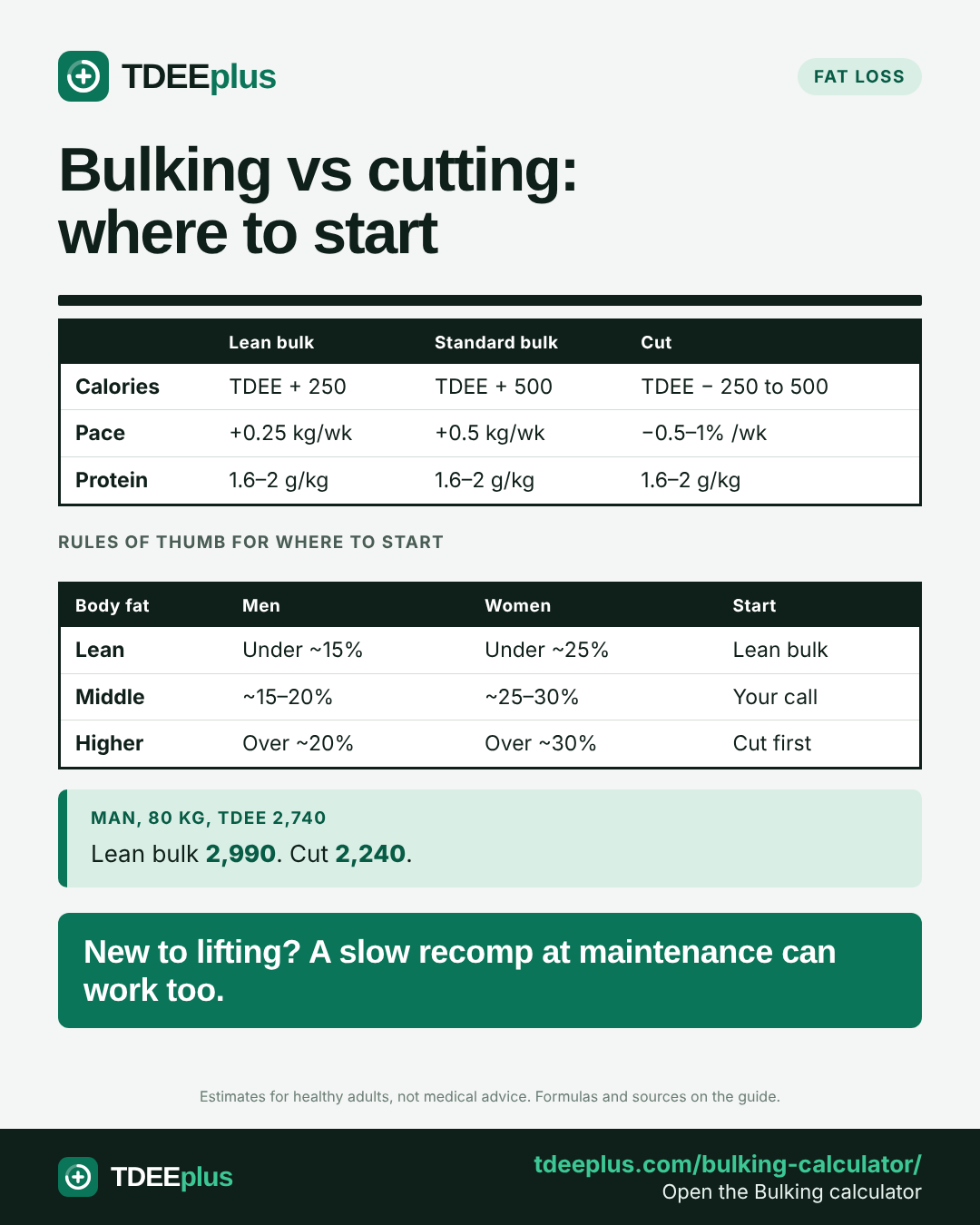
Bulking versus cutting at a glance
| Lean bulk | Standard bulk | Cut | |
|---|---|---|---|
| Calories vs maintenance | About +250 | About +500 | About −250 to −500 |
| Weight change | About +0.25 kg/week | About +0.5 kg/week | About −0.5 to −1% of body weight a week |
| Goal | Gain muscle, minimal fat | Gain muscle faster | Lose fat, keep muscle |
| Protein | 1.6–2 g/kg | 1.6–2 g/kg | 1.6–2 g/kg (or a little higher) |
| Training | Heavy resistance training in every phase | ||
Numbers match our bulking calculator and cutting calorie calculator.
Which should you do first?
These body fat guides are common rules of thumb rather than research cut-offs.
| Your situation | Men | Women | Start with |
|---|---|---|---|
| Already lean, want more muscle | Under about 15% | Under about 25% | Lean bulk |
| Middle range | About 15–20% | About 25–30% | Your preference: slow recomp, short cut or lean bulk |
| Higher body fat | Over about 20% | Over about 30% | Cut first |
| New to lifting or returning | Any, if not very high | Recomp near maintenance | |
Do not know your body fat? Estimate it with the body fat calculator, and remember it is an estimate (what 12% body fat looks like explains the ranges).
Worked example
How to run each phase
A lean bulk
- Set calories at TDEE + 250 and protein at 1.6 to 2 g/kg.
- Weigh weekly. Aim for a gain of about 0.25 to 0.5 percent of body weight a week.
- If you gain faster, trim 100 calories. If not at all after 3 weeks, add 100.
A cut
- Set calories at TDEE − 250 to 500, keeping above 1,200 (women) or 1,500 (men).
- Keep lifting heavy, and keep protein high (how to lower body fat percentage without losing muscle).
- Adjust weekly (track and adjust) and recalculate as you lose weight (why TDEE drops).
A recomp
Eat near maintenance with high protein and progressive lifting. Progress is slower and shows up as a smaller waist and stronger lifts, not the scale. Research on body recomposition suggests trained people can build muscle and lose fat at the same time, with the best results in beginners.
When to switch
- Switch from bulk to cut when you reach roughly the top of your range (about 20 percent for men or 30 percent for women) or feel you have gained too much fat.
- Switch from cut to maintenance or bulk when you reach your target, or when training and mood suffer.
- Spend two to three weeks at maintenance between phases (find your real maintenance calories).
Be careful with extremes. If dieting dominates your thoughts or you notice unhealthy eating patterns, speak to a doctor or registered dietitian.
Get calories and macros for your bulk.
Open the bulking calculatorFrequently asked questions
Should I bulk or cut first?
How big should my surplus be?
How big should my deficit be for a cut?
How long should a bulk or cut last?
Can you build muscle and lose fat at the same time?
Keep reading
Sources
- Barakat C, Pearson J, Escalante G, Campbell B, De Souza EO. Body recomposition: can trained individuals build muscle and lose fat at the same time? Strength Cond J. 2020;42(5):7–21.
- Helms ER, Aragon AA, Fitschen PJ. Evidence-based recommendations for natural bodybuilding contest preparation: nutrition and supplementation. J Int Soc Sports Nutr. 2014;11:20. PubMed 24864135
- Jäger R, Kerksick CM, Campbell BI, et al. International Society of Sports Nutrition Position Stand: protein and exercise. J Int Soc Sports Nutr. 2017;14:20. PubMed 28642676
- Garthe I, Raastad T, Refsnes PE, Koivisto A, Sundgot-Borgen J. Effect of two different weight-loss rates on body composition and strength and power-related performance in elite athletes. Int J Sport Nutr Exerc Metab. 2011;21(2):97–104.