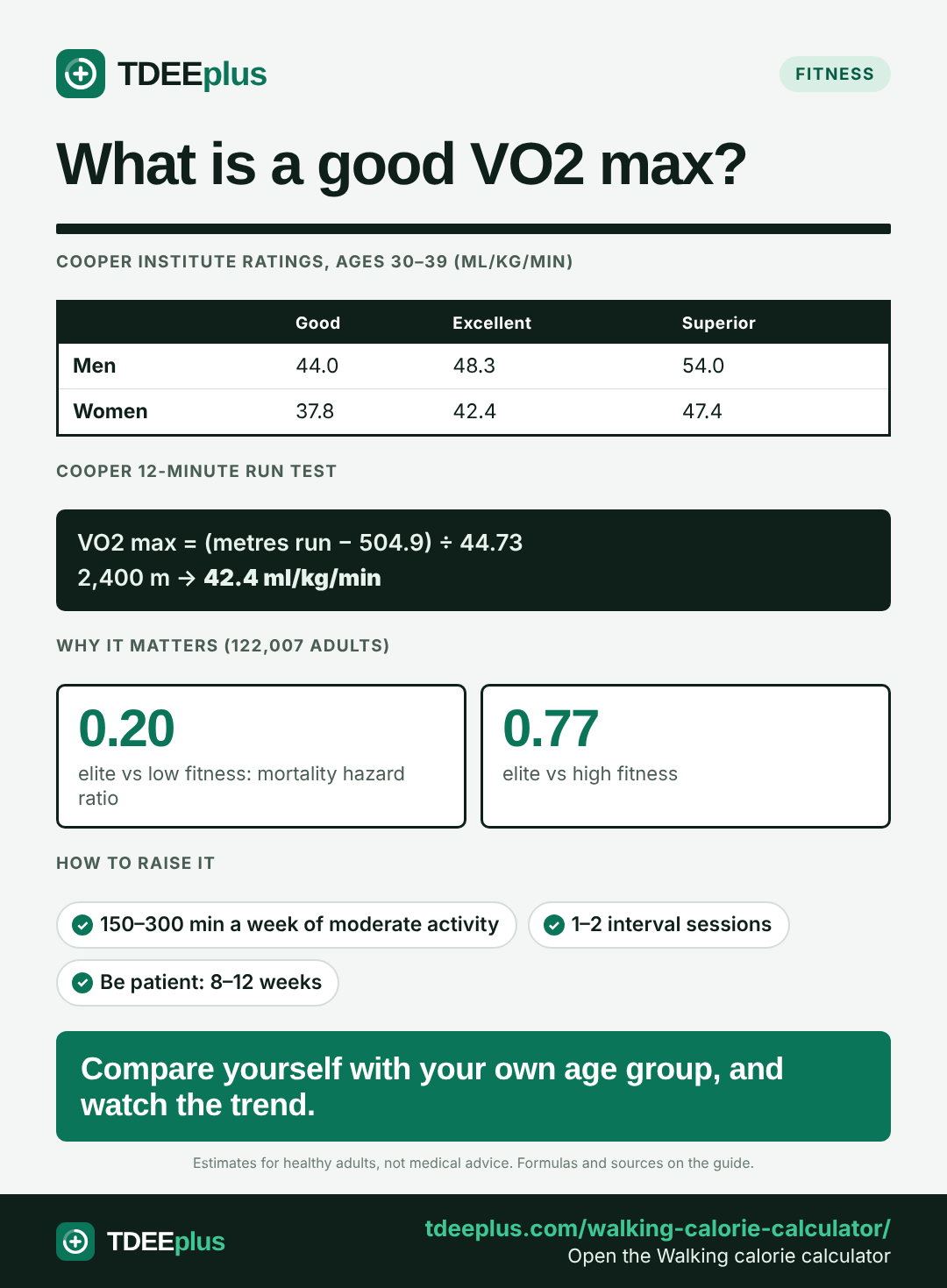
VO2 max is the most oxygen your body can use during hard exercise, measured in millilitres per kilogram of body weight per minute (ml/kg/min). A good VO2 max for a 30-to-39-year-old is about 44 for men and about 38 for women, and the numbers fall with age. It is a strong marker of cardio fitness, and it can be raised at any age with regular training. Add your training to your daily burn with the TDEE calculator.
VO2 max chart for men
The ratings below are percentile-based norms from the Cooper Institute, reprinted in the Garmin owner's manual. "Good" is roughly the 60th percentile for your age, "Excellent" the 80th and "Superior" the 95th.
| Age | Fair (40th) | Good (60th) | Excellent (80th) | Superior (95th) |
|---|---|---|---|---|
| 20–29 | 41.7 | 45.4 | 51.1 | 55.4 |
| 30–39 | 40.5 | 44.0 | 48.3 | 54.0 |
| 40–49 | 38.5 | 42.4 | 46.4 | 52.5 |
| 50–59 | 35.6 | 39.2 | 43.4 | 48.9 |
| 60–69 | 32.3 | 35.5 | 39.5 | 45.7 |
| 70–79 | 29.4 | 32.3 | 36.7 | 42.1 |
VO2 max chart for women
| Age | Fair (40th) | Good (60th) | Excellent (80th) | Superior (95th) |
|---|---|---|---|---|
| 20–29 | 36.1 | 39.5 | 43.9 | 49.6 |
| 30–39 | 34.4 | 37.8 | 42.4 | 47.4 |
| 40–49 | 33.0 | 36.3 | 39.7 | 45.3 |
| 50–59 | 30.1 | 33.0 | 36.7 | 41.1 |
| 60–69 | 27.5 | 30.0 | 33.0 | 37.8 |
| 70–79 | 25.9 | 28.1 | 30.9 | 36.7 |
Women score lower than men on average because of differences in body size, blood volume and body composition, so the two charts are not meant to be compared with each other. Below the Fair column is rated Poor. These are population norms, not a diagnosis, and healthy people fall on both sides of every line.
Why VO2 max matters
In a study of 122,007 adults who had a treadmill test at the Cleveland Clinic, fitness was grouped from low to elite, and death rates fell step by step as fitness rose. Elite performers had an adjusted hazard ratio of 0.20 against the low group, and a ratio of 0.77 against the high group, so there was no sign of a ceiling. This is observational, and fitter people differ in other ways, but the pattern is consistent. The practical message is that moving up even one category is worth the effort.
How to estimate your VO2 max
Lab test
The gold standard is a graded treadmill or bike test with a mask that measures gas exchange. It is accurate but costs money and needs equipment.
The 12-minute Cooper run test
Run or run-walk as far as you can in 12 minutes on a flat track, then use this formula published by Kenneth Cooper in 1968:
Heart-rate ratio
A rough check from Uth and colleagues: VO2 max ≈ 15.3 × (maximum heart rate ÷ resting heart rate). With a measured maximum of 190 and a resting rate of 60: 15.3 × 3.17 = 48.5. It only works if your maximum is measured, not guessed from "220 minus age", so treat it as a ballpark.
Smartwatches
Watches estimate VO2 max from your heart rate and speed during outdoor runs or walks. They are handy for trends, not for exact grading. A new strap, a hot day or a hilly route can shift the reading, so compare like with like over a few weeks.
How to raise your VO2 max
- Build an easy base. The WHO recommends 150 to 300 minutes of moderate activity a week. Brisk walking counts, and the walking calorie calculator shows what it burns.
- Add one or two interval sessions. For example, four rounds of 4 minutes hard and 3 minutes easy on a bike, or hill repeats on a run.
- Choose a machine you will use. A stationary bike or a pool (swimming workouts) is kind to the joints.
- Be patient. Gains build over 8 to 12 weeks, and beginners usually improve the most.
- Fuel the work. Hard sessions go better with a snack beforehand: see what to eat before exercise.
Training also changes your daily burn. Add it to your week honestly with how to choose your activity level, then see your new total in the TDEE calculator.
See how many calories your walks and sessions burn.
Open the walking calorie calculatorFrequently asked questions
What is a good VO2 max for a woman?
What is a good VO2 max for a man?
Is my smartwatch VO2 max accurate?
Can I improve my VO2 max?
Does a higher VO2 max mean I will live longer?
Keep reading
More guides on this topic
Sources
- The Cooper Institute. VO2 max standard ratings by age and sex (percentile-based norms), as reprinted in the Garmin owner's manual, "VO2 Max. Standard Ratings".
- Mandsager K, Harb S, Cremer P, Phelan D, Nissen SE, Jaber W. Association of cardiorespiratory fitness with long-term mortality among adults undergoing exercise treadmill testing. JAMA Netw Open. 2018;1(6):e183605. doi:10.1001/jamanetworkopen.2018.3605
- Cooper KH. A means of assessing maximal oxygen intake: correlation between field and treadmill testing. JAMA. 1968;203(3):201–204.
- Uth N, Sørensen H, Overgaard K, Pedersen PK. Estimation of VO2max from the ratio between HRmax and HRrest. Eur J Appl Physiol. 2004;91(1):111–115.
- Bull FC, Al-Ansari SS, Biddle S, et al. World Health Organization 2020 guidelines on physical activity and sedentary behaviour. Br J Sports Med. 2020;54(24):1451–1462.