A stationary bike helps with weight loss by adding calories to your weekly burn without pounding your joints. A 70 kg person burns about 240 calories in 30 minutes of moderate cycling, so three to five sessions a week add roughly 700 to 1,200 calories, but your calorie deficit from food still decides most of the result. Use the plan below and track your weight weekly.
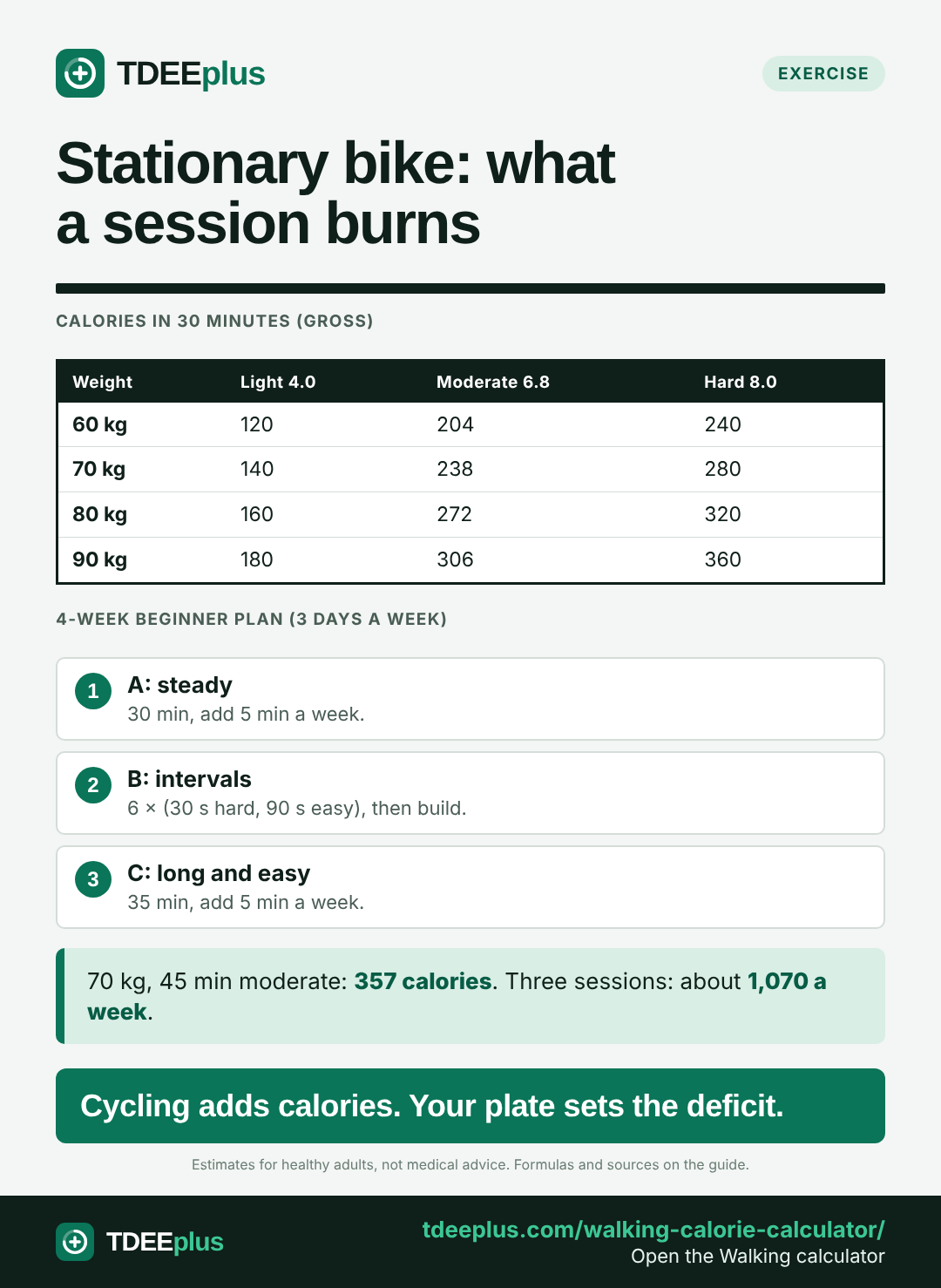
How many calories does a stationary bike burn?
These figures use the 2024 Compendium of Physical Activities. Energy is MET × body weight in kg × hours. They are gross calories, meaning the total burned, including what you would have burned sitting. Net calories subtract 1 MET and are about 15 percent lower at moderate effort.
| Body weight | Light (50 W, 4.0 METs) | Moderate (101–125 W, 6.8 METs) | Steady hard (126–150 W, 8.0 METs) | Very hard (151–199 W, 10.3 METs) |
|---|---|---|---|---|
| 60 kg | 120 | 204 | 240 | 309 |
| 70 kg | 140 | 238 | 280 | 361 |
| 80 kg | 160 | 272 | 320 | 412 |
| 90 kg | 180 | 306 | 360 | 464 |
| 100 kg | 200 | 340 | 400 | 515 |
All figures are calories for 30 minutes. Double them for an hour. A spin class pace of about 9 METs (code 01270) burns roughly 315 calories in 30 minutes for a 70 kg rider.
Set the effort without a power meter
- Light: you could sing. Easy warm-ups and recovery.
- Moderate: you can talk in full sentences but not sing. Most of your riding.
- Hard: you can say only a few words at a time. Intervals only.
If your bike shows watts, use them to compare with the table. Bike set-up matters: raise the saddle until your knee has a slight bend at the bottom of the pedal stroke.
A four-week beginner plan
| Day | Week 1 | Week 2 | Week 3 | Week 4 |
|---|---|---|---|---|
| Session A: steady | 30 min moderate | 35 min | 40 min | 45 min |
| Session B: intervals | 5 min warm-up, 6 × (30 s hard, 90 s easy), 5 min cool-down | 8 × (30 s hard, 90 s easy) | 8 × (45 s hard, 75 s easy) | 10 × (45 s hard, 75 s easy) |
| Session C: long and easy | 35 min light-moderate | 40 min | 45 min | 50 min |
Ride three days a week with a rest day between sessions, and add a fourth easy day when this feels comfortable. Walk on the other days: the walking calorie calculator shows what steps add. This also raises your VO2 max over a couple of months.
How cycling fits your calorie plan
- Find your TDEE with the TDEE calculator, and count your rides in the activity level honestly (choosing your activity level). Do not also eat back each session's calories.
- Set a deficit of 250 to 500 calories (build a weight loss plan).
- Eat a small carb-and-protein snack before long or hard sessions (what to eat before exercise).
- Weigh weekly and adjust (track and adjust).
Common mistakes
- Eating back the console calories. They are often overestimated.
- Riding hard every time. Easy days build the base and help you recover.
- Forgetting strength work. Add two short lifting sessions a week to protect muscle.
Check with a doctor before starting intense intervals if you have heart disease, chest pain, dizziness, joint problems or have been inactive for years.
Compare what walking and cycling burn for your weight.
Open the walking calorie calculatorFrequently asked questions
How long should I ride a stationary bike to lose weight?
How many calories does 30 minutes on a stationary bike burn?
Is a stationary bike better than walking for weight loss?
Does a stationary bike burn belly fat?
Is the calorie number on the bike accurate?
Keep reading
Sources
- Compendium of Physical Activities (2024 update). Bicycling: stationary cycling entries (codes 01200–01290). pacompendium.com/bicycling
- Herrmann SD, Willis EA, Ainsworth BE, et al. 2024 Adult Compendium of Physical Activities: a third update of the energy costs of human activities. J Sport Health Sci. 2024;13(1):6–12. pacompendium.com
- Bull FC, Al-Ansari SS, Biddle S, et al. World Health Organization 2020 guidelines on physical activity and sedentary behaviour. Br J Sports Med. 2020;54(24):1451–1462.
- Vissers D, Hens W, Taeymans J, Baeyens JP, Poortmans J, Van Gaal L. The effect of exercise on visceral adipose tissue in overweight adults: a systematic review and meta-analysis. PLoS One. 2013;8(2):e56415. doi:10.1371/journal.pone.0056415