A good weight loss plan has nine parts: a realistic goal, your TDEE, a moderate deficit, a protein target, simple meal habits, daily movement, strength training, weekly tracking and a plan for maintenance. You build it once from your numbers and then adjust it as your weight changes. This guide shows each step with one worked example you can copy.
Step 1: Set a goal and a pace
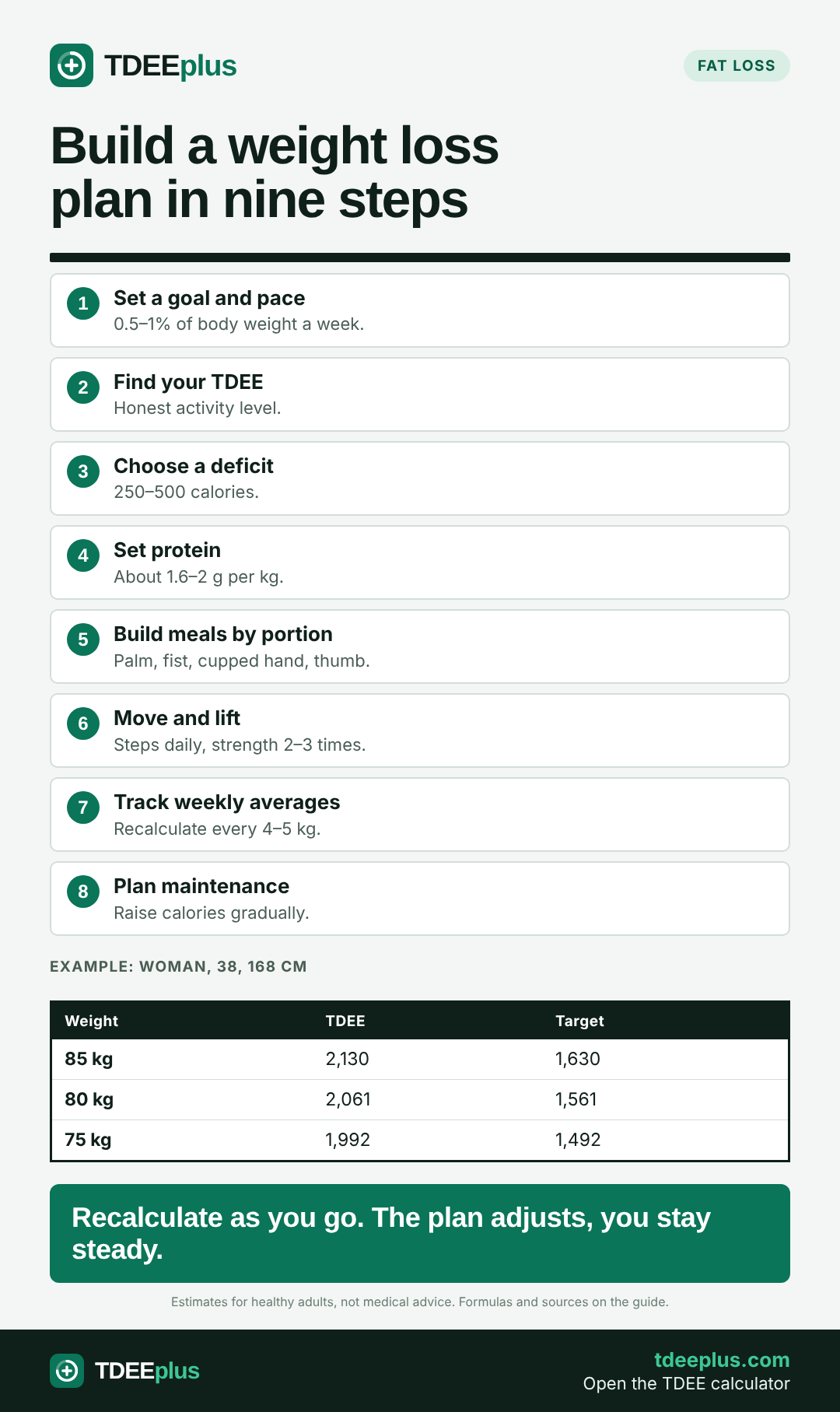
Choose a target weight and a pace. A widely used range is 0.5 to 1 percent of your body weight a week, which for most adults is roughly 0.5 to 1 kg. Slower is easier to keep up and costs less muscle. Our worked example is a 38-year-old woman, 168 cm, 85 kg, lightly active, aiming for 75 kg.
Step 2: Find your TDEE
Use the TDEE calculator, or calculate it by hand (how to calculate TDEE). Be honest about activity (choosing your activity level). For our example: BMR = 850 + 1,050 − 190 − 161 = 1,549, and × 1.375 = about 2,130 calories.
Step 3: Choose a deficit
For most people, 250 to 500 calories below TDEE is a good start (how big should your deficit be?). A 500-calorie deficit gives her about 1,630 calories, comfortably above the 1,200 floor for women. That is roughly 0.45 kg a week (500 × 7 ÷ 7,700), so 10 kg takes about 22 weeks. You can run the numbers with the cutting calorie calculator.
Step 4: Set protein, then fill the rest
Aim for about 1.6 to 2 g of protein per kg of body weight. At 85 kg that is about 136 to 170 g a day. Fill the remaining calories with carbs and fats you enjoy. The macro calculator does the split, and how much protein you need explains the range.
Step 5: Turn numbers into meals
You do not need a perfect menu. Build each meal from a palm of protein, a fist of vegetables, a cupped hand of carbs and a thumb of fat (portion control guide), and repeat the meals you like. For a ready-made week at about 1,600 calories, see the 7-day diet plan.
Step 6: Move more, every day
Daily steps are the easiest calories to add. Start by lifting your current average by 1,500 to 2,000 steps. The walking calorie calculator shows what that burns. Add structured cardio if you enjoy it, such as a stationary bike or swimming.
Step 7: Lift weights two or three times a week
Strength training tells your body to keep muscle while you lose fat, so more of the weight you lose is fat. Full-body sessions of 30 to 45 minutes are plenty for beginners.
Step 8: Track the average, not the day
Weigh yourself most mornings, then compare weekly averages. Studies of self-monitoring link regular weighing and food logging with better weight loss. Our week-by-week guide tells you exactly when to change your calories. Re-run your TDEE every 4 to 5 kg lost:
| Weight | TDEE (light activity) | Target (500 deficit) |
|---|---|---|
| 85 kg (start) | 2,130 | 1,630 |
| 80 kg | 2,061 | 1,561 |
| 75 kg (goal) | 1,992 | 1,492 |
The target falls only about 140 calories over 10 kg, which is why plateaus happen when people never recalculate.
Step 9: Plan the finish
At 75 kg her maintenance is about 1,992 calories. When she arrives, she raises intake by 400 to 500 calories over a couple of weeks and holds her weight for a while. Weight regain is common when a plan ends without a maintenance step.
A note on pace and safety
Resist the urge to speed up. Large cuts, skipped meals and extra hours of cardio usually backfire within weeks. Skip DIY dieting and talk to a doctor if you are pregnant or breastfeeding, under 18, have a medical condition or take medicines that affect weight, or have a history of disordered eating. Calorie restriction for weight loss explains the floors and who should get help.
Start with your own numbers.
Open the TDEE calculatorFrequently asked questions
How do I make a weight loss plan?
How long will it take to lose 10 kg?
Is a weight loss plan the same as a meal plan?
How fast is too fast?
What do I do after I reach my goal?
Keep reading
More guides on this topic
Sources
- Mifflin MD, St Jeor ST, Hill LA, Scott BJ, Daugherty SA, Koh YO. A new predictive equation for resting energy expenditure in healthy individuals. Am J Clin Nutr. 1990;51(2):241–247. PubMed 2305711
- Jensen MD, Ryan DH, Apovian CM, et al. 2013 AHA/ACC/TOS guideline for the management of overweight and obesity in adults. Circulation. 2014;129(25 Suppl 2):S102–S138. PubMed 24222017
- Burke LE, Wang J, Sevick MA. Self-monitoring in weight loss: a systematic review of the literature. J Am Diet Assoc. 2011;111(1):92–102.
- Hall KD, Sacks G, Chandramohan D, et al. Quantification of the effect of energy imbalance on bodyweight. Lancet. 2011;378(9793):826–837. PubMed 21872751
- Centers for Disease Control and Prevention. Losing Weight: gradual, steady weight loss of about 1 to 2 pounds per week. cdc.gov.
- Longland TM, Oikawa SY, Mitchell CJ, Devries MC, Phillips SM. Higher compared with lower dietary protein during an energy deficit combined with intense exercise promotes greater lean mass gain and fat mass loss: a randomized trial. Am J Clin Nutr. 2016;103(3):738–746. PubMed 26817506