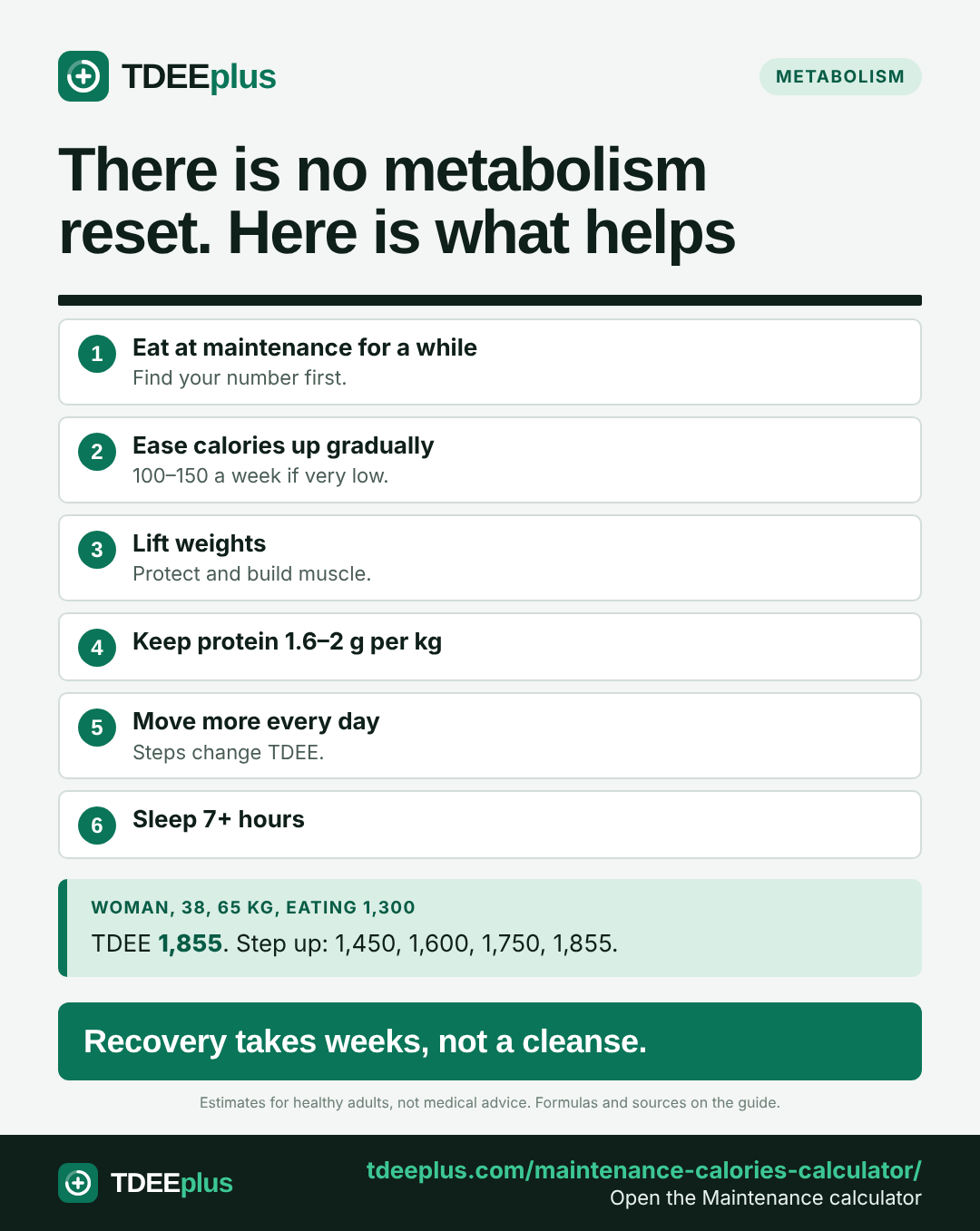
You cannot flip a switch to reset your metabolism, but you can help it recover after dieting. Eat at maintenance or ease calories up gradually, lift weights, keep protein high, sleep well and increase everyday movement. Over weeks these steps restore energy and training capacity, even though no trick makes you burn dramatically more. Start by finding your maintenance level with the maintenance calorie calculator.
What is happening when you diet
Your body burns calories through your resting metabolism (what BMR means), movement and digestion (TDEE vs BMR). When you lose weight, your TDEE falls because you are smaller. On top of that, research shows an additional drop called adaptive thermogenesis, a reduction in energy use beyond what the smaller body explains. It is usually modest in typical diets and larger after extreme weight loss, as shown in follow-ups of "The Biggest Loser" contestants. Read why your TDEE drops as you lose weight for the full picture.
The "reset" myth
Your metabolism is not broken. It adapts to what you eat and weigh. Detoxes, "metabolism-boosting" teas and cleanses do not change it in any lasting way. What changes it is food, muscle and movement.
What actually helps
- Stop dieting hard and eat at maintenance for a while. Find your number with the maintenance calorie calculator and how to find your real maintenance calories.
- Come up gradually if you are very low. A "reverse diet" adds 100 to 150 calories a week until you reach maintenance. The evidence is limited, but it is a reasonable way to avoid rebound.
- Lift weights. More muscle raises your resting burn a little and protects your results.
- Keep protein at 1.6 to 2 g per kg. See how much protein you need.
- Move more through the day. Steps and everyday activity change TDEE more than most people expect, and the TDEE calculator shows by how much.
- Sleep seven or more hours. Sleep affects hunger and training.
- Consider planned diet breaks. In the MATADOR trial, men with obesity who alternated two weeks of dieting with two weeks at maintenance lost more weight than men dieting continuously. It was small, so view it as an option.
This is an example of an approach, not a proven protocol. A quick weight rise of 1 to 2 kg is often water and stored carbs as you eat more, and it does not mean fat gain. Track the weekly average (track and adjust week by week).
If you feel unusually tired or cold
Fatigue, feeling cold, hair thinning or irregular periods have many causes, including low calorie intake, thyroid problems, low iron and some medicines. If these continue, see a doctor rather than trying to fix them with diet changes alone.
If you are stuck at a plateau
A plateau is not proof of a broken metabolism. Work through the weight loss plateau checklist first, and check the common TDEE mistakes.
Find your maintenance calories to rebuild from.
Open the maintenance calculatorFrequently asked questions
Can you reset your metabolism?
What is metabolic adaptation?
What is reverse dieting?
What are signs of a slow metabolism?
Do diet breaks help?
Keep reading
Sources
- Rosenbaum M, Leibel RL. Adaptive thermogenesis in humans. Int J Obes (Lond). 2010;34(Suppl 1):S47–S55.
- Fothergill E, et al. Persistent metabolic adaptation 6 years after "The Biggest Loser" competition. Obesity. 2016. doi:10.1002/oby.21538
- Byrne NM, Sainsbury A, King NA, Hills AP, Wood RE. Intermittent energy restriction improves weight loss efficiency in obese men: the MATADOR study. Int J Obes (Lond). 2018;42(2):129–138. doi:10.1038/ijo.2017.206
- Hall KD, Sacks G, Chandramohan D, et al. Quantification of the effect of energy imbalance on bodyweight. Lancet. 2011;378(9793):826–837. PubMed 21872751
- Centers for Disease Control and Prevention. About sleep: adults need 7 or more hours per night. cdc.gov.