A weight loss plateau is when your average weight stays flat for about three weeks even though you are following your plan. It usually happens because a smaller body burns fewer calories, so the same intake has become your new maintenance, or because small portion and tracking slips have crept in. Before changing anything, check that it is real, then work through the fixes below in order. Recalculate with the TDEE calculator first.
Step 1: Is it a real plateau?
Day-to-day weight can swing by a kilogram or more from water, salt, carbs, hormones and digestion, which is why single weigh-ins mislead. Compare weekly averages, as in tracking and adjusting week by week.
| What you see | What it usually means |
|---|---|
| Flat for 3–5 days, then a drop | Water. Not a plateau. |
| Weekly average flat for 1–2 weeks | Normal noise. Keep going. |
| Weekly average flat for about 3 weeks | A plateau. Work through the fixes. |
| Waist is shrinking, scale is flat | You may be losing fat and holding water or gaining muscle. |
Track your waist every two to four weeks, and use the weight loss percentage calculator to see your real progress and weekly rate.
Step 2: Why it happens
Your deficit shrinks as you lose
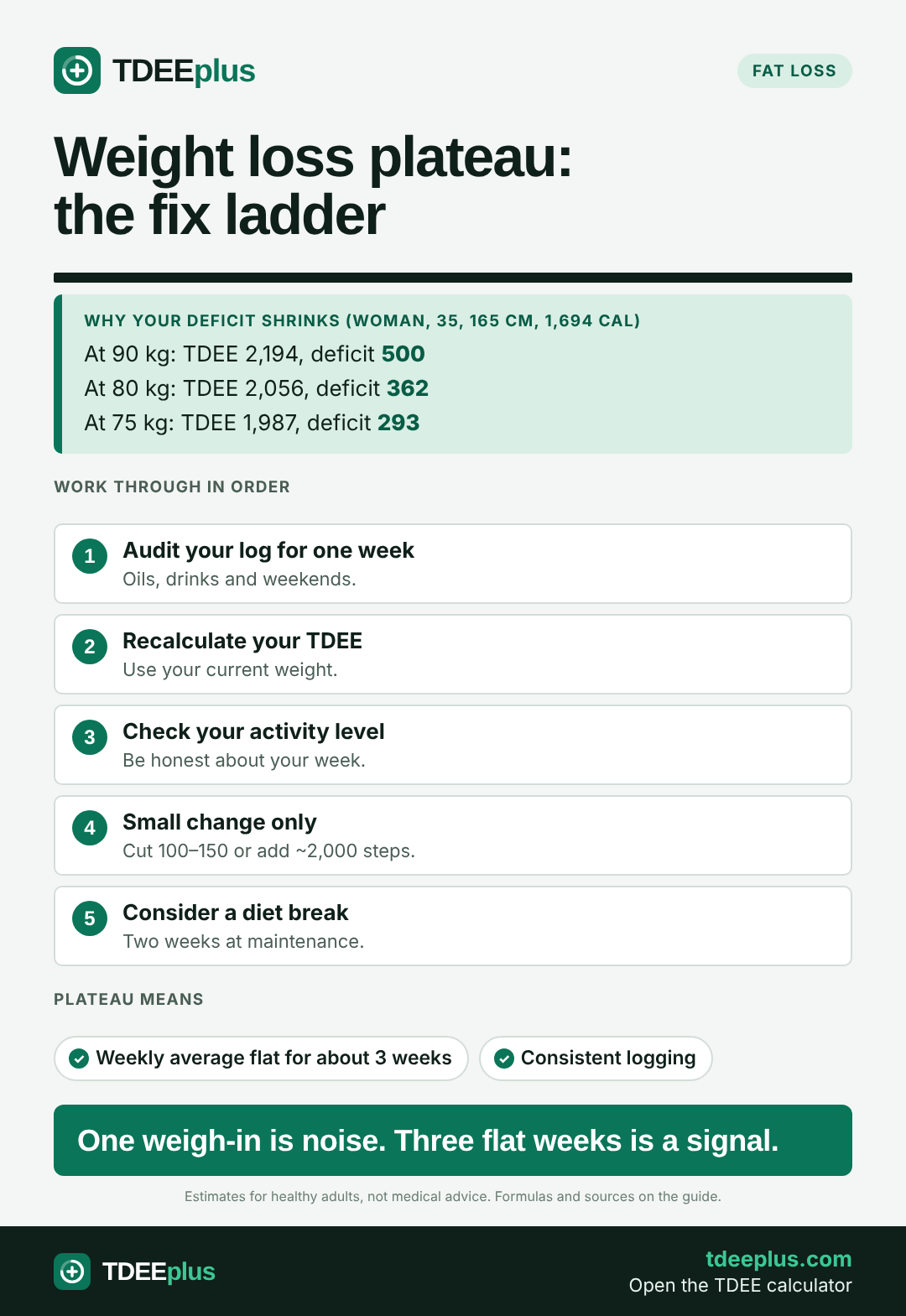
This is the biggest cause. Weight drives energy needs, so as you get lighter your TDEE falls.
That is also why the old "3,500 calories equals one pound" rule overpredicts long-term loss: it treats the deficit as fixed when it changes as your weight does.
Metabolic adaptation
Research shows that after weight loss, resting energy use can fall slightly more than the lighter body explains. In the follow-up of "The Biggest Loser" contestants, the effect was large and lasting, but those were extreme weight losses. For most people it is a modest effect that adds to the first cause.
Logging drift
Portions grow, oils and drinks go unlogged, weekends relax. Two untracked days can erase a week's deficit. Our TDEE calculator mistakes guide lists the common slips.
Less movement without noticing
Dieting tends to lower everyday movement without us choosing it: fewer steps, more sitting. A smartwatch step count helps you notice.
Step 3: The fix ladder
- Audit your log for one week. Weigh foods, log oils, drinks and weekends. This alone solves many plateaus.
- Recalculate your TDEE at your current weight. Use the TDEE calculator. Re-run it after every 4–5 kg lost.
- Check your activity level. Be honest about the week you are really having: choosing your activity level.
- Make a small adjustment. Cut 100–150 calories or add about 2,000 steps a day. Avoid big cuts: see how big your deficit should be.
- Keep protein and strength training. They protect muscle while you lose fat. See how much protein you need.
- Consider a planned diet break. Two weeks at your maintenance calories can restore energy and adherence. Find your number with how to find your real maintenance calories or the maintenance calculator.
- Re-test after three weeks. Change one thing at a time so you know what worked.
What not to do
- Do not crash below the safe floor of about 1,200 calories (women) or 1,500 (men) without medical supervision. See calorie restriction for weight loss.
- Do not add punishing cardio on top of a low intake. It drives hunger and tends to backfire.
- Do not judge a plan on one weigh-in.
If you have been flat for months, feel unwell, or have symptoms such as unusual fatigue, a doctor can check for medical causes such as thyroid problems or medicines that affect weight.
Recalculate your calories at your new weight.
Open the TDEE calculatorFrequently asked questions
How long is a weight loss plateau?
Why did my weight loss stop?
Should I eat less to break a plateau?
Is metabolic adaptation real?
Do diet breaks help?
Keep reading
Sources
- Hall KD, Sacks G, Chandramohan D, et al. Quantification of the effect of energy imbalance on bodyweight. Lancet. 2011;378(9793):826–837. PubMed 21872751
- Fothergill E, et al. Persistent metabolic adaptation 6 years after "The Biggest Loser" competition. Obesity. 2016. doi:10.1002/oby.21538
- Rosenbaum M, Leibel RL. Adaptive thermogenesis in humans. Int J Obes (Lond). 2010;34(Suppl 1):S47–S55.
- Thomas DM, Gonzalez MC, Pereira AZ, Redman LM, Heymsfield SB. Time to correctly predict the amount of weight losses with dieting. J Acad Nutr Diet. 2014;114(6):857–861.
- Byrne NM, Sainsbury A, King NA, Hills AP, Wood RE. Intermittent energy restriction improves weight loss efficiency in obese men: the MATADOR study. Int J Obes (Lond). 2018;42(2):129–138. doi:10.1038/ijo.2017.206