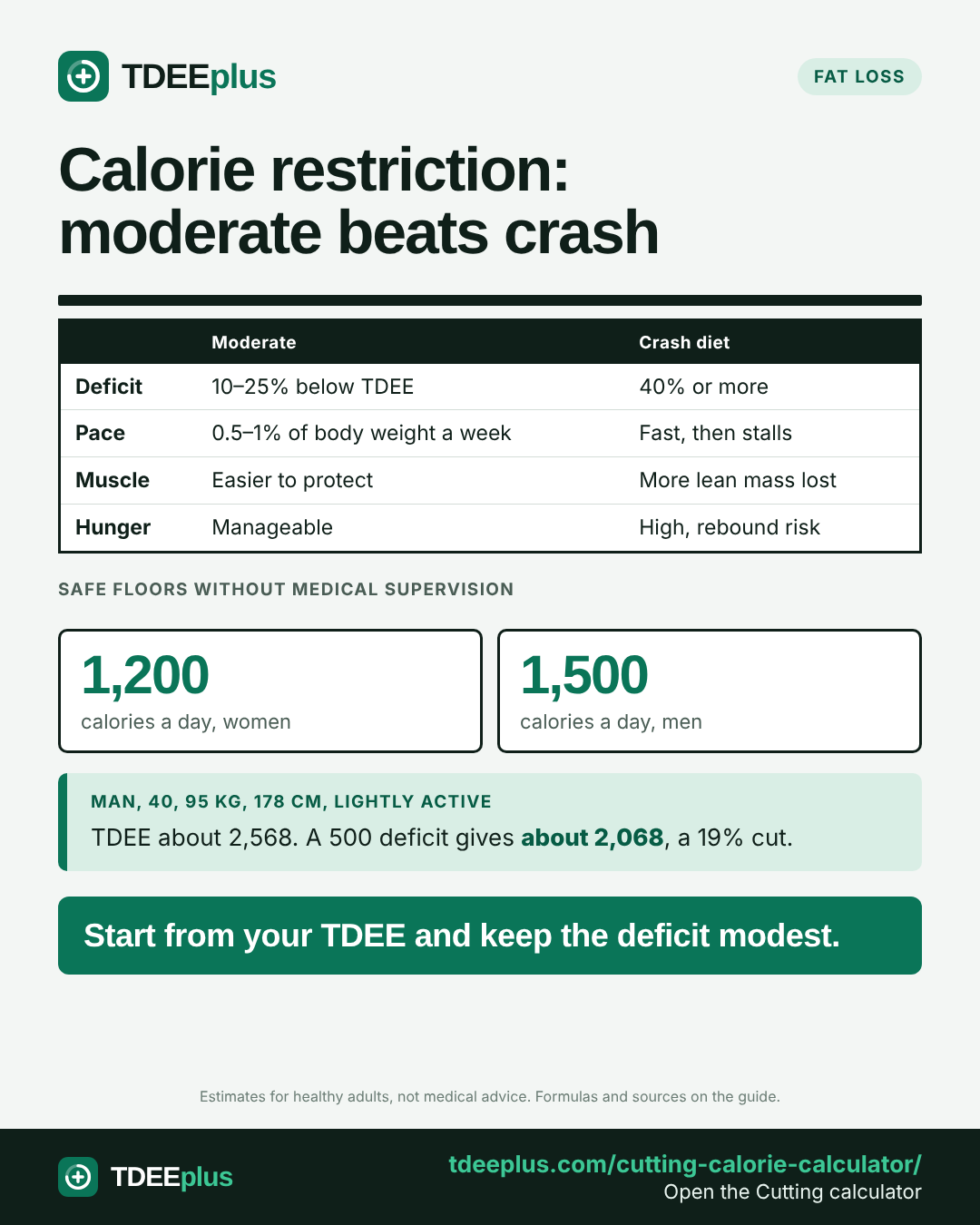
Calorie restriction means eating fewer calories than you burn, consistently, so your body uses stored fat to make up the gap. For most adults a safe version is a moderate deficit of about 10 to 25 percent below maintenance, kept above 1,200 calories (women) or 1,500 (men) unless a doctor is supervising. Start from your TDEE, not from a round number you read online. The cutting calorie calculator sets it for you.
How calorie restriction works
Your body burns a certain number of calories a day (your TDEE). Eat less than that and it makes up the difference from fat and, if you are not careful, some muscle. Because a smaller body burns less, the gap narrows over time, so restriction is a moving target (why TDEE drops as you lose weight).
Researchers have studied calorie restriction closely. In the two-year CALERIE trial, adults aimed for a 25 percent cut and averaged about a 12 percent cut, which still produced steady weight loss and improved health markers. The lesson is that you do not need an extreme deficit for it to work, and a moderate one is easier to sustain.
Moderate restriction versus crash dieting
| Moderate restriction | Crash diet | |
|---|---|---|
| Deficit | 10–25% below TDEE (250–500 calories) | 40% or more, or very low calorie |
| Pace | About 0.5–1% of body weight a week | Faster at first, then stalls |
| Muscle | Easier to protect with protein and lifting | More lean mass is lost |
| Hunger | Manageable | High, so it often ends in rebound |
| Nutrients | Enough room for a balanced diet | Hard to get enough protein and vitamins |
Set your safe target in three steps
- Find your TDEE. Use the TDEE calculator.
- Choose a deficit. 250 to 500 calories suits most people; see how big should your calorie deficit be?
- Check the floor. If the result is under 1,200 (women) or 1,500 (men), use a smaller deficit. The cutting calorie calculator does this check for you.
Protect muscle while you restrict
- Keep protein high. In a 4-week trial of men dieting at about 40 percent below needs, those eating 2.4 g/kg of protein gained more lean mass and lost more fat than those on 1.2 g/kg. See how much protein you need.
- Lift weights two to three times a week. It tells your body to keep muscle.
- Sleep seven or more hours. Poor sleep raises hunger and makes sticking to a deficit harder.
- Use portions, not just numbers. Portion control keeps things simple.
Calorie restriction versus intermittent fasting
Intermittent fasting and time-restricted eating are about when you eat. Calorie restriction is about how much. A 12-month randomized trial of 139 adults with obesity compared calorie restriction alone with calorie restriction plus eating only between 8 a.m. and 4 p.m. Both groups lost weight, and the time window added no extra benefit. If a shorter eating window helps you eat less and you enjoy it, it is a fine tool. The deficit still does the work.
Who should not restrict calories on their own
Skip DIY restriction if you are pregnant or breastfeeding, under 18, have a medical condition, take medicines that affect weight or blood sugar, or have a history of disordered eating. See your doctor or a registered dietitian first. Very low calorie diets of 800 calories or less should only be done under medical supervision.
Get a safe daily target with a built-in floor check.
Open the cutting calorie calculatorFrequently asked questions
What is calorie restriction?
What is the lowest number of calories I should eat?
Is calorie restriction the same as starvation mode?
Is intermittent fasting better than calorie restriction?
How fast should I lose weight?
Keep reading
More guides on this topic
Sources
- Ravussin E, Redman LM, Rochon J, et al. A 2-year randomized controlled trial of human caloric restriction: feasibility and effects on predictors of health span and longevity. J Gerontol A Biol Sci Med Sci. 2015;70(9):1097–1104.
- Liu D, Huang Y, Huang C, et al. Calorie restriction with or without time-restricted eating in weight loss. N Engl J Med. 2022;386(16):1495–1504. doi:10.1056/NEJMoa2114833
- Longland TM, Oikawa SY, Mitchell CJ, Devries MC, Phillips SM. Higher compared with lower dietary protein during an energy deficit combined with intense exercise promotes greater lean mass gain and fat mass loss: a randomized trial. Am J Clin Nutr. 2016;103(3):738–746. PubMed 26817506
- Jensen MD, Ryan DH, Apovian CM, et al. 2013 AHA/ACC/TOS guideline for the management of overweight and obesity in adults. Circulation. 2014;129(25 Suppl 2):S102–S138. PubMed 24222017
- Centers for Disease Control and Prevention. Losing Weight: gradual, steady weight loss of about 1 to 2 pounds per week. cdc.gov.