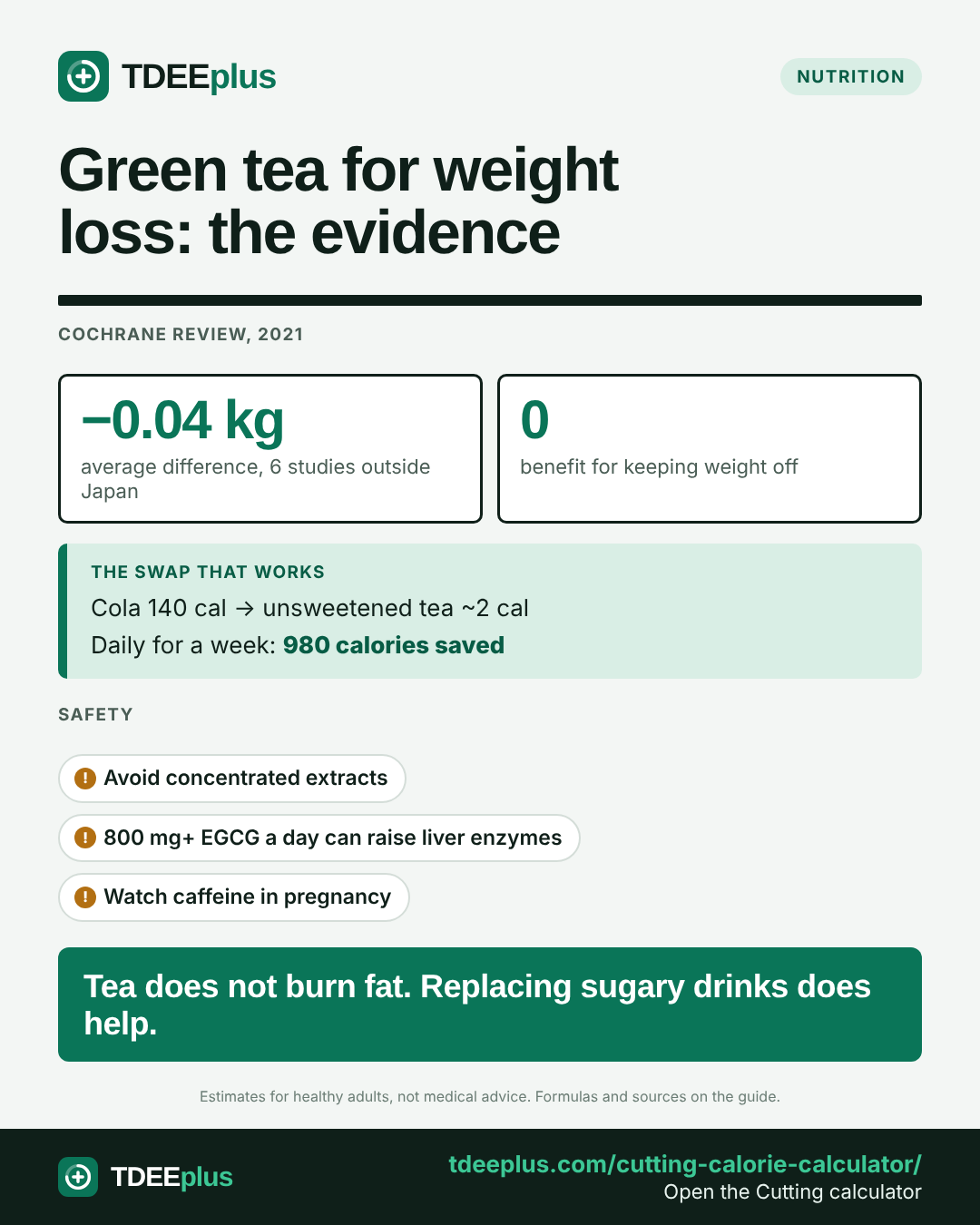
Green tea has at most a small effect on weight loss. A Cochrane review of 15 weight-loss studies found no clinically important difference in overweight and obese adults, and no benefit for keeping weight off. Where green tea does help is when unsweetened tea replaces sugary drinks, because that cuts calories. It does not replace a calorie deficit.
What the research says
| Review | What it found |
|---|---|
| Cochrane, 2021 (15 weight-loss studies, 3 on maintenance) | Small, non-significant weight loss. In 6 studies outside Japan (532 people), the average difference was −0.04 kg. No benefit for maintaining weight. |
| Earlier meta-analysis, 2009 | Reported a small effect on weight in some analyses, which was weaker or absent in others. |
In the Cochrane review, some studies from Japan showed differences from 0.2 to 3.5 kg in favour of green tea, but they were too different to combine. The authors judged that any benefit is unlikely to matter in practice. Studies lasted 12 to 13 weeks, so we know little about long-term effects.
Why people think it works
Green tea contains catechins such as EGCG and caffeine, which can raise energy use slightly in lab studies. Over real life, the change is too small to move your weight. Your total calories still decide the result. Work out yours with the TDEE calculator and how big your deficit should be.
The swap that does help
This is the same idea as the small changes in portion control for weight loss and our weight loss plan.
Safety: tea versus supplements
- Brewed tea: 3 to 4 cups a day is typical in studies and generally fine for healthy adults. Each cup has about 25 to 45 mg of caffeine.
- Extracts and "fat burner" pills: The European Food Safety Authority found that 800 mg or more of EGCG a day from supplements can raise liver enzymes, and there are reports of liver injury. Avoid concentrated extracts unless a doctor agrees.
- Pregnancy and breastfeeding: keep caffeine within your doctor's limit.
- Medicines: green tea can interact with some medicines. Ask your pharmacist.
- Iron: tea with meals can reduce iron absorption, so drink it between meals if you are low in iron.
If you like green tea, here is how to enjoy it
- Brew it right. Use water around 80 °C (176 °F), not boiling, and steep for 2 to 3 minutes. Hotter and longer makes it bitter.
- Keep it unsweetened. A teaspoon of sugar is about 16 calories, and a sweetened bottled tea can have as many calories as a soft drink. Check the label.
- Mind the time of day. The caffeine can disturb sleep if you drink it late. Adults need seven or more hours a night, and poor sleep makes dieting harder.
- Treat it as a drink, not a treatment. Its real advantages are that it is hydrating, nearly calorie-free and pleasant, and that it can take the place of higher-calorie drinks.
Other drinks that save calories
The same swap works with water, sparkling water, black coffee or any unsweetened tea. If you want a plan for where your drinks fit, add them to your calorie log, because liquid calories are among the most commonly missed (common tracking mistakes). Our calories per gram guide shows how to count a drink that has sugar or alcohol.
What works better for weight loss
- A moderate deficit from your TDEE.
- Protein near 1.6 to 2 g/kg (how much protein you need).
- Daily steps and strength training.
- Weekly tracking (track and adjust).
Get a calorie target and macros for fat loss.
Open the cutting calorie calculatorFrequently asked questions
Does green tea help you lose weight?
How much green tea should I drink?
Are green tea fat burner supplements safe?
Is matcha better than green tea?
Can green tea replace a calorie deficit?
Keep reading
Sources
- Jurgens TM, Whelan AM, Killian L, Doucette S, Kirk S, Foy E. Green tea for weight loss and weight maintenance in overweight or obese adults. Cochrane Database Syst Rev. 2021;(6):CD008650. doi:10.1002/14651858.CD008650.pub2
- Hursel R, Viechtbauer W, Westerterp-Plantenga MS. The effects of green tea on weight loss and weight maintenance: a meta-analysis. Int J Obes (Lond). 2009;33(9):956–961. PubMed 19597519
- EFSA Panel on Food Additives and Nutrient Sources added to Food. Scientific opinion on the safety of green tea catechins. EFSA Journal. 2018;16(4):5239.
- U.S. Department of Agriculture. FoodData Central: brewed green tea and cola (values rounded).