On a food label, "Calories" and "kilocalories" mean the same thing. A kilocalorie (kcal) is 1,000 small calories (cal) and equals 4.184 kilojoules (kJ). When your TDEE comes out at 2,500 "calories", the unit is kcal. The rest of this guide explains where the mix-up comes from and how to convert when you need to.
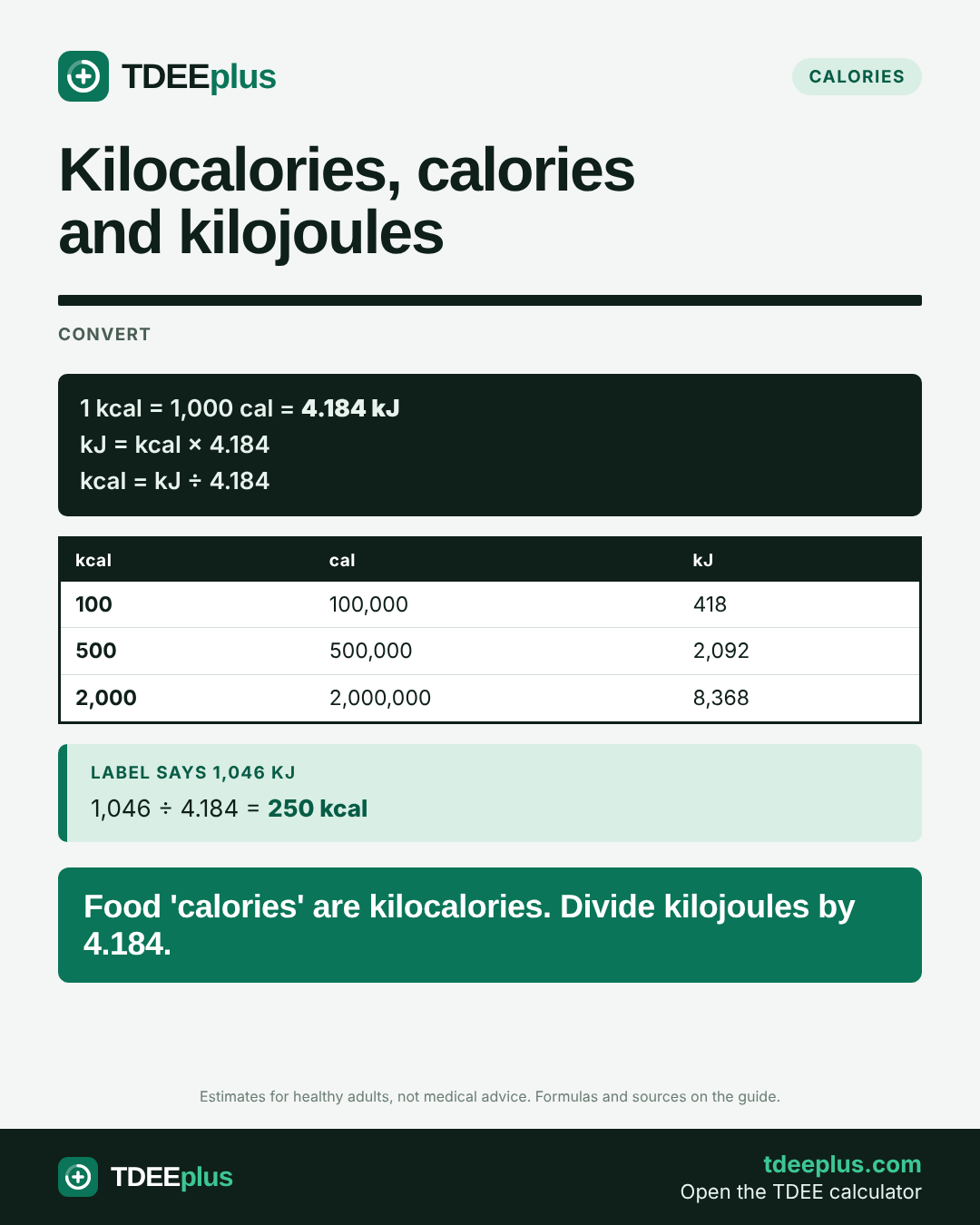
The three units
| Unit | Symbol | What it is |
|---|---|---|
| Small calorie | cal | About the energy needed to raise 1 g of water by 1 °C. Defined as 4.184 joules. |
| Kilocalorie (food "Calorie") | kcal, Cal | 1,000 small calories. The unit used for food energy. |
| Kilojoule | kJ | The metric (SI-based) unit. 1 kcal = 4.184 kJ. |
Scientists measure energy in small calories or joules. A slice of bread has roughly 80,000 small calories, which is a clumsy number. Nutrition therefore uses the kilocalorie, and everyday language shortened "kilocalorie" to "calorie". Some writers use a capital C (Calorie) for the food unit, but labels rarely bother with the distinction. For the general idea of what a calorie is, see what is a calorie.
Conversion table
| Kilocalories (kcal) | Small calories (cal) | Kilojoules (kJ) |
|---|---|---|
| 100 | 100,000 | 418 |
| 500 | 500,000 | 2,092 |
| 1,000 | 1,000,000 | 4,184 |
| 2,000 | 2,000,000 | 8,368 |
| 2,500 | 2,500,000 | 10,460 |
What labels show around the world
- United States: "Calories", meaning kcal.
- European Union and UK: energy in both kJ and kcal; the rules require both.
- Australia and New Zealand: mainly kilojoules, so a 2,000 kcal diet is about 8,400 kJ.
- Canada: Calories (kcal) on the panel.
Our calculators display "calories" by default and let you switch to kilojoules using the unit toggle, so a result of 2,740 calories appears as 11,464 kJ. If you follow a plan written in kilojoules, convert it once and log in one unit only.
Why the mix-up persists
The prefix "kilo" is easy to drop in conversation, and food packaging in the United States prints "Calories" with a capital C without explaining it. Nutrition research papers, by contrast, are careful to write kcal. If you ever read a figure like "1.5 million calories", it is almost certainly a measurement in small calories, or a typo. In everyday dieting, whenever you see calories, assume kilocalories.
Handy rules of thumb
- kcal to kJ, roughly: multiply by 4.2. So 2,000 kcal is about 8,400 kJ.
- kJ to kcal, roughly: divide by 4.2, or multiply by 0.24.
- Labels can differ by a hair. Kilojoules and kilocalories are each rounded separately, so 250 kcal may be printed next to 1,050 kJ rather than 1,046.
Historically, food energy was measured by burning a sample in a bomb calorimeter and recording the heat released. Today most values come from the Atwater system, which multiplies grams of protein, carbohydrate and fat by average energy factors. That is why the numbers on a pack are good estimates, not laboratory readings for the exact item in your hand.
Calories per gram
The same conversion applies to the energy in nutrients. Protein and carbohydrate give about 4 kcal (17 kJ) per gram and fat about 9 kcal (37 kJ). See calories per gram of protein, carbs, fat and alcohol for how to use them. When you read a label, the Calories line and the macro lines should roughly agree; how to read a nutrition facts label shows how to check.
Common mistakes
- Mixing kJ and kcal. A 2,000 kJ snack is not 2,000 kcal. It is about 478 kcal.
- Entering small calories. If a lab or article gives "calories" in thousands, check whether it means kcal.
- Converting twice. Many apps already convert for you. Check the unit once.
To turn a kcal number into a plan, use the macro calculator. If you are new to calorie targets, start with how many calories you should eat.
Find your daily calorie needs in kcal or kilojoules.
Open the TDEE calculatorFrequently asked questions
Is a kilocalorie the same as a calorie on food labels?
How many calories are in a kilocalorie?
How do I convert kilojoules to calories?
Why do some labels show kJ and kcal?
Do I need to convert anything in a calorie calculator?
Keep reading
Sources
- National Institute of Standards and Technology. Guide for the Use of the International System of Units (SI), NIST Special Publication 811, Appendix B.8: the thermochemical calorie is 4.184 J.
- Regulation (EU) No 1169/2011 on the provision of food information to consumers: energy value to be expressed in kJ and kcal.
- U.S. Food and Drug Administration. How to understand and use the Nutrition Facts label. fda.gov.