A calorie is a unit of energy. In nutrition it measures the energy in food and drink and the energy your body uses. To see how many your body uses, try the TDEE calculator, which estimates your total daily energy expenditure. The "calories" on labels are really kilocalories (kcal), as explained in kilocalories to calories.
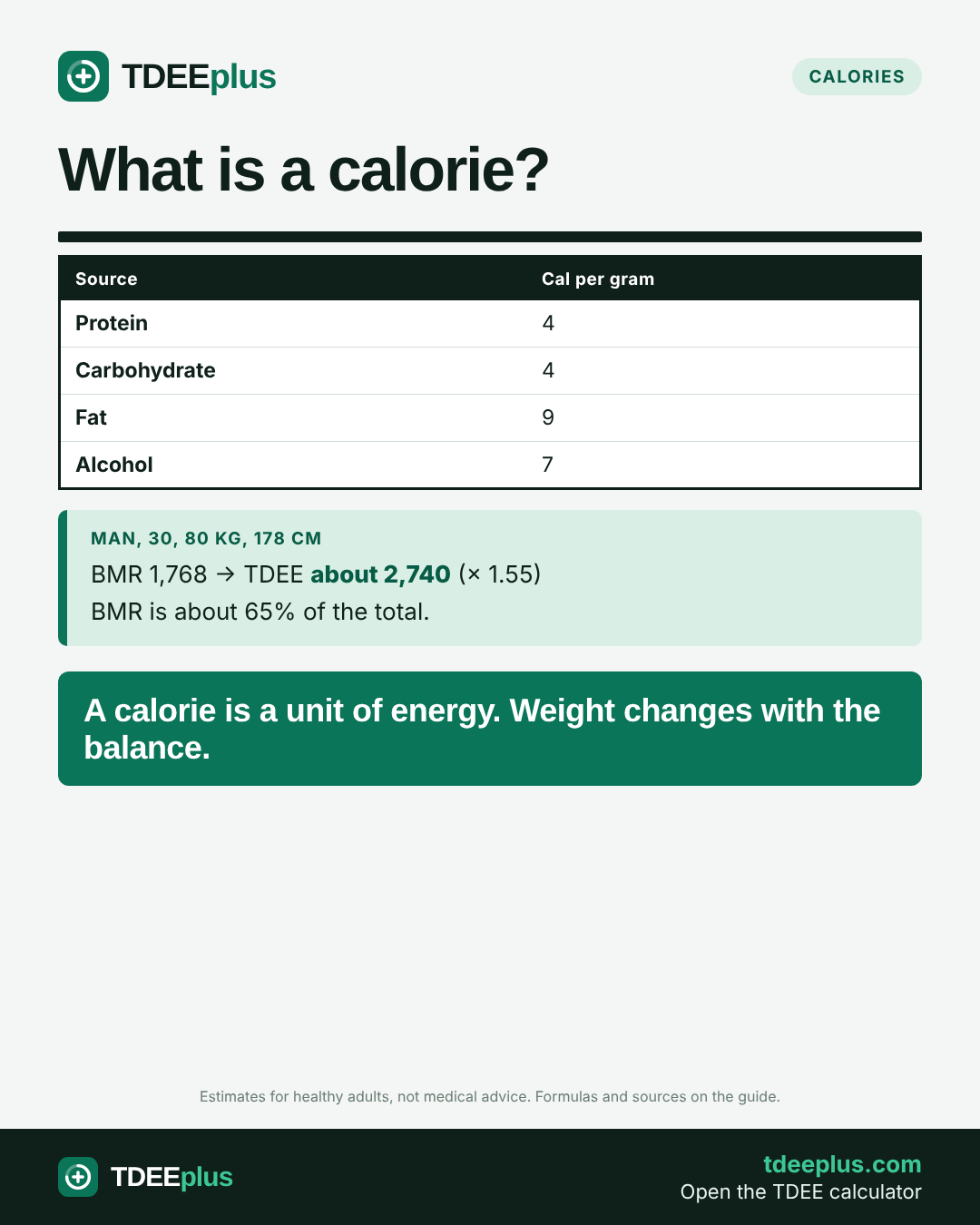
The definition
One small calorie is roughly the energy needed to raise one gram of water by one degree Celsius. One food Calorie, or kilocalorie, is 1,000 of those. Scientists now often use the joule instead: 1 kcal equals 4.184 kJ. You do not need to remember the physics to use the idea. A calorie is simply a measure of fuel.
Where food calories come from
| Source | Calories per gram | Example |
|---|---|---|
| Protein | 4 | 30 g of chicken protein = 120 calories |
| Carbohydrate | 4 | 50 g of rice carbs = 200 calories |
| Fat | 9 | 14 g of olive oil = about 126 calories |
| Alcohol | 7 | 14 g of alcohol (a glass of wine) = about 98 calories |
These factors, called Atwater factors, are averages used on labels. See calories per gram for how to apply them and what are macros for the nutrients behind them.
How the calories in food are worked out
Food labels do not come from burning your exact sandwich in a lab. Manufacturers either analyse the food for protein, fat, carbohydrate and alcohol and multiply by the Atwater factors (4, 9, 4 and 7), or use a database of similar foods. The result is rounded, and fibre, which is only partly digested, is treated differently in some systems. That is why two sources can differ by 5 to 10 percent for the same food, and why it is more useful to be consistent than perfectly exact.
How your body uses calories
Your daily energy use, or TDEE, has four parts:
- Basal metabolic rate (BMR): the energy to keep you alive at rest. It is usually the biggest part, often about 60 to 70 percent of the total (what is BMR).
- Thermic effect of food: energy used to digest food, roughly 10 percent of intake, higher for protein.
- Everyday movement: walking, fidgeting, chores.
- Exercise: planned workouts, usually the smallest part for most people.
See TDEE vs BMR and the Mifflin-St Jeor equation explained for how those numbers are calculated.
Energy balance
- Eat about your TDEE: weight stays roughly steady (maintenance calories).
- Eat less: your body draws on stored energy, mostly fat. Use a modest deficit (calorie deficit size).
- Eat more: the extra is stored as fat or, with training, partly as muscle (bulking calculator).
The long-run relationship is not as simple as "3,500 calories per pound", because your expenditure changes as your weight changes; see how many calories are in a pound of fat.
Are all calories equal?
Physically, yes. Biologically, the experience differs. Protein and fibre-rich foods keep you fuller (what is satiety), digestion uses more energy for protein than for fat, and foods bring different vitamins and minerals. So calories matter for weight, and food quality matters for health and for how easy a plan is to follow (balanced diet).
Common misconceptions
- "Eating fewer calories always slows metabolism a lot." Some adaptation occurs, but it is modest in a moderate deficit.
- "Exercise cancels any meal." A 30-minute walk burns roughly 100 to 150 calories, so food is the larger lever (walking calorie calculator).
- "Calories on labels are exact." They are estimates. Use them as a guide.
Estimate how many calories your body uses every day.
Open the TDEE calculatorFrequently asked questions
What is a calorie in simple terms?
How many calories do I need a day?
Are all calories the same?
Where do calories come from?
How do I burn calories?
Keep reading
Sources
- Mifflin MD, St Jeor ST, Hill LA, Scott BJ, Daugherty SA, Koh YO. A new predictive equation for resting energy expenditure in healthy individuals. Am J Clin Nutr. 1990;51(2):241–247. PubMed 2305711
- National Institute of Standards and Technology. Guide for the Use of the International System of Units (SI), SP 811, Appendix B.8: thermochemical calorie.
- U.S. Food and Drug Administration. How to understand and use the Nutrition Facts label. fda.gov.
- Hall KD, Sacks G, Chandramohan D, et al. Quantification of the effect of energy imbalance on bodyweight. Lancet. 2011;378(9793):826–837. PubMed 21872751