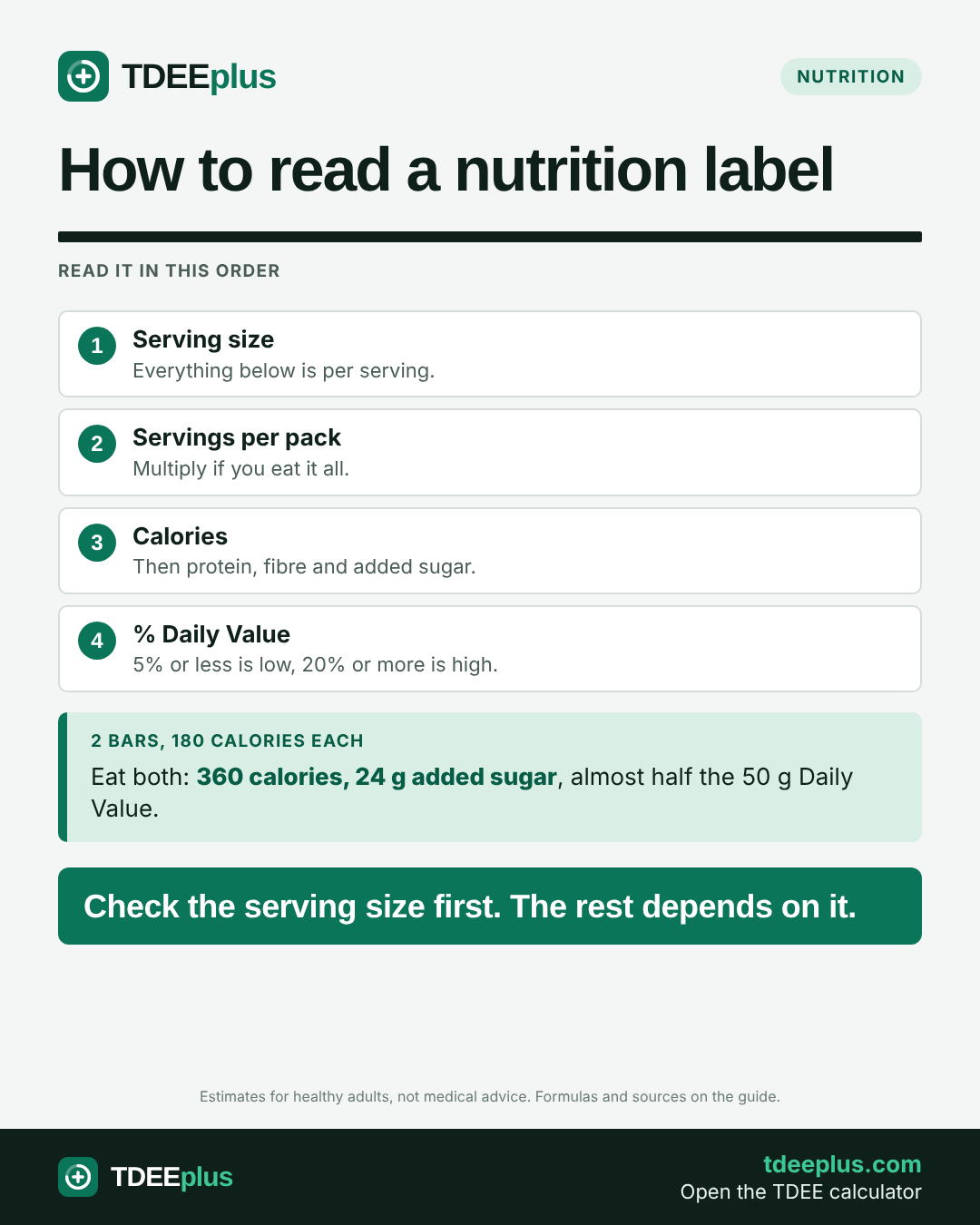
To read a nutrition facts label, start with the serving size, then calories, then protein, carbohydrate and fat, and finish with the % Daily Value to judge whether a food is high or low in something. Everything is for one serving. Once you know the numbers, enter them into your plan from the macro calculator or compare them with your TDEE.
1. Serving size and servings per container
The FDA says serving size is the amount people typically eat, not a recommendation. All values below it, including calories, are for that amount. A bag that looks like one portion may be listed as 2.5 servings, so eating it all means multiplying every number by 2.5. This is the most common label mistake, and one of the tracking errors that quietly add hundreds of calories.
2. Calories
The calorie line gives energy per serving. The label uses the 4-4-9 values for protein, carbs and fat (see calories per gram). The label uses "Calories" for what scientists call kilocalories (kilocalories to calories).
3. Fat, carbohydrate and protein
- Total fat includes saturated fat and trans fat. Saturated fat has a Daily Value of 20 g (foods high in saturated fat).
- Total carbohydrate includes dietary fibre (Daily Value 28 g), total sugars and added sugars (Daily Value 50 g).
- Protein is listed in grams; a % Daily Value is only required in specific cases.
For macro tracking, log grams of protein, carbohydrate and fat, and check that the calories roughly match: protein × 4 + carbs × 4 + fat × 9.
4. % Daily Value
The % Daily Value shows how much one serving contributes to a daily total based on 2,000 calories. According to the FDA, 5% or less is low and 20% or more is high. Aim for high in fibre, vitamin D, calcium, iron and potassium, and low in saturated fat, sodium and added sugars. If you eat more or fewer calories than 2,000, scale the idea, not the exact numbers.
| Nutrient | Daily Value | Aim |
|---|---|---|
| Saturated fat | 20 g | Less |
| Sodium | 2,300 mg | Less |
| Added sugars | 50 g | Less |
| Dietary fibre | 28 g | More |
| Potassium | 4,700 mg | More |
| Calcium | 1,300 mg | More |
5. A worked example
Tips for macro trackers
- Weigh, then check the label. If the serving is 40 g and you eat 60 g, scale by 1.5.
- Watch "per 100 g" vs "per serving". Many countries show both. Use the same column consistently.
- Remember cooking changes weight. Dry pasta weights differ from cooked weights. Pick one and stick to it.
- Treat labels as estimates. US rules allow some tolerance, so a label can be a little off.
Front-of-pack claims
Words on the front of a pack are regulated, and they are worth knowing. Under FDA rules, "calorie free" means fewer than 5 calories per serving and "low calorie" means 40 calories or fewer per serving. "Sugar free" does not mean calorie free: the product can still contain fat, starch or sugar alcohols. And a "serving" is whatever the manufacturer lists, so a "low calorie" snack eaten as three servings is not low calorie. Always read the panel, not the slogan.
For typical values of staple foods to compare against, see the macro counting grocery list, and for the foods that carry most saturated fat see the saturated fat list.
Turn label numbers into a daily plan with the macro calculator.
Open the macro calculatorFrequently asked questions
What is the first thing to check on a nutrition facts label?
What does %DV mean?
What are added sugars?
Why do the calories not match the macros exactly?
Are 'net carbs' on the label?
Keep reading
Sources
- U.S. Food and Drug Administration. How to understand and use the Nutrition Facts label. fda.gov.
- U.S. Food and Drug Administration. Daily Value on the Nutrition and Supplement Facts Labels. fda.gov.
- U.S. Department of Agriculture and U.S. Department of Health and Human Services. Dietary Guidelines for Americans, 2025–2030. Released January 2026. dietaryguidelines.gov.