Loose skin after weight loss depends mostly on how much weight you lost, how long you carried it, your age and your genetics. What helps is losing weight gradually, building muscle with strength training, not smoking and giving skin time to adjust. Creams and supplements have little evidence behind them, and large amounts of excess skin are usually handled with surgery. Track your progress with the weight loss percentage calculator.
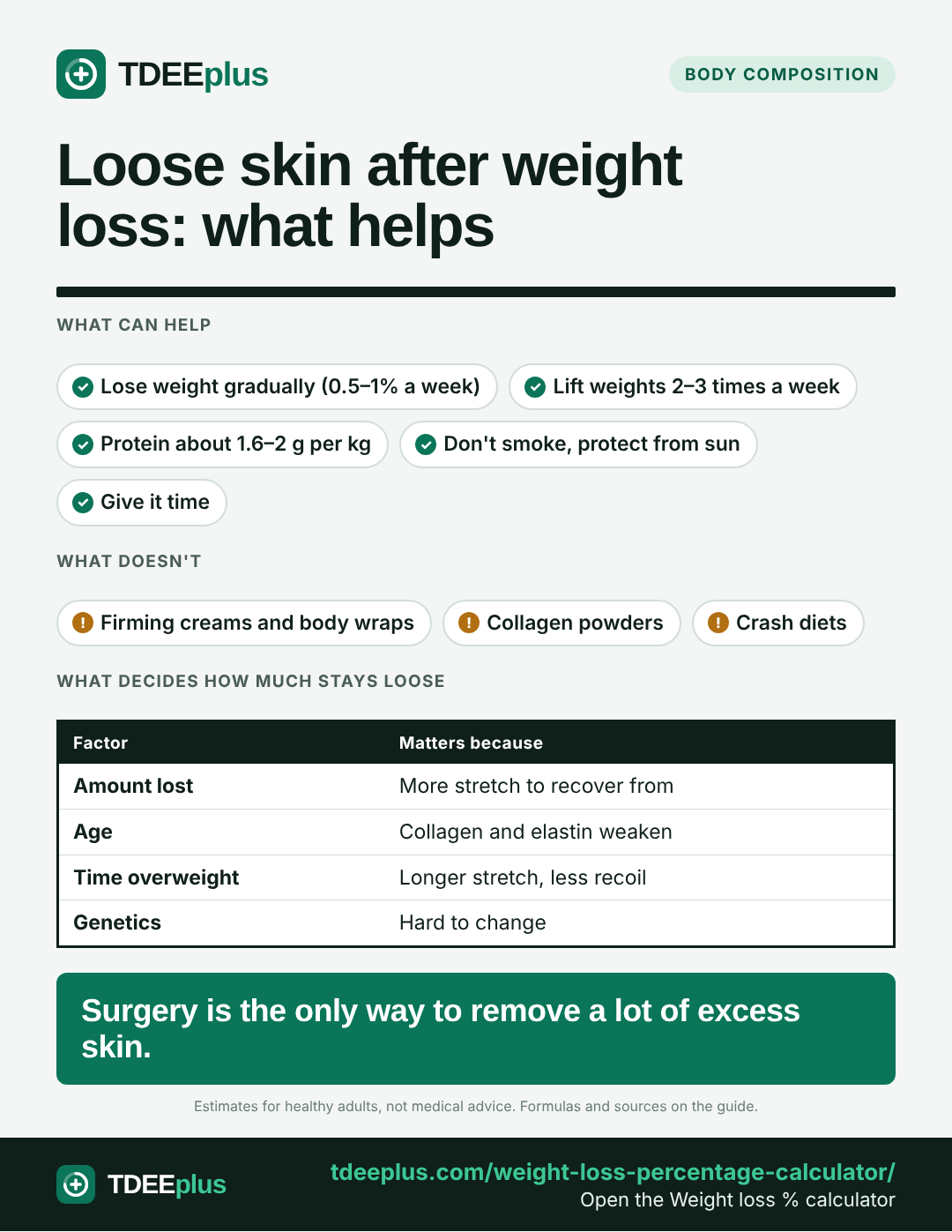
Why loose skin happens
Skin stretches to cover extra body mass. The proteins collagen and elastin let it spring back, but they weaken with age, sun exposure and the length of time the skin has been stretched. When the fat underneath shrinks, skin may not fully shrink with it. According to the American Society for Metabolic and Bariatric Surgery, the amount of sagging depends on age, genetics, exercise, how quickly weight is lost and smoking.
| Factor | More likely to snap back | More likely to stay loose |
|---|---|---|
| Amount of weight lost | Smaller amounts | Large amounts |
| Age | Younger | Older |
| Time overweight | Short | Many years |
| Speed of loss | Gradual | Rapid |
| Smoking, sun damage | Non-smoker, sun-protected | Smoker, heavy sun exposure |
Think of these as tendencies, not rules. Genetics play a big part, and two people with the same history can end up differently.
What can help
- Lose weight gradually. Aim for about 0.5 to 1 percent of your body weight a week and give skin time to adapt. See how to build a weight loss plan.
- Lift weights. Muscle fills out the space under the skin and helps you keep your shape. Two or three sessions a week is a good start.
- Keep protein up. About 1.6 to 2 g per kg supports muscle and skin repair (how much protein you need).
- Stay hydrated, sleep well and do not smoke. These do not tighten skin on their own but support its health.
- Protect your skin from the sun. UV damages collagen.
- Be patient. Skin may keep adjusting for many months after you reach a stable weight.
What does not work
- Firming creams and body wraps. They may moisturise and feel nice but do not rebuild collagen in a meaningful way.
- Collagen powders and supplements. Some small studies suggest skin benefits in general, but none show they tighten skin after large weight loss.
- Crash diets. Faster loss means more muscle loss as well, which makes the skin look looser. See calorie restriction for weight loss for safe limits.
Medical options
For significant excess skin, body contouring surgery (for example abdominoplasty, lower body lift or arm lift) is the only treatment that removes it. Surgeons usually want your weight to have been stable for many months and some recommend waiting 12 to 18 months or longer after major weight loss. Non-surgical devices (such as radiofrequency or ultrasound treatments) may give modest tightening for mild laxity and results vary. Talk to a board-certified plastic surgeon or your doctor. Excess skin can also cause rashes or infections in the folds, which is a medical reason to seek help.
Track what you can control
Measure your waist and body fat as you go with the body fat calculator, and use the weight loss percentage calculator to see how much of your starting weight you have lost. A moderate pace helps skin and the rest of your body, and the TDEE calculator helps you set a calorie target that supports it. If your target is a particular body fat, what 12% body fat looks like explains what the numbers mean.
See your weight loss percentage and weekly rate.
Open the calculatorFrequently asked questions
Can loose skin tighten up on its own?
Do creams or collagen tighten loose skin?
Does losing weight slowly help?
When is surgery an option?
Does strength training help loose skin?
Keep reading
Sources
- American Society for Metabolic and Bariatric Surgery (ASMBS), as summarised in: Premier Health. Plastic surgery helps with struggle of extra skin after major weight loss. premierhealth.com
- Jensen MD, Ryan DH, Apovian CM, et al. 2013 AHA/ACC/TOS guideline for the management of overweight and obesity in adults. Circulation. 2014;129(25 Suppl 2):S102–S138. PubMed 24222017
- Longland TM, Oikawa SY, Mitchell CJ, Devries MC, Phillips SM. Higher compared with lower dietary protein during an energy deficit combined with intense exercise promotes greater lean mass gain and fat mass loss: a randomized trial. Am J Clin Nutr. 2016;103(3):738–746. PubMed 26817506