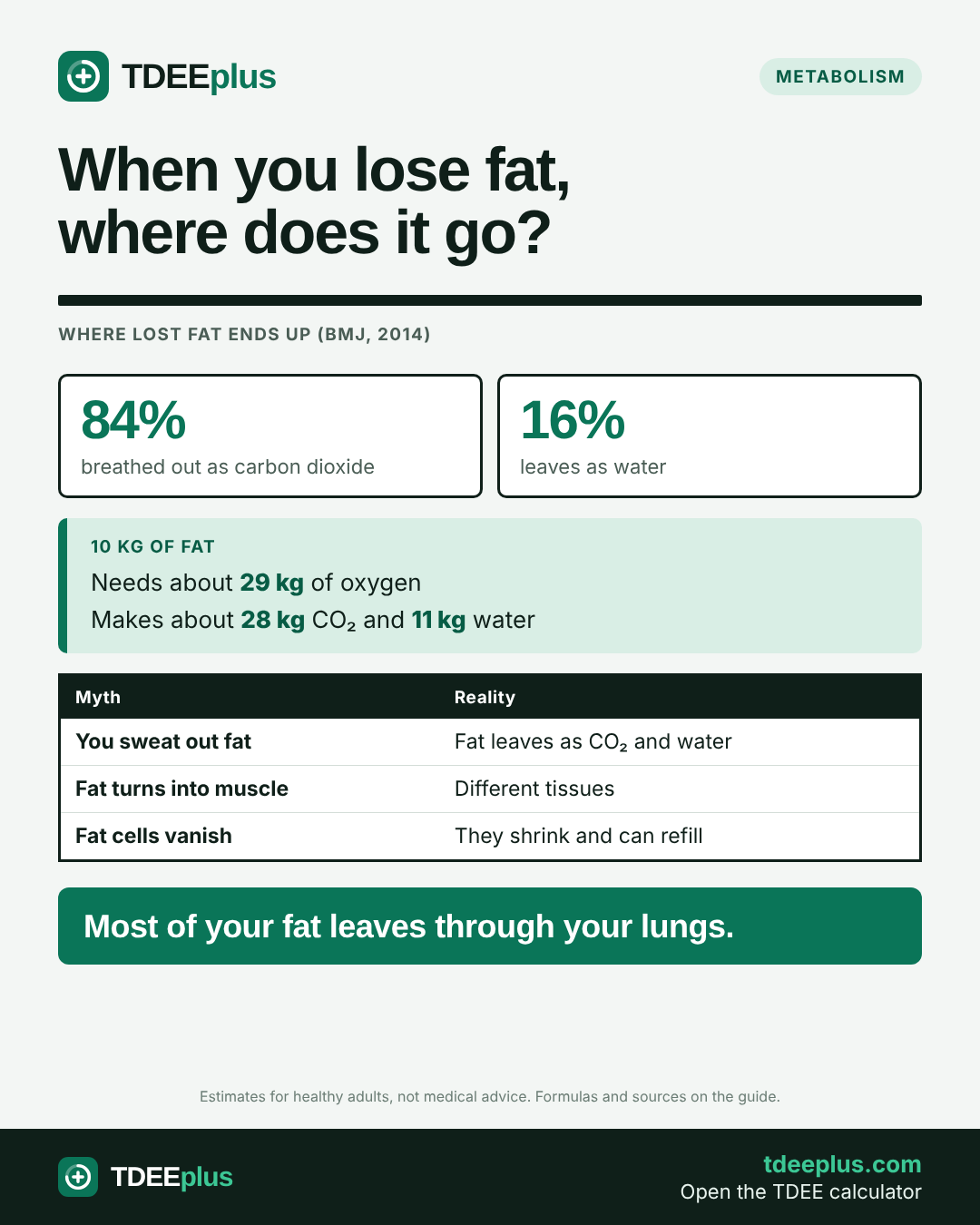
When you lose fat, most of it leaves your body through your lungs as carbon dioxide. A 2014 BMJ analysis found that about 84 percent of the fat you lose is exhaled as carbon dioxide and the other 16 percent becomes water. Fat is not sweated out or burned into heat alone. It is chemically broken down into gas and water, and you breathe most of it out. To see your own daily burn, use the TDEE calculator.
The chemistry in plain English
Fat is made of carbon, hydrogen and oxygen. When your cells burn it for energy, it reacts with oxygen you breathe in and turns into carbon dioxide (CO₂) and water (H₂O), with energy released along the way. The CO₂ travels in your blood to the lungs and is exhaled. The water leaves through urine, sweat, breath and other fluids.
This takes weeks and months, not one gym session. Meerman and Brown also point out that the lungs are the main exit, which is why the old idea of "sweating out fat" is a myth.
Do fat cells disappear?
Not usually. Research in adults suggests the number of fat cells is largely set by adolescence and stays fairly stable, with a small yearly turnover. When you lose fat your cells shrink; when you gain it they fill up again. That is one reason a maintenance plan matters (how to find your real maintenance calories).
Why early weight loss feels fast
In the first week of a diet most of the drop on the scale is water and stored carbohydrate (glycogen), which holds water with it. Fat loss itself is slower. A 500-calorie daily deficit equals about 3,500 calories a week, which is roughly 0.45 kg of fat at about 7,700 calories per kilogram. That is why the scale and your fat loss can tell different stories on any given day, and why you should compare weekly averages (track and adjust week by week).
Weight loss is not the same as fat loss
The scale measures everything: fat, muscle, water, stored carbohydrate and the contents of your gut. Fat loss is only one slice of a drop in weight.
| What leaves | How fast | What to know |
|---|---|---|
| Water and glycogen | Days | Big early drops, easily regained when you eat more carbs or salt |
| Fat | Weeks to months | About 7,700 calories per kg, leaves mostly as CO₂ |
| Muscle | Depends on your plan | More likely if the deficit is large, protein is low and you do not lift |
This is why the same loss on the scale can leave different bodies. Keeping protein up and lifting weights nudges more of the loss toward fat (how to lower body fat without losing muscle).
What affects how fast fat goes
- Your deficit. A larger gap between what you eat and burn means more fat is used each day, up to the point where muscle starts to pay too.
- Your size. Bigger bodies burn more, so they can lose fat in absolute terms faster at the same relative deficit.
- Your activity. More movement raises your TDEE, which widens the gap without eating less.
- Time. There is no hack that makes fat leave overnight. The BMJ authors note that fat loss takes sustained effort, not a single workout.
What it means for your plan
| Myth | Reality |
|---|---|
| You sweat out fat | Sweat is mostly water and salt. Fat leaves as CO₂ and water. |
| Fat turns into muscle | They are different tissues. You can lose one and build the other. |
| Fat cells vanish | They shrink, and can refill. |
| Fast weight loss is fat loss | Early drops are mostly water and glycogen. |
- Your metabolism does the work. Your body burns calories every moment, and more of it than you might think is at rest. See what BMR means and TDEE vs BMR.
- The deficit is what matters. Work out yours in how many calories to eat to lose weight.
- Keep muscle. Lifting and protein help your body take the energy from fat rather than lean tissue. See how to lower body fat percentage.
- See your progress. The weight loss percentage calculator shows how much of your starting weight you have lost.
Find the calorie target that turns into steady fat loss.
Open the TDEE calculatorFrequently asked questions
Where does fat go when you lose weight?
Do I sweat or poop out fat?
Do fat cells disappear?
Why do I lose weight so fast in the first week?
How many calories is a kilogram of fat?
Keep reading
Sources
- Meerman R, Brown AJ. When somebody loses weight, where does the fat go? BMJ. 2014;349:g7257. doi:10.1136/bmj.g7257
- Hall KD, Sacks G, Chandramohan D, et al. Quantification of the effect of energy imbalance on bodyweight. Lancet. 2011;378(9793):826–837. PubMed 21872751
- Spalding KL, Arner E, Westermark PO, et al. Dynamics of fat cell turnover in humans. Nature. 2008;453(7196):783–787.