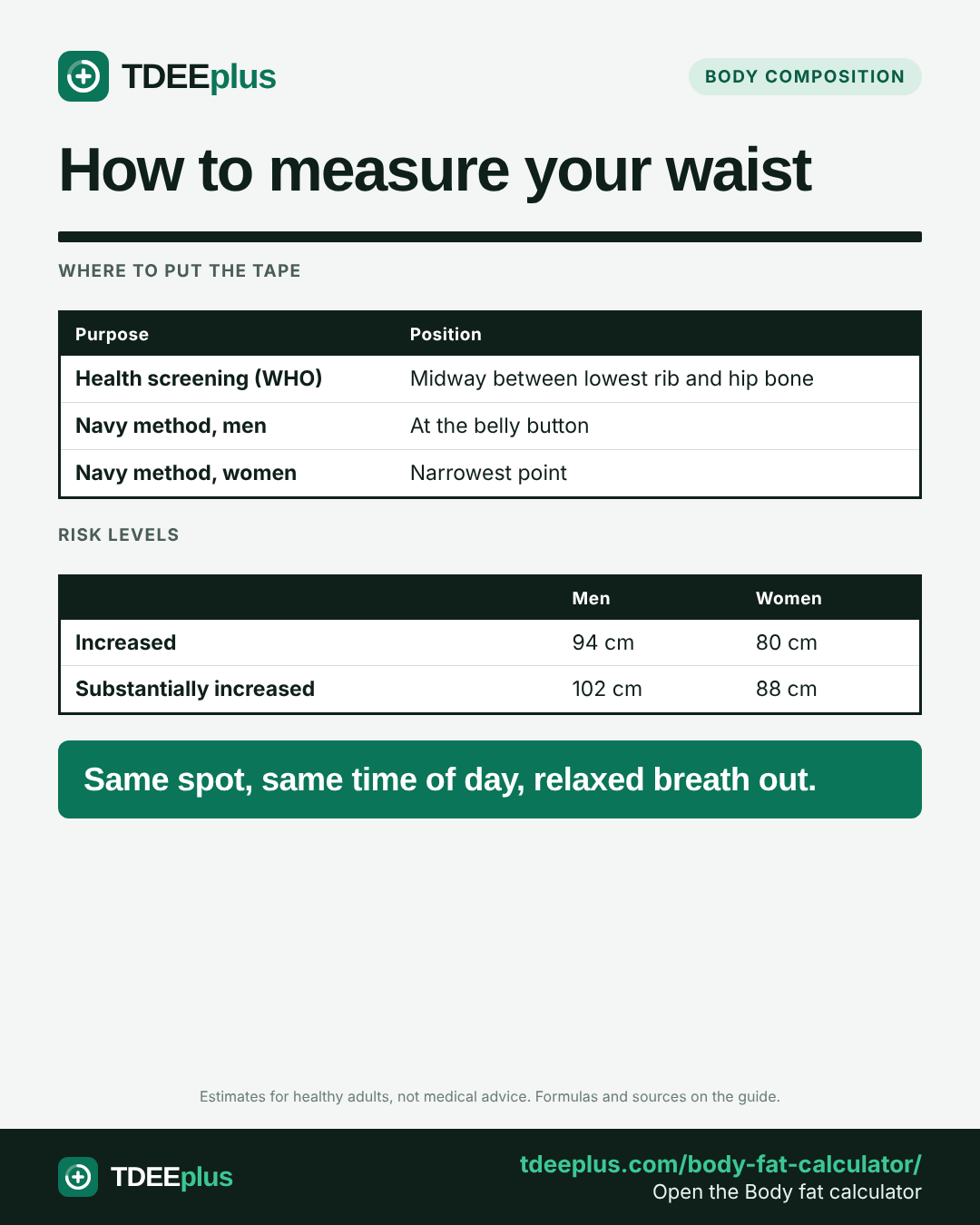
To measure your waist, stand relaxed, find the midpoint between the bottom of your lowest rib and the top of your hip bone, wrap a tape measure around your bare middle at that level, and read it at the end of a normal breath out. The tape should be flat and snug, not squeezing. Then use the number with the body fat calculator, the BMI calculator or the TDEE calculator to track progress.
Step by step (WHO method)
- Prepare. Measure in the morning, before eating or drinking if possible, over bare skin or thin clothing.
- Stand up straight with feet together, arms relaxed at your sides, weight even on both feet.
- Find the landmarks. Press gently to find the lowest rib and the top of your hip bone on the side of the body. The midpoint between them is your measuring level.
- Place the tape around your waist at that level, parallel to the floor, at the same height front and back.
- Breathe out normally, do not suck in, and read the number where the tape meets the zero end.
- Repeat. Take two readings. If they differ by more than 1 cm, measure again, then average them.
This follows the protocol described in the WHO's expert consultation on waist circumference. It aims to give a repeatable result, so you can compare week to week.
Different methods use different spots
The "waist" is not the same place for every purpose, which causes confusion.
| Method | Where to measure |
|---|---|
| WHO / health screening | Midpoint between lowest rib and top of the hip bone |
| US Navy body fat, men | At the belly button, level with the floor |
| US Navy body fat, women | At the narrowest point of the waist |
| Clothing size | Often at the natural waist or where trousers sit, which can differ |
If you are using a body fat calculator, follow its instructions exactly. Our body fat calculator uses the Navy method and explains each measurement.
Common mistakes
- Sucking in. This can cut several centimetres off the reading.
- Tape too tight or too loose. It should rest on the skin without denting it.
- Tape sloping. Use a mirror, or ask a helper, to check it is level.
- Different spot each time. Mark your landmarks mentally and use the same ones every time.
- Measuring after a big meal. It can add a little.
- Measuring over thick clothing.
What the number means
The WHO describes action levels for waist circumference. Above these, risk of metabolic problems such as type 2 diabetes and heart disease rises.
| Waist | Men | Women |
|---|---|---|
| Increased risk | 94 cm (37 in) or more | 80 cm (31.5 in) or more |
| Substantially increased risk | 102 cm (40 in) or more | 88 cm (34.5 in) or more |
These cut-offs were developed mainly on European populations, and risk starts at lower values for many Asian groups. Waist-to-height ratio (waist ÷ height) is simpler: a value under 0.5 is a common target. For example, an 88 cm waist at 178 cm tall gives 88 ÷ 178 = 0.49. Our BMI calculator includes waist-to-height ratio if you enter your waist.
Using it to track progress
- Measure every two to four weeks, not daily. Changes are slow.
- Pair it with weight and photos. A falling waist with steady weight can mean you are losing fat and gaining muscle (does muscle weigh more than fat).
- Remember you cannot spot-reduce belly fat with exercise alone; see the best way to burn belly fat and how to burn visceral fat.
- Compare your estimated body fat with normal body fat ranges or the 15% body fat guide.
Use your waist, neck and height to estimate body fat.
Open the body fat calculatorFrequently asked questions
Where exactly should I measure my waist?
Should I measure at my belly button?
Should I breathe in or out?
What is a healthy waist size?
How often should I measure?
Keep reading
Sources
- World Health Organization. Waist Circumference and Waist–Hip Ratio: Report of a WHO Expert Consultation. Geneva: WHO; 2008.
- National Institute for Health and Care Excellence. Obesity: identification, assessment and management (CG189), waist-to-height ratio recommendations, 2022 update. nice.org.uk
- Hodgdon JA, Beckett MB. Prediction of Percent Body Fat for U.S. Navy Men and Women from Body Circumferences and Height. Report 84-11 and 84-29. Naval Health Research Center; 1984.