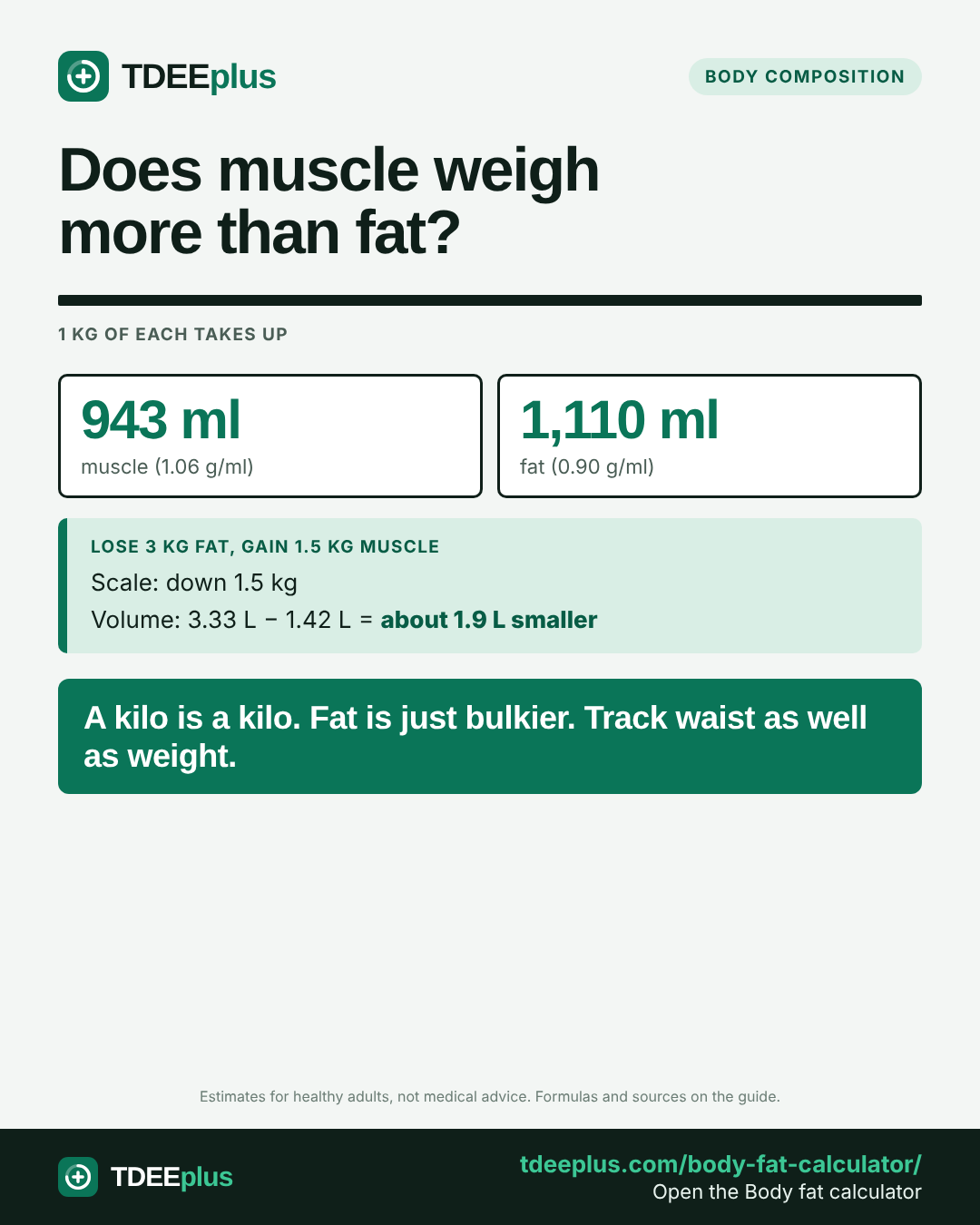
No: a kilogram of muscle weighs exactly the same as a kilogram of fat. The reason people say otherwise is density. Muscle is denser, so the same weight takes up about 15 percent less space. That is why you can look leaner and fit smaller clothes without the scale moving. To see this in your own numbers, estimate body fat with the body fat calculator and set your calories with the TDEE calculator.
The density maths
Skeletal muscle has a density of about 1.06 g/ml and body fat about 0.90 g/ml. Volume is weight divided by density.
| 1 kg of... | Density | Volume |
|---|---|---|
| Muscle | about 1.06 g/ml | about 943 ml |
| Fat | about 0.90 g/ml | about 1,110 ml |
So 1 kg of muscle takes up 943 ÷ 1,110 = 0.85 of the space of 1 kg of fat, about 15 percent less. The difference is real but modest. Muscle is not "heavy" in any magical way, and a small gain in muscle will not hide large changes elsewhere.
A worked example
This is why people on a recomposition plan often say "I weigh the same but I look different". It is also why the scale is a poor judge of fat loss when you also train.
Where the myth comes from
"Muscle weighs more than fat" is shorthand for "muscle is denser than fat". The saying persists because it is true in a practical sense: a lean, muscular person is often heavier than their size suggests, and a person with more body fat looks bigger at the same weight. Take 5 lb (2.27 kg) of each. Fat fills 2.27 ÷ 0.90 = 2.52 litres, while muscle fills 2.27 ÷ 1.06 = 2.14 litres, or about 0.38 litres less. Same weight, different shape.
Why the scale misleads
- Muscle gain offsets fat loss on the scale, especially for beginners.
- Water and glycogen shift daily, and more when you change carbs or start training (where does fat go when you lose weight).
- Food in the gut, salt and hormones add a kilogram or two for a few days.
If the scale seems stuck, check other measures before deciding the plan has failed; see weight loss plateau.
Better ways to track progress
| Measure | What it shows | How often |
|---|---|---|
| Weekly average weight | Overall trend | Daily weigh-ins, weekly average |
| Waist | Central fat change | Every 2 to 4 weeks (how to measure your waist) |
| Body fat estimate | Fat versus lean change, roughly | Every 4 weeks, same method |
| Photos | Visible changes | Every 4 weeks, same light and pose |
| Strength | Muscle and skill | Each session |
Compare your body fat to ranges in normal body fat for women and the guides on 12% and 15% body fat. The FFMI calculator shows your lean mass relative to height.
Can you lose fat and build muscle together?
Yes, in the right situations: new lifters, people returning to training, and people with more fat to lose, as long as protein is high and training is progressive. It is slower for advanced lifters, who often do better with separate phases (bulking vs cutting). Read can you build muscle in a calorie deficit for the evidence.
Estimate your body fat and track it alongside your weight.
Open the body fat calculatorFrequently asked questions
Does muscle weigh more than fat?
Why did I gain weight but my clothes fit better?
How much denser is muscle than fat?
Can I lose fat and gain muscle at the same time?
What is better than the scale to track progress?
Keep reading
Sources
- Mendez J, Keys A. Density and composition of mammalian muscle. Metabolism. 1960;9:184–188.
- Brozek J, Grande F, Anderson JT, Keys A. Densitometric analysis of body composition: revision of some quantitative assumptions. Ann N Y Acad Sci. 1963;110:113–140.
- Barakat C, Pearson J, Escalante G, Campbell B, De Souza EO. Body recomposition: can trained individuals build muscle and lose fat at the same time? Strength Cond J. 2020;42(5):7–21.