At 15 percent body fat, a man typically looks lean and athletic, and a woman looks very lean. Muscle shape shows, especially in the shoulders and arms. But a percentage is not a picture: the same number looks different depending on muscle, height and how fat is distributed. To estimate your own, use the body fat calculator.
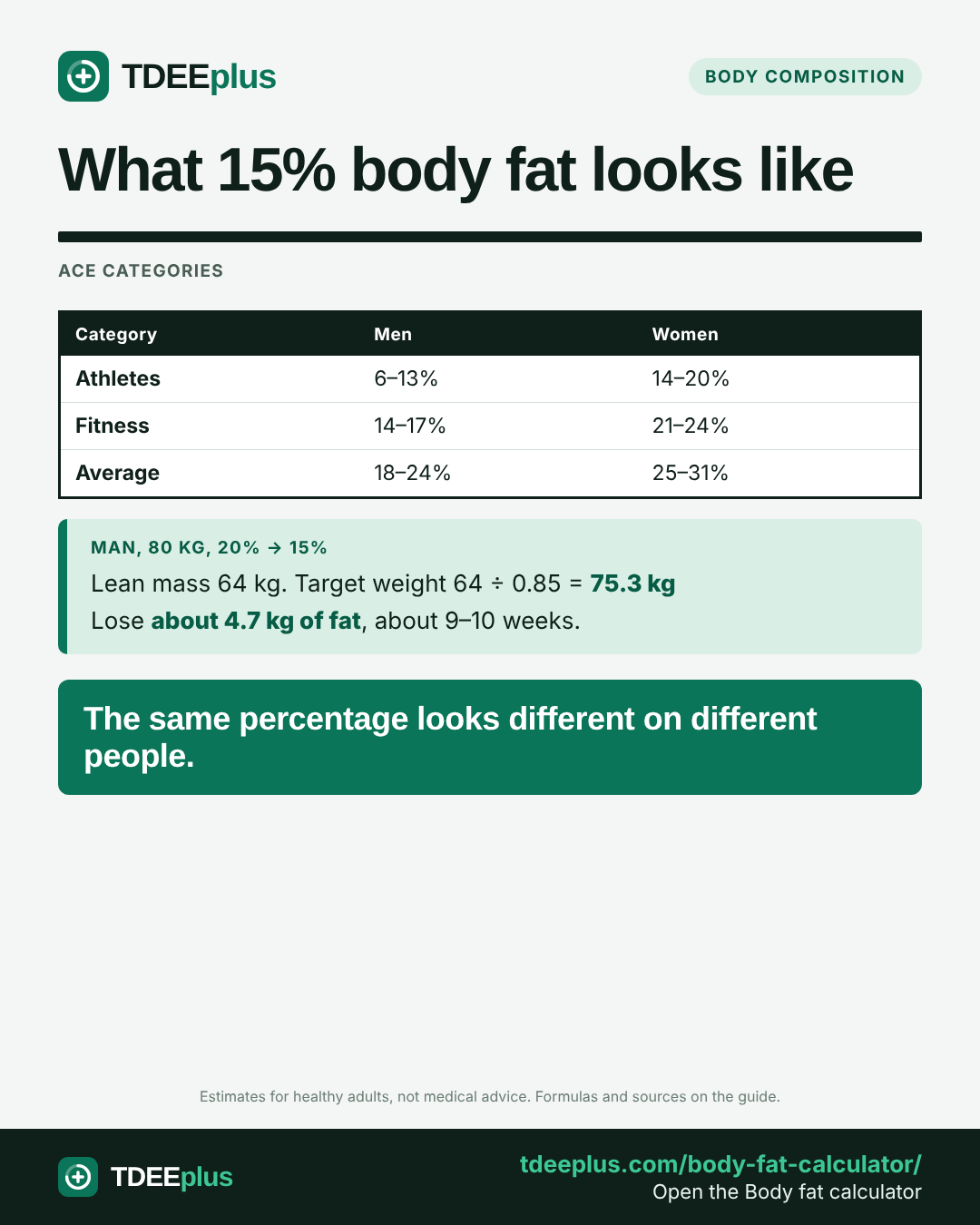
Where 15% sits
The American Council on Exercise groups body fat into these ranges:
| Category | Men | Women |
|---|---|---|
| Essential fat | 2 to 5% | 10 to 13% |
| Athletes | 6 to 13% | 14 to 20% |
| Fitness | 14 to 17% | 21 to 24% |
| Average | 18 to 24% | 25 to 31% |
| Obese | 25% and above | 32% and above |
So 15 percent is in the fitness range for men and in the athlete range for women. These categories are general estimates; a doctor can say what suits an individual. For clinical health ranges by age, see Gallagher and colleagues, who suggest roughly 8 to 20 percent for men aged 20 to 39 and 21 to 33 percent for women of the same age.
What it can look like on a man
- Clear shoulder and arm definition, with visible separation between muscles in good light.
- Upper abs may be faintly visible when flexed or lit from the side. They are often not sharp.
- A waist that is trim but not "shredded". Lower abs and vein visibility are usually found at about 10 to 12 percent (what 12% body fat looks like).
- Often described as a "beach body" look: lean, not extreme.
What it can look like on a woman
- Very lean, with visible muscle definition in the arms, shoulders and legs.
- Less fat on the hips and thighs than most women carry. Women store more fat there for reproductive health.
- For many women this is hard to maintain, and it can disrupt periods and bone health if energy intake is too low. See normal body fat percentage for women.
Why the same number looks different
- Muscle mass. A muscular person at 15% looks harder than a less muscular person at 15%. Check with the FFMI calculator.
- Fat distribution. Some people carry fat at the waist, others on the hips, thighs or arms.
- Height and frame. The same percentage on a taller person looks different.
- Lighting, pump and posture. Gym lighting and a post-workout pump can add or remove definition.
- Measurement error. Home methods, such as tape measures and smart scales, can be off by several points. The tape method is explained in how to measure your waist, and DEXA is covered in DEXA scan cost.
How to get to 15%: a worked example
- Set a moderate deficit with the cutting calculator.
- Keep protein high and lift weights to protect lean mass (how to lower body fat percentage).
- Track waist, photos and strength alongside weight (does muscle weigh more than fat).
- Recalculate your TDEE as you lose weight (TDEE calculator).
Lean is not the same as healthy or happy. If you are pursuing a very low body fat and notice fatigue, poor sleep, missed periods or food preoccupation, speak to a doctor.
Estimate your body fat from tape measurements.
Open the body fat calculatorFrequently asked questions
What does 15% body fat look like on a man?
What does 15% body fat look like on a woman?
Is 15% body fat healthy?
Why does my 15% not look like the photos?
How long to go from 20% to 15%?
Keep reading
Sources
- American Council on Exercise. Percent body fat norms for men and women (ACE body composition categories). acefitness.org.
- Gallagher D, Heymsfield SB, Heo M, et al. Healthy percentage body fat ranges: an approach for developing guidelines based on body mass index. Am J Clin Nutr. 2000;72(3):694–701. PubMed 10966886
- Mountjoy M, Sundgot-Borgen JK, Burke LM, et al. IOC consensus statement on relative energy deficiency in sport (RED-S): 2018 update. Br J Sports Med. 2018;52(11):687–697.