The foods highest in saturated fat are coconut and palm oils, butter, lard, full-fat cheese, cream, fatty red meat, poultry skin and many baked or fried foods. The US Dietary Guidelines say to keep saturated fat under 10 percent of calories, about 22 g on 2,000 calories, while the American Heart Association suggests under 6 percent, about 13 g. See where you land by setting your fat grams with the macro calculator after finding your calories with the TDEE calculator.
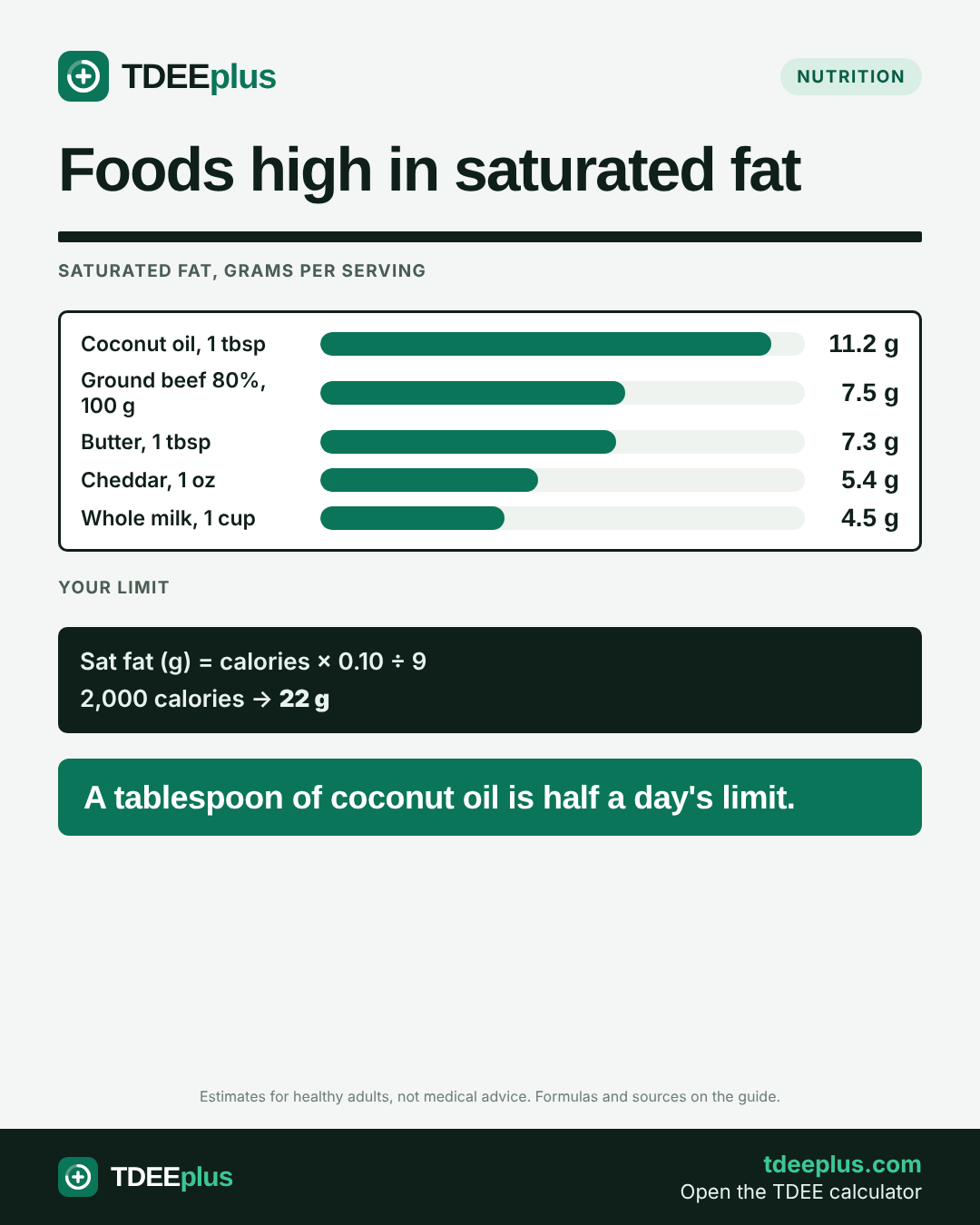
Saturated fat per serving
Values are rounded from USDA FoodData Central and vary by brand.
| Food | Serving | Saturated fat | % of a 22 g limit |
|---|---|---|---|
| Coconut oil | 1 tbsp (13.6 g) | about 11.2 g | about 51% |
| Butter | 1 tbsp (14 g) | about 7.3 g | about 33% |
| Palm oil | 1 tbsp | about 6.7 g | about 30% |
| Cheddar cheese | 1 oz (28 g) | about 5.4 g | about 25% |
| Heavy cream | 1 tbsp (15 g) | about 3.5 g | about 16% |
| Whole milk | 1 cup | about 4.5 g | about 20% |
| Ground beef, 80% lean, cooked | 100 g | about 7.5 g | about 34% |
| Egg, large | 1 | about 1.6 g | about 7% |
| Olive oil | 1 tbsp | about 1.9 g | about 9% |
Notice how quickly the fats add up. A tablespoon of coconut oil uses about half of a 22 g day, and a few slices of cheese and a buttered pan can do the rest. By comparison, olive oil has the same calories per tablespoon as butter but much less saturated fat. See saturated vs unsaturated fat for why that matters.
Daily limits
- US Dietary Guidelines: less than 10% of calories (about 22 g on 2,000 calories). The 2025–2030 edition keeps this limit.
- American Heart Association: less than 6% of calories (about 13 g on 2,000 calories).
- FDA Daily Value: 20 g on the label.
For a full explanation of limits and how to hit them, read how much saturated fat per day is OK.
Easy swaps
- Cook with olive or rapeseed (canola) oil instead of butter, coconut oil or lard.
- Choose leaner cuts of meat and remove poultry skin.
- Use low-fat or nonfat yoghurt and milk where you are happy with the taste.
- Use less cheese, but choose strongly flavoured types so a little goes further.
- Replace some meat with fish, beans or lentils (see high protein grocery list).
The evidence supports swapping, not just cutting: a Cochrane review of 15 trials found a 17% lower risk of combined cardiovascular events when saturated fat was reduced, with benefits seen when it was replaced by polyunsaturated fat or carbohydrate. Effects on overall mortality were small or none, so keep the aim practical: lower, not zero.
Fitting it into your fat macro
Your total fat target and your saturated fat limit are separate numbers. If your fat goal is 70 g and your saturated limit is 22 g, then at most about a third of your fat can be saturated. Choose mostly unsaturated sources such as fish, olive oil, nuts and avocado. For tracking tips see how to read a nutrition facts label, and for choosing a split read macro splits explained.
People with high cholesterol or heart disease may be advised a lower limit. Check with your doctor or dietitian.
Set your total fat grams, then keep saturated fat to a third or less.
Open the macro calculatorFrequently asked questions
What foods are highest in saturated fat?
How much saturated fat is too much?
Is coconut oil healthy?
Do I have to avoid all saturated fat?
What should I replace saturated fat with?
Keep reading
Sources
- American Heart Association. Saturated fats. heart.org.
- U.S. Department of Agriculture and U.S. Department of Health and Human Services. Dietary Guidelines for Americans, 2025–2030. Released January 2026. dietaryguidelines.gov.
- Hooper L, Martin N, Jimoh OF, Kirk C, Foster E, Abdelhamid AS. Reduction in saturated fat intake for cardiovascular disease. Cochrane Database Syst Rev. 2020;(8):CD011737. cochrane.org/evidence/CD011737.
- U.S. Department of Agriculture, Agricultural Research Service. FoodData Central. fdc.nal.usda.gov. Values in this guide are rounded from USDA entries for the foods named; brands and preparation change them.
- U.S. Food and Drug Administration. How to understand and use the Nutrition Facts label. fda.gov.