The Mifflin-St Jeor equation estimates how many calories you burn at rest, your basal metabolic rate (BMR), from your weight, height, age and sex. It is the formula behind our BMR calculator and TDEE calculator. Published in 1990, it is widely recommended as the best general-purpose equation for healthy adults.
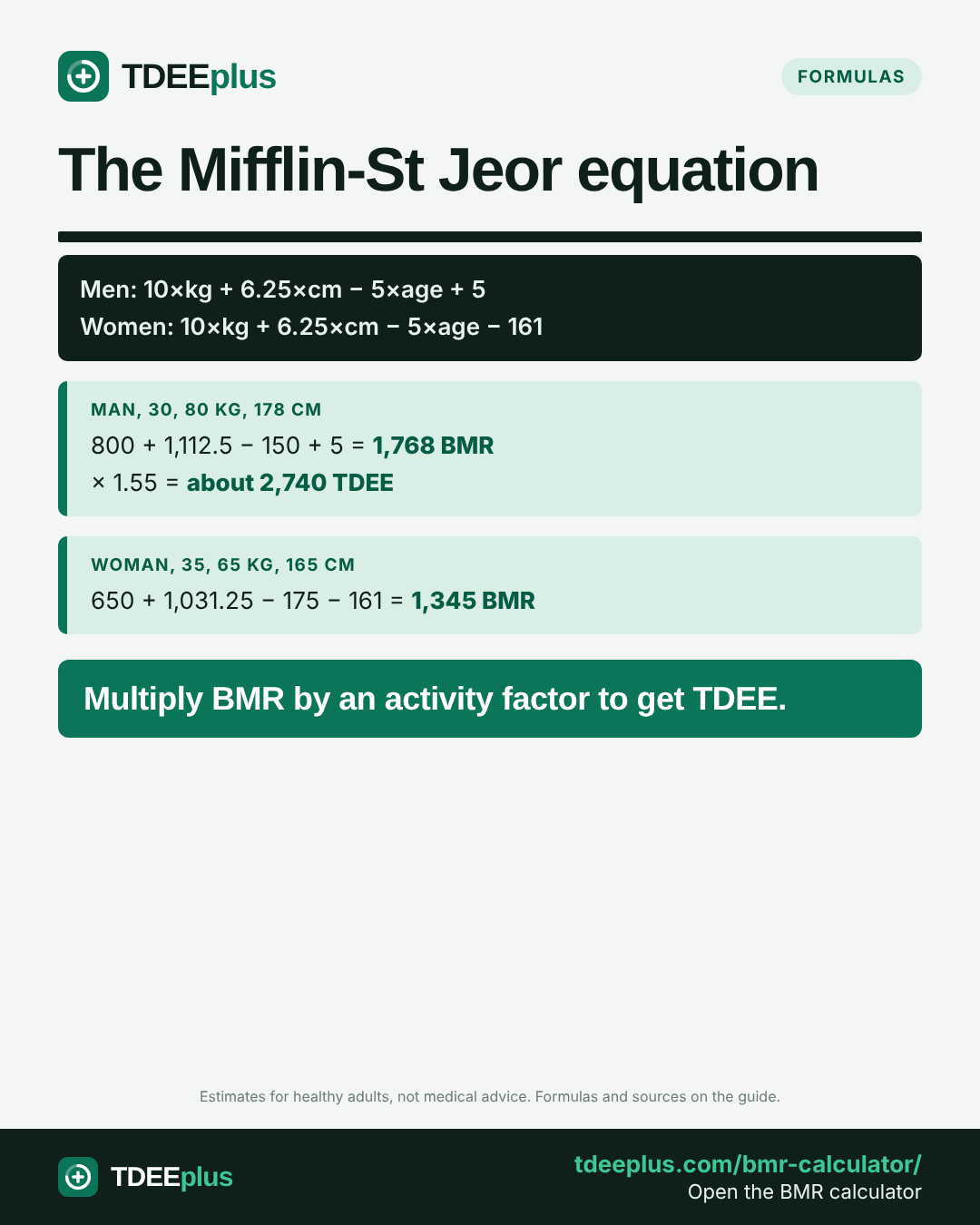
The formula
In US units, the same equation becomes:
The result is in calories (kilocalories) per day. Read how units relate in kilocalories to calories.
What each term does
| Term | Effect | Why |
|---|---|---|
| 10 × weight | Each extra kg adds 10 calories | A larger body has more tissue to maintain |
| 6.25 × height | Each extra cm adds 6.25 calories | Taller people have more surface area and tissue |
| −5 × age | Each year subtracts 5 calories | Lean mass tends to fall with age |
| +5 or −161 | The sex constant | Men on average have more lean mass at the same size |
Worked examples
From BMR to TDEE
BMR is only the energy used at rest. To get total daily needs, multiply by an activity factor:
| Activity level | Factor |
|---|---|
| Sedentary (desk job, little exercise) | 1.2 |
| Lightly active (1 to 3 workouts a week) | 1.375 |
| Moderately active (3 to 5 workouts) | 1.55 |
| Very active (6 to 7 workouts) | 1.725 |
| Athlete or physical job | 1.9 |
Choosing the level is where most errors occur. See how to choose your activity level and how to calculate TDEE.
How accurate is it?
In a 2005 systematic review in the Journal of the American Dietetic Association, Frankenfield and colleagues compared common equations against measured resting metabolic rate and found Mifflin-St Jeor predicted within 10 percent of the measured value for a larger share of people than the others. The original 1990 study was based on 498 healthy adults aged 19 to 78, with a range of body sizes. It is a good estimate, not an exact measure: individuals can differ by 10 percent or more (see what is BMR).
When to use something else
- You know your body fat. Katch-McArdle uses lean mass and can suit muscular or very lean people (Katch-McArdle calculator).
- You are under 18, pregnant or very ill. The equation was not built for you.
- You have a medical condition affecting metabolism, such as thyroid disease. Ask your doctor.
To compare equations, read which TDEE formula is best. Test your result against the scale for a few weeks and adjust (track and adjust calories).
Calculate your BMR with the Mifflin-St Jeor equation.
Open the BMR calculatorFrequently asked questions
What is the Mifflin-St Jeor equation?
What is the formula?
Why is it better than Harris-Benedict?
Is Mifflin-St Jeor accurate for athletes?
Do I multiply the result by anything?
Keep reading
Sources
- Mifflin MD, St Jeor ST, Hill LA, Scott BJ, Daugherty SA, Koh YO. A new predictive equation for resting energy expenditure in healthy individuals. Am J Clin Nutr. 1990;51(2):241–247. PubMed 2305711
- Frankenfield D, Roth-Yousey L, Compher C. Comparison of predictive equations for resting metabolic rate in healthy nonobese and obese adults: a systematic review. J Am Diet Assoc. 2005;105(5):775–789. PubMed 15883556
- Roza AM, Shizgal HM. The Harris Benedict equation reevaluated: resting energy requirements and the body cell mass. Am J Clin Nutr. 1984;40(1):168–182. PubMed 6741850