A 1,200-calorie diet is a low intake that suits only some people, usually smaller, older or sedentary women, and only with care. For many adults it is a very large deficit. Before you follow a plan like this, find out your actual maintenance with the TDEE calculator and compare it with the 1,200 target. The rest of this guide shows a sample day and explains who it is, and is not, for. It is general information, not medical advice.
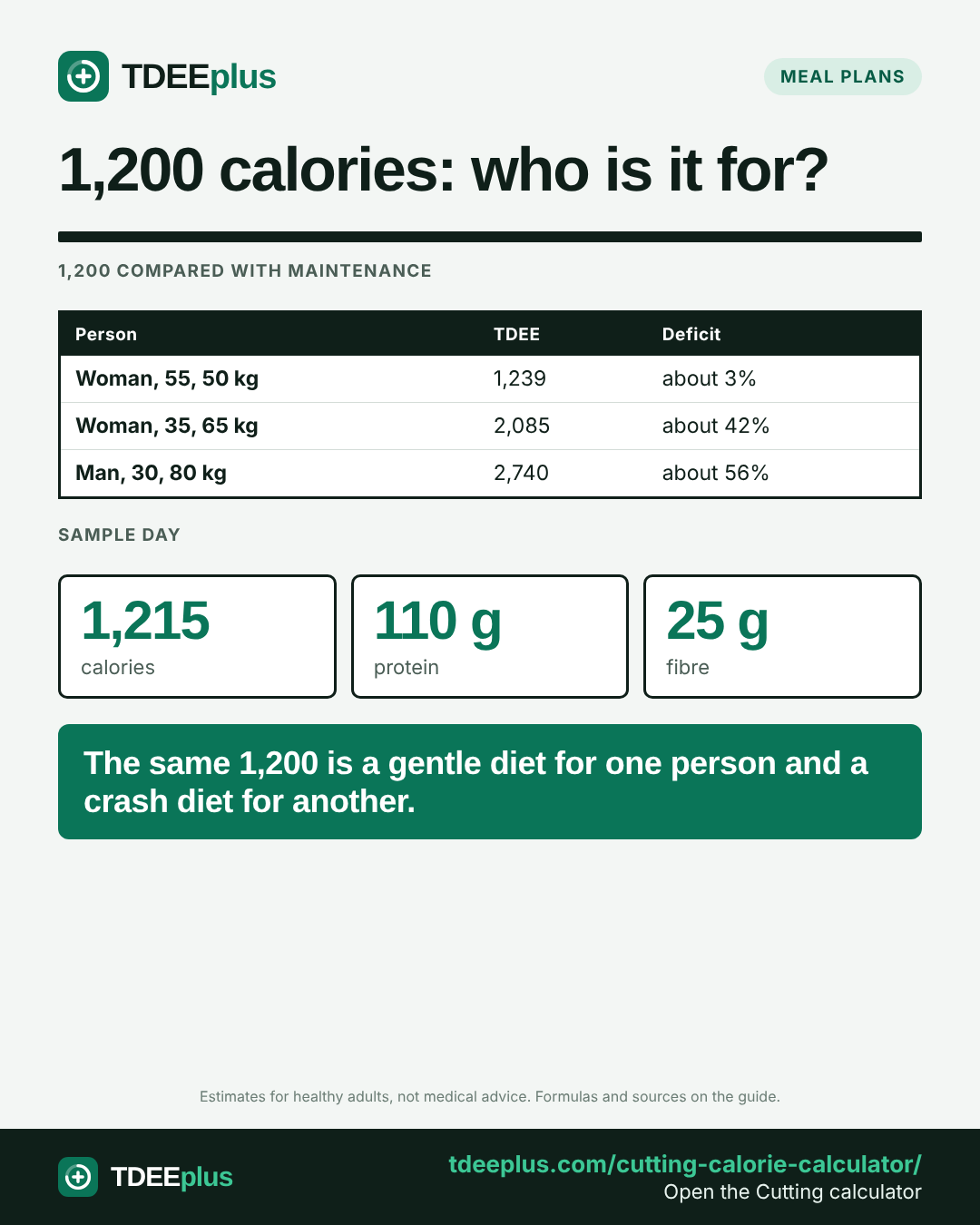
Who 1,200 calories might suit, and who should avoid it
1,200 calories is a commonly cited floor for women dieting without supervision, with 1,500 for men. Whether it is appropriate depends on your maintenance, which is where the number can mislead.
| Person | Maintenance (TDEE) | 1,200 compared with maintenance |
|---|---|---|
| Woman, 55, 50 kg, 155 cm, sedentary | about 1,239 | Close to maintenance, a deficit of about 3% |
| Woman, 35, 65 kg, 165 cm, moderately active | about 2,085 | A deficit of 885, or about 42% |
| Man, 30, 80 kg, 178 cm, moderately active | about 2,740 | A deficit of about 56%, far too aggressive |
Calculated with the Mifflin-St Jeor equation (see the Mifflin-St Jeor equation explained). The same 1,200 calories is no deficit for one person and a crash diet for another. A moderate deficit of 10 to 25 percent of your TDEE is generally more sustainable (calorie restriction for weight loss).
Speak to a doctor first, and avoid it, if you:
- are under 18, pregnant or breastfeeding;
- have or have had an eating disorder, or counting calories worsens your relationship with food;
- have diabetes, kidney disease, heart disease or any condition that needs medication;
- train hard or play sport, since energy needs are much higher.
Diets under about 800 calories a day should only be done under medical supervision.
A sample day, with the numbers
This day is built to give plenty of protein and fibre in a small budget. Values are rounded from USDA FoodData Central.
| Meal | Foods | Calories | Protein |
|---|---|---|---|
| Breakfast | 2 large eggs scrambled in 1 tsp olive oil, 1 slice whole-wheat toast (30 g), 1 small orange (130 g) | about 320 | about 17.5 g |
| Lunch | 100 g cooked chicken breast, 60 g spinach, 1 tomato (100 g), 80 g cooked lentils, 2 tsp (9 g) olive oil dressing | about 370 | about 41 g |
| Snack | 170 g plain nonfat Greek yoghurt, 1 apple (150 g) | about 180 | about 18 g |
| Dinner | 120 g baked cod, 150 g steamed broccoli, 150 g boiled potatoes, 1 tsp olive oil | about 350 | about 34 g |
| Day total | about 1,215 | about 110 g |
This is a single example day, not a rigid prescription. For a full week, see the 7-day diet plan for weight loss, which has more variety.
Making a low-calorie day work
- Prioritise protein. Aim for at least 1.2 g per kg of body weight, or more, to protect muscle (how much protein do you need).
- Choose filling, nutrient-dense foods. See high volume low calorie foods and what is satiety.
- Measure oils and spreads. They are the biggest hidden calories (portion control).
- Include fibre and vegetables every meal (highest fibre foods).
- Limit how long you do it. A very low intake is hard to keep and can lead to missed nutrients; review it with a professional.
Risks of eating too little
- Loss of muscle along with fat, and a bigger drop in energy expenditure.
- Fatigue, irritability, poor sleep and trouble concentrating.
- Missed nutrients such as iron, calcium and vitamins.
- Rebound overeating and weight regain.
- Gallstones with rapid weight loss, and menstrual changes in women.
If a plan makes you feel unwell, stop and speak to a doctor. Rather than 1,200 by default, set a target based on your own numbers using the cutting calculator, and read a weight loss plan for a complete approach.
Get a deficit that fits your own maintenance calories.
Open the cutting calculatorFrequently asked questions
Is a 1200 calorie diet safe?
Who might eat 1,200 calories?
How much weight will I lose on 1,200 calories?
Can I eat 1,200 calories and exercise?
Is there a better way to lose weight?
Keep reading
Sources
- Mifflin MD, St Jeor ST, Hill LA, Scott BJ, Daugherty SA, Koh YO. A new predictive equation for resting energy expenditure in healthy individuals. Am J Clin Nutr. 1990;51(2):241–247. PubMed 2305711
- Jensen MD, Ryan DH, Apovian CM, et al. 2013 AHA/ACC/TOS guideline for the management of overweight and obesity in adults. Circulation. 2014;129(25 Suppl 2):S102–S138. PubMed 24222017
- Centers for Disease Control and Prevention. Losing Weight: gradual, steady weight loss of about 1 to 2 pounds per week. cdc.gov.
- U.S. Department of Agriculture, Agricultural Research Service. FoodData Central. fdc.nal.usda.gov. Values in this guide are rounded from USDA entries for the foods named; brands and preparation change them.
- National Heart, Lung, and Blood Institute. Aim for a Healthy Weight: calorie levels for weight loss (1,200 to 1,500 calories for most women and 1,500 to 1,800 for most men). nhlbi.nih.gov.