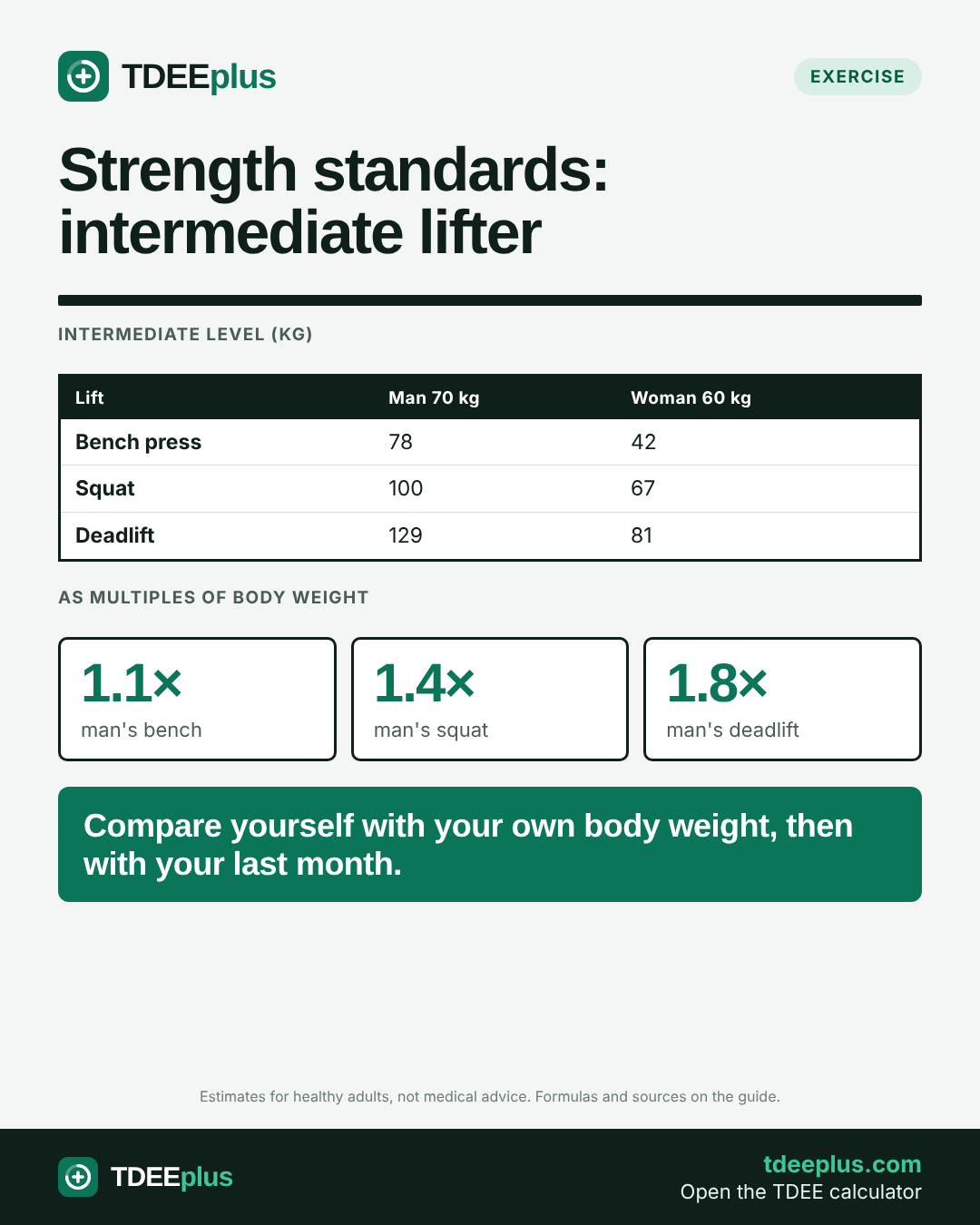
Strength standards compare your lifts with those of other people your size. For a 70 kg man, a bench press of about 78 kg, a squat of 100 kg and a deadlift of 129 kg sit around the intermediate level, stronger than half of lifters in the data. Strength is also tied to body composition: use the body fat calculator and the FFMI calculator to see how your lean mass compares, and the TDEE calculator to fuel your training.
How to read the tables
The figures come from StrengthLog, which built percentile-based standards from the training logs of its users: 17,296 men and 7,112 women for the bench press, about 15,300 men and 6,800 women for the squat, and about 15,100 men and 6,600 women for the deadlift. The levels are:
- Beginner: stronger than about 5% of lifters
- Novice: about 25%
- Intermediate: about 50%
- Advanced: about 75%
- Elite: about 95%
These are logs from gym-goers, not verified competition results, so use them as a guide. All weights are one-rep maximum equivalents in kilograms. If you do not know your max, see the one-rep max formula in the section below.
Men, selected body weights (kg)
| Lift, body weight | Beginner | Novice | Intermediate | Advanced | Elite |
|---|---|---|---|---|---|
| Bench press, 70 kg | 46 | 64 | 78 | 94 | 127 |
| Bench press, 80 kg | 54 | 74 | 90 | 109 | 143 |
| Squat, 70 kg | 51 | 80 | 100 | 120 | 157 |
| Squat, 80 kg | 57 | 89 | 112 | 137 | 180 |
| Deadlift, 70 kg | 66 | 100 | 129 | 155 | 192 |
| Deadlift, 80 kg | 73 | 111 | 142 | 172 | 216 |
Women, selected body weights (kg)
| Lift, body weight | Beginner | Novice | Intermediate | Advanced | Elite |
|---|---|---|---|---|---|
| Bench press, 60 kg | 22 | 33 | 42 | 51 | 75 |
| Bench press, 70 kg | 24 | 35 | 45 | 56 | 83 |
| Squat, 60 kg | 24 | 48 | 67 | 85 | 117 |
| Squat, 70 kg | 26 | 51 | 70 | 90 | 127 |
| Deadlift, 60 kg | 38 | 64 | 81 | 103 | 135 |
| Deadlift, 70 kg | 39 | 69 | 86 | 111 | 145 |
Other body weights have their own rows on the StrengthLog site. Heavier lifters lift more in total but less per kilogram of body weight, which is why the standards are shown by body weight, not as one number.
Estimating your one-rep max
You can estimate a max from a set of a few reps. A widely used formula is the Epley equation: 1RM = weight × (1 + reps ÷ 30). For example, 80 kg for 5 reps gives 80 × (1 + 5 ÷ 30) = 80 × 1.167 = 93 kg. Estimates become less reliable above about 10 reps. Treat the result as a rough number, and only test a true max with a spotter and a thorough warm-up.
Moving up a level
- Train the lifts regularly. Two to three sessions a week for each main lift is enough for most people.
- Add load slowly. Beginners can add small amounts each week; progress slows as you advance.
- Eat enough protein and calories. Gaining strength and muscle is easier with a small surplus (bulking calculator); see how much protein you need.
- Recover. Sleep and rest days matter as much as the programme.
Strength can still be built in a deficit, especially by beginners; see can you build muscle in a calorie deficit and bulking vs cutting. For tracking progress beyond the scale, see does muscle weigh more than fat.
Limits of any standard
Limb length, injury history, training age and technique all change what a given number means. Compare yourself mostly with your past self. If you have a health condition, or are over 40 and new to lifting, check with a doctor before testing maximal lifts.
Check your body fat to see how your strength fits your body composition.
Open the body fat calculatorFrequently asked questions
What are strength standards?
Where do these numbers come from?
How strong should a beginner be?
Do I need to know my one-rep max?
Are these standards for natural lifters?
Keep reading
Sources
- StrengthLog. Strength standards for the bench press, squat and deadlift (percentile-based, from the training logs of StrengthLog users). strengthlog.com.
- Jäger R, Kerksick CM, Campbell BI, et al. International Society of Sports Nutrition Position Stand: protein and exercise. J Int Soc Sports Nutr. 2017;14:20. PubMed 28642676
- Epley B. Poundage chart. In: Boyd Epley Workout. Lincoln, NE: Body Enterprises; 1985. (Epley one-rep max formula.)