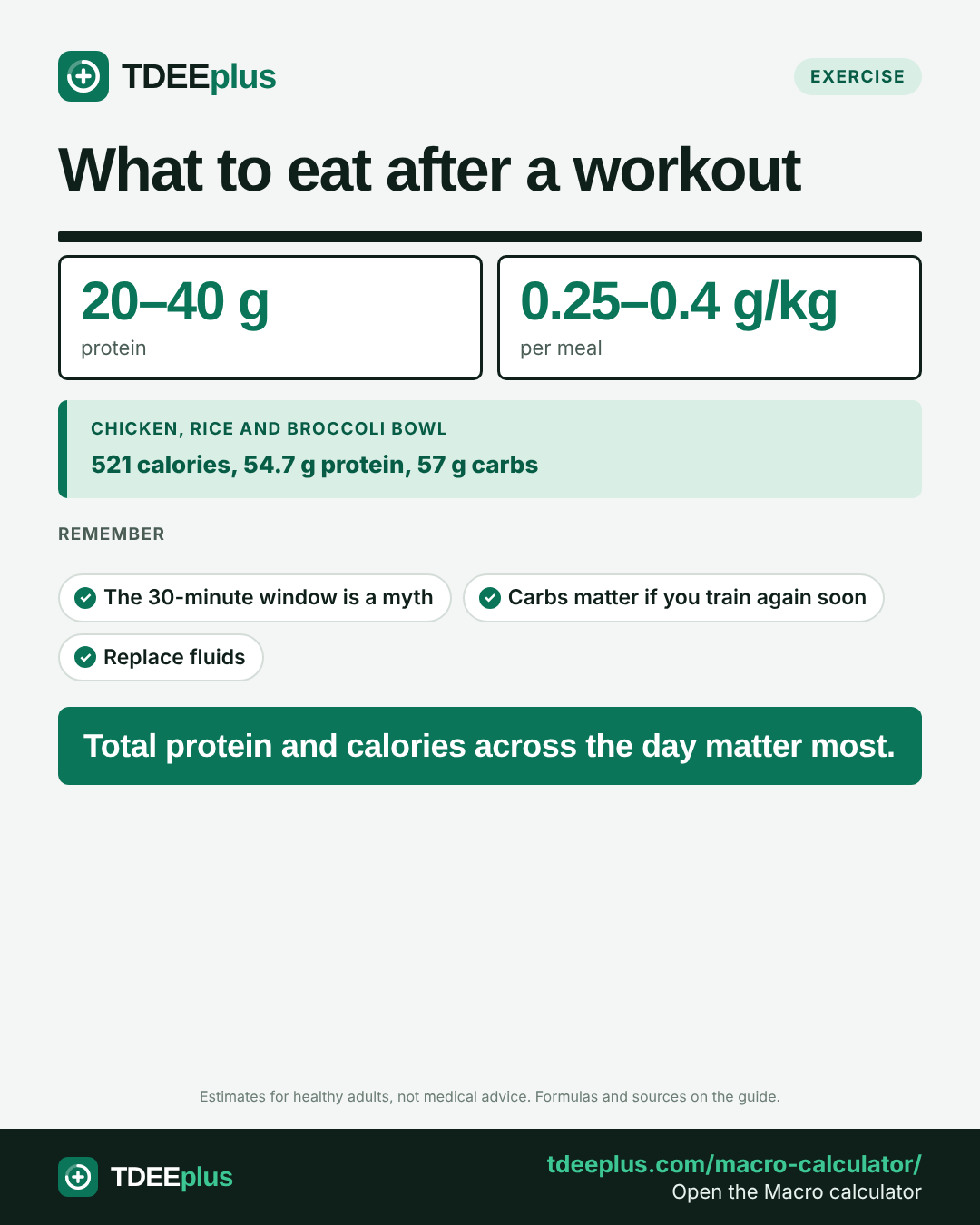
After a workout, aim for a meal or snack with about 20 to 40 g of protein, some carbohydrate and fluids. How soon you eat matters less than most people think: your total protein and calories across the day do most of the work. Start by setting your daily numbers with the macro calculator and the TDEE calculator.
Protein: how much
Studies of muscle building suggest about 0.25 to 0.4 g of protein per kg of body weight in a meal gets most of the benefit, and the International Society of Sports Nutrition suggests about 20 to 40 g after training. For an 80 kg person, 0.4 g per kg is 32 g. If you eat several protein-rich meals through the day, the post-workout meal does not have to be perfect. See how much protein you need for daily targets.
Carbohydrate: when it matters
Carbs refill the glycogen stores your muscles use. This matters if you have another hard session within about eight hours. In that case, sports nutrition guidelines suggest roughly 1.0 to 1.2 g of carbohydrate per kg of body weight per hour for the first four hours. That is about 80 to 96 g an hour for an 80 kg athlete. If you train once a day, normal meals will restore glycogen by the next day. Learn what to eat beforehand in what to eat before exercise.
How much does timing matter?
- The old idea of a 30-minute "anabolic window" has not held up. The window is wider, perhaps several hours, especially if you ate protein before training.
- Eat sooner if you trained fasted, or are doing a second session soon.
- For most people, eating a normal meal within a couple of hours is fine.
Fluids
Replace what you lost in sweat. A common guide is about 1.25 to 1.5 litres of fluid for each kilogram of body weight lost during the session, since you keep losing fluid in urine. Weigh yourself before and after a long, sweaty workout to see how much you lose. Add salt through food if you have sweated a lot.
Meal ideas with macros
Values are rounded from USDA data and are approximate.
| Meal | Calories | Protein | Carbs |
|---|---|---|---|
| 150 g chicken breast, 1 cup brown rice, 1 cup broccoli | about 520 | about 55 g | about 57 g |
| 250 g plain Greek yoghurt, 1 banana, 1 tbsp honey | about 315 | about 27 g | about 53 g |
| 3 eggs, 2 slices whole-wheat toast, 1 orange | about 430 | about 26 g | about 41 g |
| Shake: 1 scoop whey, 1 cup 2% milk, 1 banana | about 345 | about 33 g | about 42 g |
| 1 cup low-fat chocolate milk | about 180 to 190 | about 8 g | about 26 to 32 g |
More shake ideas are in protein shake recipes, and our high protein grocery list covers ingredients.
Match it to your goal
- Fat loss: eat the meal within your calorie target, keep protein high and do not add calories "to earn" the workout. See how to lower body fat percentage.
- Muscle gain: make sure total calories are slightly above maintenance (bulking calculator).
- Endurance training: favour more carbs, especially if you train again the same day.
- Light exercise (a walk or easy session): a normal meal is plenty (walking calorie calculator).
This guide gives general information, not personal medical advice. If you have a medical condition such as diabetes, kidney disease or a history of disordered eating, ask a doctor or dietitian. For tracking tips read how to count calories and for building lean mass see can you build muscle in a calorie deficit.
Set your daily protein and carbs, then plan your post-workout meal.
Open the macro calculatorFrequently asked questions
What should I eat after a workout?
Do I have to eat within 30 minutes?
How much protein do I need after training?
Do I need carbs after a workout?
What if I am trying to lose fat?
Keep reading
Sources
- Kerksick CM, Arent S, Schoenfeld BJ, et al. International Society of Sports Nutrition position stand: nutrient timing. J Int Soc Sports Nutr. 2017;14:33. PMC5596471
- Thomas DT, Erdman KA, Burke LM. American College of Sports Medicine joint position statement: nutrition and athletic performance. Med Sci Sports Exerc. 2016;48(3):543–568. PubMed 26891166
- Jäger R, Kerksick CM, Campbell BI, et al. International Society of Sports Nutrition Position Stand: protein and exercise. J Int Soc Sports Nutr. 2017;14:20. PubMed 28642676
- Schoenfeld BJ, Aragon AA. How much protein can the body use in a single meal for muscle-building? Implications for daily protein distribution. J Int Soc Sports Nutr. 2018;15:10.
- U.S. Department of Agriculture, Agricultural Research Service. FoodData Central. fdc.nal.usda.gov. Values in this guide are rounded from USDA entries for the foods named; brands and preparation change them.