You can build muscle in a calorie deficit, but it is easier for some people than others. Beginners, people returning after a break, and people with more body fat have the best odds, especially if they train with progressive resistance exercise and eat plenty of protein. For experienced lifters, gains are slower and separate bulking and cutting phases may work better. Work out a deficit with the cutting calculator and the TDEE calculator.
What the research shows
- A meta-analysis of 59 studies (Murphy and Koehler, 2022) found that an energy deficit reduced gains in lean mass, but deficits of about 500 calories a day or less were not associated with lean mass loss. Strength still improved in a deficit, even when lean mass did not. Nearly all the participants were beginners, so the findings may not apply to experienced lifters.
- A randomised trial (Longland and colleagues, 2016) put overweight young men on a 40 percent calorie deficit for four weeks with intense exercise. The group eating more protein (2.4 g per kg a day) gained about 1.2 kg of lean mass and lost more fat than the group on 1.2 g per kg. It was a short study in a specific group.
- A review of recomposition (Barakat and colleagues, 2020) concludes that it is possible even in trained people, but slower and needing careful training and nutrition.
The common thread: protein, resistance training and a modest deficit. Read more in how to lower body fat percentage.
Who it works for
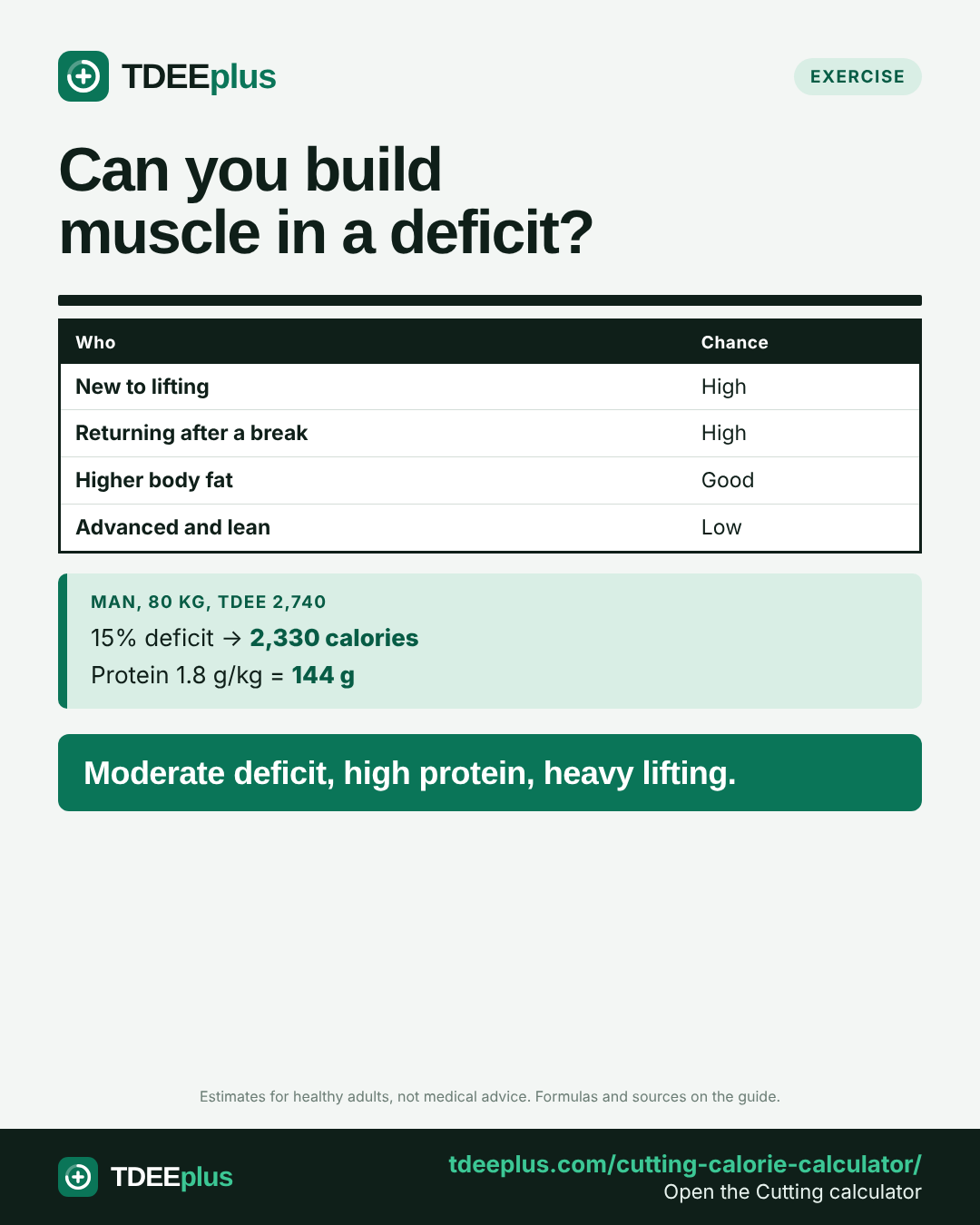
| Situation | Chance of gaining muscle in a deficit |
|---|---|
| New to lifting | High. Beginners respond quickly to training |
| Returning after a break | High. Muscle memory speeds regain |
| Higher body fat | Good. Stored fat provides energy |
| Intermediate lifter | Possible but slow |
| Advanced and already lean | Low. Maintaining muscle is the realistic goal |
How to set it up
- Set a modest deficit. About 10 to 20 percent below TDEE, or around 250 to 500 calories (calorie deficit size).
- Eat enough protein. 1.6 to 2.2 g per kg (how much protein), spread over several meals (high protein grocery list).
- Lift progressively. Heavy compound lifts, 2 to 4 sessions a week, close to hard effort.
- Eat carbs around training to support performance (what to eat after a workout).
- Sleep 7 or more hours. Poor sleep hurts recovery.
- Be patient. Expect slower weight loss than a pure fat-loss diet.
How to tell it is working
- Strength is steady or rising (strength standards).
- Waist is falling (how to measure your waist).
- Weight is drifting down slowly, or steady while your shape changes (does muscle weigh more than fat).
- Photos show more definition. For a more precise check consider a scan (DEXA scan cost).
If strength falls week after week and you feel run down, the deficit is probably too big.
When to separate bulking and cutting
If you are an experienced lifter who is already lean, you will usually build more muscle with a small surplus and lose fat in a separate phase. See bulking vs cutting, plan the surplus with the bulking calculator and check lean mass with the FFMI calculator.
This is general information, not medical advice. If you have a medical condition or a history of disordered eating, ask a professional before cutting calories.
Set a modest deficit that protects your muscle.
Open the cutting calculatorFrequently asked questions
Can you build muscle in a calorie deficit?
How much protein do I need in a deficit?
How big should the deficit be?
Will I get stronger in a deficit?
What is better for advanced lifters, recomp or separate phases?
Keep reading
Sources
- Murphy C, Koehler K. Energy deficiency impairs resistance training gains in lean mass but not strength: a meta-analysis and meta-regression. Scand J Med Sci Sports. 2022;32(1):125–137.
- Longland TM, Oikawa SY, Mitchell CJ, Devries MC, Phillips SM. Higher compared with lower dietary protein during an energy deficit combined with intense exercise promotes greater lean mass gain and fat mass loss: a randomized trial. Am J Clin Nutr. 2016;103(3):738–746. PubMed 26817506
- Barakat C, Pearson J, Escalante G, Campbell B, De Souza EO. Body recomposition: can trained individuals build muscle and lose fat at the same time? Strength Cond J. 2020;42(5):7–21.
- Helms ER, Aragon AA, Fitschen PJ. Evidence-based recommendations for natural bodybuilding contest preparation: nutrition and supplementation. J Int Soc Sports Nutr. 2014;11:20. PubMed 24864135
- Jäger R, Kerksick CM, Campbell BI, et al. International Society of Sports Nutrition Position Stand: protein and exercise. J Int Soc Sports Nutr. 2017;14:20. PubMed 28642676