A balanced diet gives you enough energy and every nutrient you need, in the right proportions, from a variety of whole foods. It is built on vegetables and fruit, whole grains, protein foods, dairy or fortified alternatives and unsaturated fats, with limited added sugar, salt and processed foods. How much you need depends on your body, which you can estimate with the TDEE calculator.
The plate model
The easiest way to see balance is on a plate. Public-health models such as the US MyPlate use a similar idea.
- About half the plate: vegetables and fruit, with more vegetables than fruit.
- About a quarter: protein foods, such as fish, poultry, eggs, beans, lentils, tofu or lean meat.
- About a quarter: whole grains or starchy foods, such as oats, brown rice, whole-wheat bread, potatoes or pasta.
- On the side: dairy or a fortified alternative, and a small amount of unsaturated fat such as olive oil, nuts or avocado.
It is a visual guide, not a precise recipe. Portions will be larger for a tall, active person and smaller for someone who is smaller or sedentary. If you need help judging size, see portion control for weight loss.
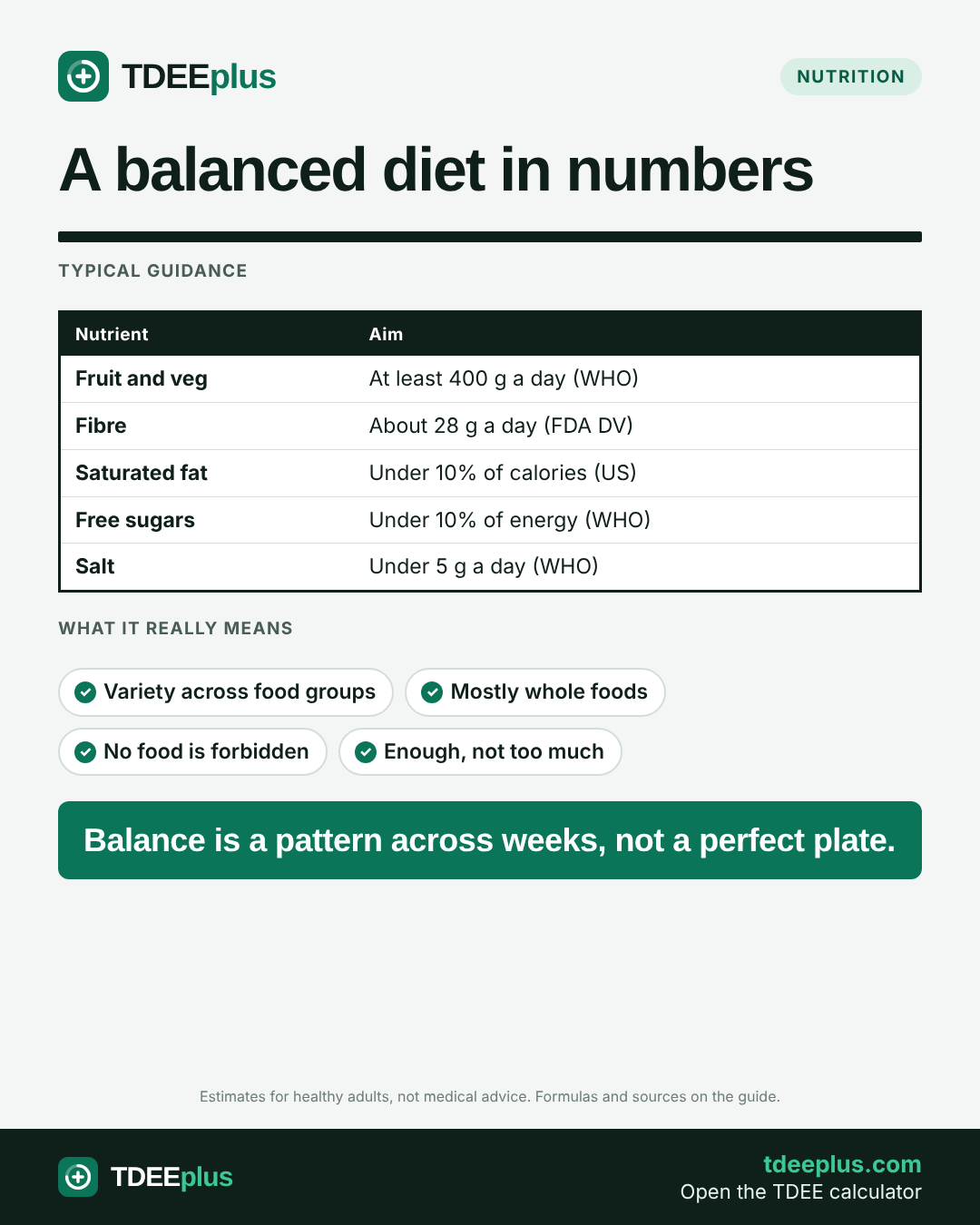
Numbers worth knowing
| Nutrient | Typical guidance |
|---|---|
| Vegetables and fruit | At least 400 g a day (WHO) |
| Fibre | About 28 g a day on a 2,000-calorie diet (FDA Daily Value) |
| Saturated fat | Under 10% of calories (US guidelines); under about 6% for the American Heart Association |
| Added sugars | As low as possible. WHO: free sugars under 10% of energy, ideally under 5% |
| Salt | Under 5 g a day, about 2 g of sodium (WHO) |
| Protein | The 2025–2030 US guidelines advise 1.2 to 1.6 g per kg of body weight a day for adults |
The 2025–2030 US Dietary Guidelines, released in January 2026, put more weight on whole, minimally processed foods and on protein than earlier editions, and take a stricter line on added sugar. Guidance does change, which is why we link the sources below. For a personal protein number see how much protein you need.
Balance and macros
The Institute of Medicine's Acceptable Macronutrient Distribution Ranges are 45 to 65 percent of calories from carbohydrate, 20 to 35 percent from fat and 10 to 35 percent from protein. Anything in those ranges can be balanced if the foods are varied. A typical split of 30/35/35 sits well inside them; the guide to macro splits explains the options, and what are macros covers the basics.
What a balanced day can look like
Common mistakes
- Cutting a whole food group without a medical reason, then missing nutrients.
- Judging by "clean" or "bad" labels. Chocolate or pizza can fit in a balanced pattern; what matters is how often and how much.
- Skipping fibre. Most adults fall short. See the highest fibre foods.
- Drinking calories. Sugary drinks and alcohol add energy that does not fill you up.
- Ignoring energy balance. A balanced plate eaten in large excess still causes weight gain. Match it to your daily calorie intake.
If you are losing or gaining weight
A balanced diet is the base for both goals. For fat loss, keep the same food groups and lower portion sizes slightly, using a moderate deficit from the cutting calculator. For muscle gain, raise portions and protein using the bulking calculator. If you have a medical condition, are pregnant or have a history of disordered eating, work with a doctor or registered dietitian.
Turn your calorie target into grams of protein, carbs and fat.
Open the macro calculatorFrequently asked questions
What is a balanced diet in simple terms?
Do I need to count calories to eat a balanced diet?
Is a balanced diet the same as a low-carb or high-protein diet?
How much fruit and vegetables should I eat?
Can I lose weight on a balanced diet?
Keep reading
Sources
- U.S. Department of Agriculture and U.S. Department of Health and Human Services. Dietary Guidelines for Americans, 2025–2030. Released January 2026. dietaryguidelines.gov.
- World Health Organization. Healthy diet (fact sheet). who.int/health-topics/healthy-diet.
- Institute of Medicine. Dietary Reference Intakes for Energy, Carbohydrate, Fiber, Fat, Fatty Acids, Cholesterol, Protein, and Amino Acids. Washington, DC: National Academies Press; 2005 (Acceptable Macronutrient Distribution Ranges).
- U.S. Food and Drug Administration. How to understand and use the Nutrition Facts label. fda.gov.