The highest fibre foods are legumes, seeds, berries, some vegetables and whole grains. A cup of cooked split peas has about 16 g, lentils about 16 g and black beans about 15 g. The FDA Daily Value is 28 g a day. If you are tracking food, the macro calculator helps you plan the carbs these foods come with, and the TDEE calculator sets the calories.
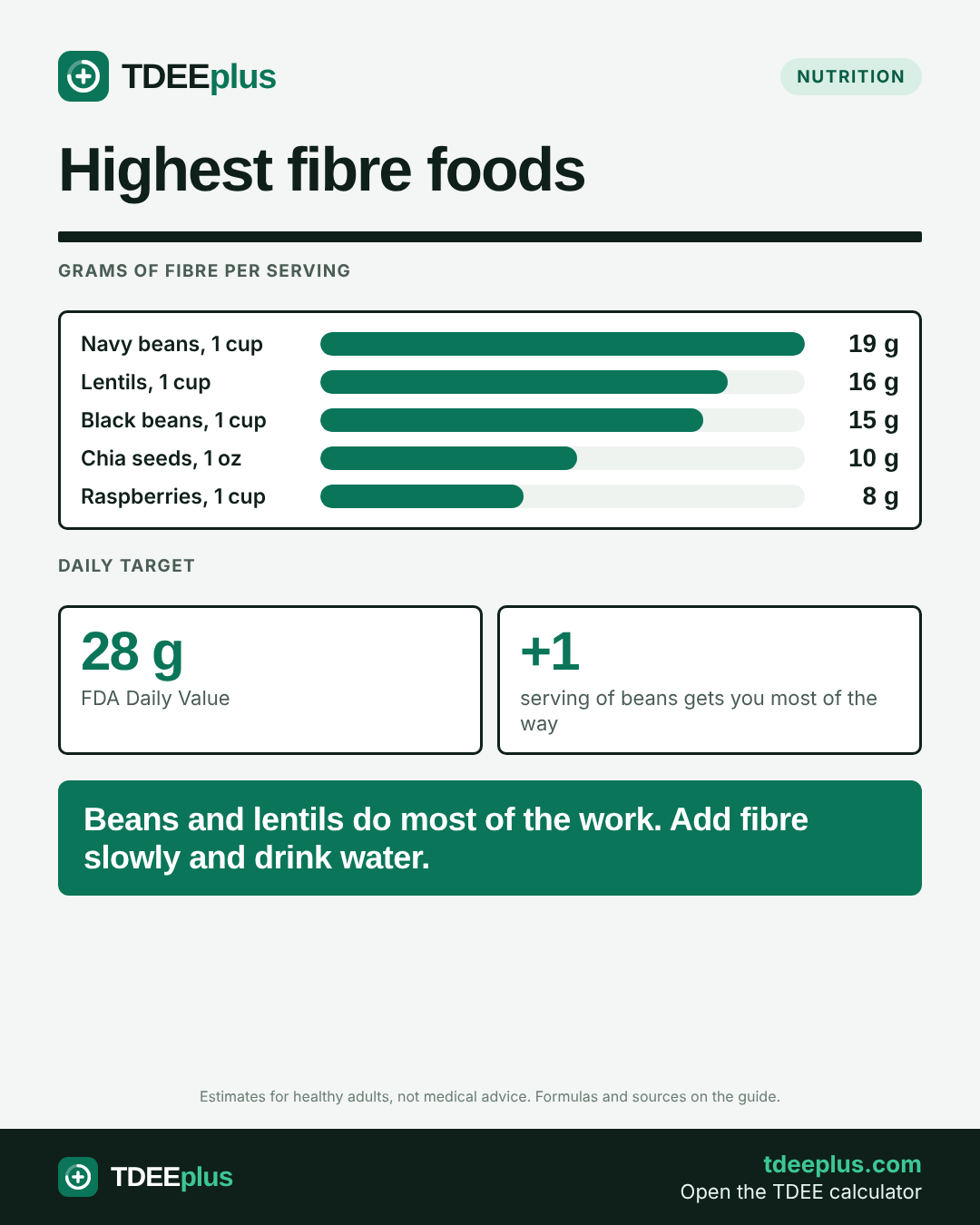
The list, by serving
Values are rounded from USDA FoodData Central for typical servings. Calories are approximate.
| Food | Serving | Fibre | Calories |
|---|---|---|---|
| Navy beans, cooked | 1 cup | 19 g | 255 |
| Split peas, cooked | 1 cup | 16 g | 231 |
| Lentils, cooked | 1 cup | 16 g | 230 |
| Black beans, cooked | 1 cup | 15 g | 227 |
| Kidney beans, cooked | 1 cup | 13 g | 225 |
| Chickpeas, cooked | 1 cup | 12.5 g | 269 |
| Chia seeds | 1 oz (28 g) | about 10 g | about 138 |
| Green peas, cooked | 1 cup | about 9 g | about 134 |
| Raspberries | 1 cup | 8 g | 64 |
| Edamame, shelled, cooked | 1 cup | 8 g | about 188 |
| Artichoke, medium, cooked | 1 medium | about 7 g | about 64 |
| Whole-wheat spaghetti, cooked | 1 cup | about 6 g | about 174 |
| Avocado | half (about 100 g) | about 7 g | about 160 |
| Pear, medium, with skin | 1 | 5.5 g | 101 |
| Broccoli, cooked | 1 cup chopped | 5 g | about 55 |
| Quinoa, cooked | 1 cup | 5 g | 222 |
| Apple, medium, with skin | 1 | 4.4 g | 95 |
| Rolled oats, dry | ½ cup (40 g) | 4 g | about 150 |
| Almonds | 1 oz (about 23) | 3.5 g | 164 |
| Popcorn, air-popped | 3 cups | 3.6 g | about 93 |
Note how different "highest" can look. Chia and flax are the most concentrated by weight, but you eat a spoonful of them, not a cup. If you want fibre with the fewest calories, raspberries, artichokes, broccoli and other vegetables give the most per calorie. Beans and lentils give the most per portion and also bring protein, which is why they appear in our high protein grocery list.
How much fibre you need
The FDA's Daily Value is 28 g a day for a 2,000-calorie diet. The Institute of Medicine's adequate intake of 14 g per 1,000 calories gives about 25 g for adult women and 38 g for adult men up to 50. If you eat 1,600 calories, 22 g is a reasonable target; at 3,000 calories, about 42 g. Most people fall short, so adding two or three foods from the table is enough to make a difference.
Why fibre helps when you are cutting
Fibre adds bulk and slows digestion, and foods rich in it tend to have fewer calories per bite. That can make a deficit feel easier. The effect is modest rather than magical: a bowl of lentil soup will keep you full longer than the same calories of white bread, but it does not change the energy balance. To set a realistic deficit, use the cutting calculator, then read high volume, low calorie foods and what satiety is for more on fullness.
How to add fibre without discomfort
- Go up gradually. Add about 5 g a week. A sudden jump from 12 g to 35 g often causes gas and bloating.
- Drink water. Fibre absorbs fluid; a dry high-fibre diet can cause constipation.
- Mix sources. Soluble fibre (oats, beans, fruit) and insoluble fibre (whole grains, vegetable skins) do different jobs.
- Choose whole foods first. Fibre in food comes with vitamins and minerals; added-fibre bars and powders are a backup, not a base.
- Rinse canned beans. It lowers the sodium and keeps the fibre.
Reading fibre on a label
On a US label, fibre is listed under total carbohydrate with a % Daily Value. Five percent or less is low and 20 percent or more is high, per the FDA, so a food with 6 g of fibre (about 21%) counts as a high source. Our guide on how to read a nutrition facts label walks through the rest. Plan the full day using the balanced diet guide.
Plan your carbs, protein and fat around these high-fibre foods.
Open the macro calculatorFrequently asked questions
How much fibre do I need a day?
What is the highest fibre food?
Does fibre help with weight loss?
Can I eat too much fibre?
Does fibre count in net carbs?
Keep reading
Sources
- U.S. Department of Agriculture, Agricultural Research Service. FoodData Central. fdc.nal.usda.gov. Values in this guide are rounded from USDA entries for the foods named; brands and preparation change them.
- U.S. Food and Drug Administration. How to understand and use the Nutrition Facts label. fda.gov.
- Institute of Medicine. Dietary Reference Intakes for Energy, Carbohydrate, Fiber, Fat, Fatty Acids, Cholesterol, Protein, and Amino Acids. Washington, DC: National Academies Press; 2005 (protein RDA of 0.8 g/kg/day for adults).