Macros, short for macronutrients, are protein, carbohydrate and fat: the three nutrients that supply your calories. Protein and carbs have about 4 calories per gram and fat has about 9. Counting them means tracking grams of each rather than just total calories. To find your own numbers, start from your TDEE (TDEE calculator) and use the macro calculator.
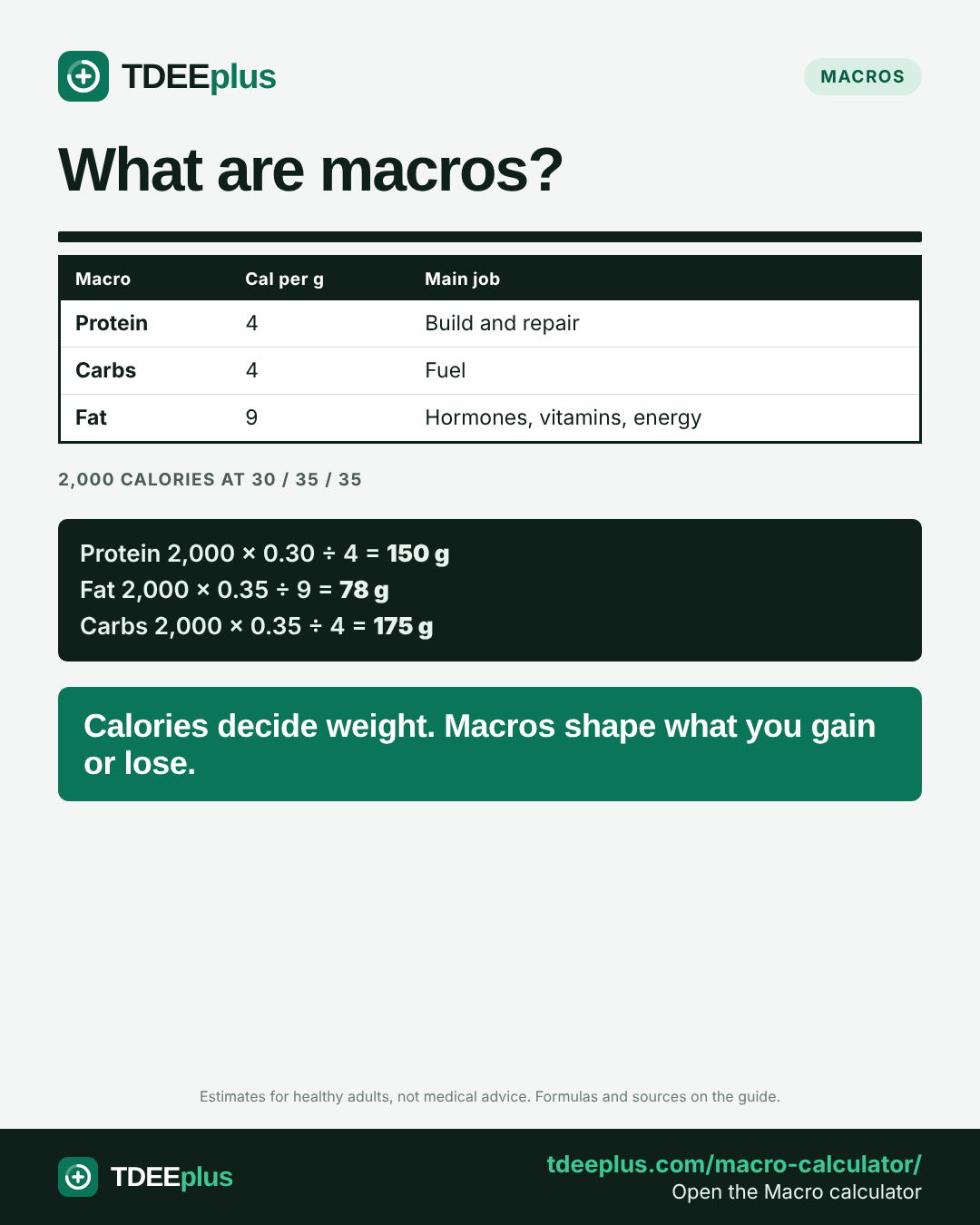
The three macros
| Macro | Calories per gram | Main jobs | Common sources |
|---|---|---|---|
| Protein | 4 | Builds and repairs muscle and other tissue, makes enzymes and hormones | Meat, fish, eggs, dairy, beans, tofu |
| Carbohydrate | 4 | The body's main fuel, especially for the brain and exercise | Grains, potatoes, fruit, legumes, dairy |
| Fat | 9 | Energy storage, absorbing vitamins A, D, E and K, hormone production | Oils, nuts, seeds, avocado, fish, dairy |
Fibre is a type of carbohydrate your body cannot fully digest, and alcohol supplies 7 calories per gram without being a macro. Details are in calories per gram.
Macros versus micros
Micronutrients are vitamins and minerals. You need them in milligrams or micrograms and they do not provide calories, but you cannot be healthy without them. A balanced diet covers both (what is a balanced diet).
Healthy ranges
The Institute of Medicine's Acceptable Macronutrient Distribution Ranges, which most guidelines follow, are:
- Carbohydrate: 45 to 65 percent of calories
- Fat: 20 to 35 percent of calories
- Protein: 10 to 35 percent of calories
Your exact split depends on goals, activity and preference. If you want to compare options like 30/35/35 or 40/40/20, read macro splits explained.
How to turn calories into grams
Many people set protein by body weight instead. An 80 kg person at 1.6 g per kg needs 128 g of protein. See how much protein you need for ranges by goal.
Why track macros at all?
- Protect muscle in a deficit. Higher protein helps retain lean mass (how to lower body fat percentage).
- Feel fuller. Protein and fibre make a diet easier to follow (what is satiety).
- Fuel training. Carbs support harder sessions.
- Get the fats right. A minimum of fat supports health, while the type matters (saturated vs unsaturated fat).
Calories still decide whether you gain or lose weight. Macros decide how that weight change feels and what it is made of.
Common macro myths
- "Carbs make you fat." Excess calories from any macro can be stored as fat. Carbs are not special in that respect.
- "You must hit macros to the gram." Being within about 5 to 10 g of protein and roughly on calories most days is plenty.
- "Fat is the enemy." You need fat for hormones and vitamin absorption. It is calorie-dense, so portions matter.
- "Protein builds muscle by itself." It supports muscle only when you also train and eat enough overall.
You may not need to count at all if a plate model and sensible portions get you where you want to go. Macro counting is most useful when you have a specific goal such as gaining muscle, cutting body fat, or fixing a stalled result.
How to get started
- Find your calorie target and set a modest deficit or surplus.
- Set protein first, then fat at a sensible level, and let carbs fill the rest.
- Shop with a list sorted by macro (macro counting grocery list).
- Read labels (how to read a nutrition facts label).
- Check your progress every two to three weeks and adjust.
Get your daily grams of protein, carbs and fat.
Open the macro calculatorFrequently asked questions
What are macros in simple terms?
How many calories are in each macro?
What is the difference between macros and micros?
Do I need to count macros to lose weight?
What is a good macro split?
Keep reading
Sources
- Institute of Medicine. Dietary Reference Intakes for Energy, Carbohydrate, Fiber, Fat, Fatty Acids, Cholesterol, Protein, and Amino Acids. Washington, DC: National Academies Press; 2005 (Acceptable Macronutrient Distribution Ranges).
- Institute of Medicine. Dietary Reference Intakes for Energy, Carbohydrate, Fiber, Fat, Fatty Acids, Cholesterol, Protein, and Amino Acids. Washington, DC: National Academies Press; 2005 (protein RDA of 0.8 g/kg/day for adults).
- U.S. Department of Agriculture and U.S. Department of Health and Human Services. Dietary Guidelines for Americans, 2025–2030. Released January 2026. dietaryguidelines.gov.
- U.S. Food and Drug Administration. Nutrition labeling of food, 21 CFR 101.9(c)(1): 4, 4 and 9 calories per gram.