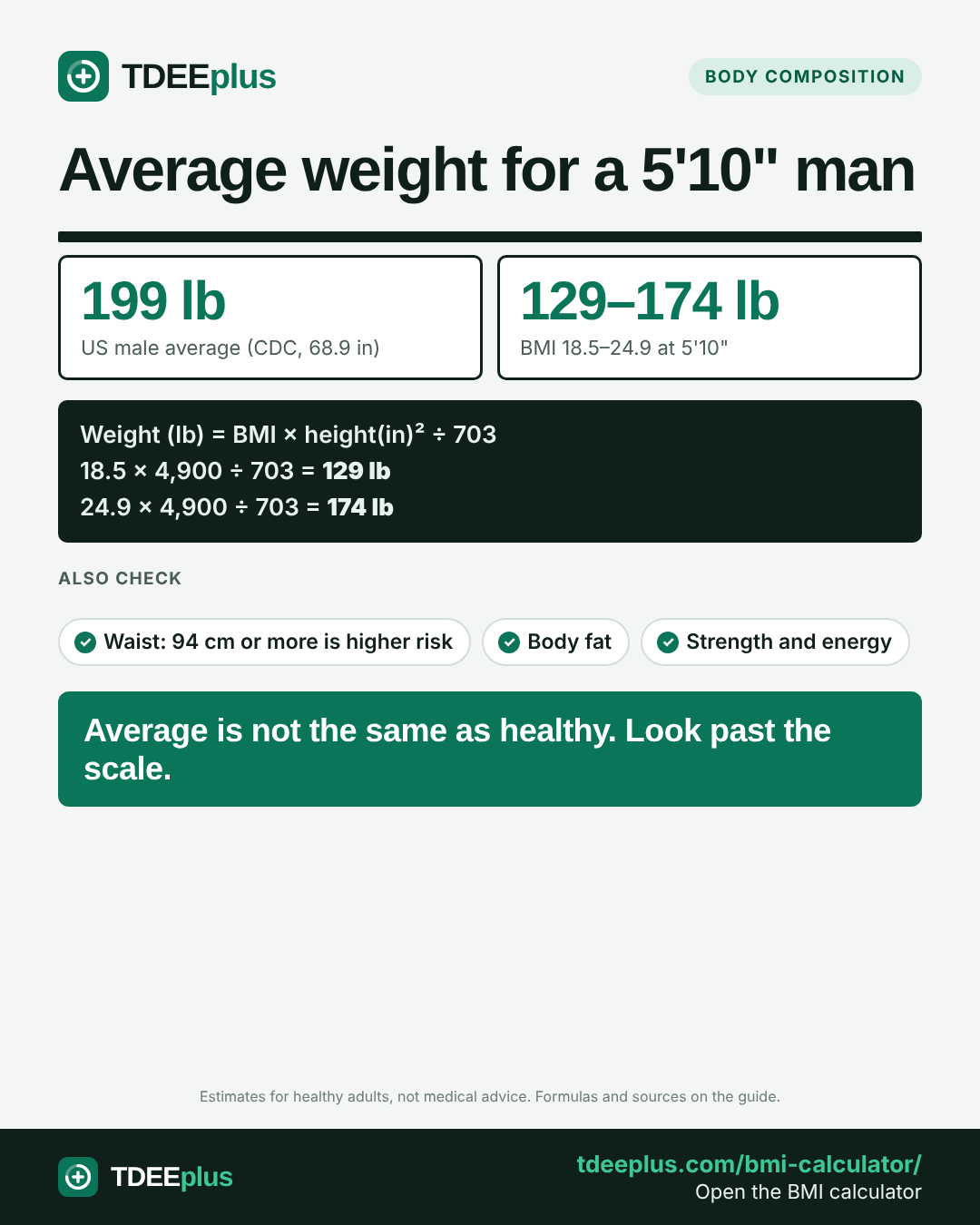
The average adult man in the United States weighs about 199 lb (90 kg) at an average height of 68.9 inches, close to 5'9". That figure is an average of the population, not a healthy target. For a man who is exactly 5'10", a BMI of 18.5 to 24.9 corresponds to about 129 to 174 lb (58.5 to 78.7 kg). You can check your own figure with the BMI calculator.
Average versus healthy
CDC survey data for August 2021 to August 2023 show that men aged 20 and over averaged 199.0 lb and 68.9 in. At that height and weight, BMI is about 29.5, in the overweight range. So the average is not the same as healthy. It reflects the population, not a goal, and it should not be used to judge whether your weight is fine.
The healthy range for any height comes from BMI, which is weight divided by height squared. The working-out for 70 inches (5'10") is:
Healthy BMI weight by height
| Height | BMI 18.5 to 24.9 (lb) | BMI 18.5 to 24.9 (kg) |
|---|---|---|
| 5'6" (66 in) | 115 to 154 | 52 to 70 |
| 5'7" | 118 to 159 | 54 to 72 |
| 5'8" | 122 to 164 | 55 to 74 |
| 5'9" | 125 to 169 | 57 to 76 |
| 5'10" | 129 to 174 | 58 to 79 |
| 5'11" | 133 to 179 | 60 to 81 |
| 6'0" | 136 to 184 | 62 to 83 |
| 6'1" | 140 to 189 | 64 to 86 |
| 6'2" | 144 to 194 | 65 to 88 |
The ranges are WHO adult cut-offs, rounded. The lower end is a bare minimum: a man at 129 lb and 5'10" would be very thin. Most men who feel and look healthy sit in the middle of the range or somewhat above it if they carry muscle.
Where BMI falls short
- Muscle. BMI cannot tell muscle from fat. A lifter at 5'10" and 190 lb has a BMI of 27.3 and may have a low body fat (FFMI calculator).
- Fat distribution. Fat around the waist carries more risk. Measure it (how to measure your waist) and compare with height: under 0.5 is a common target.
- Age and ethnicity. Health risk begins at lower BMI values in many Asian groups, from about 23 (WHO).
- Frame. Bone structure varies, so two men at the same height can both be healthy at different weights.
For more on how BMI is used and misused, see body mass index.
What to check besides weight
- Waist. Men at or above 94 cm (37 in) are at increased risk, and at or above 102 cm (40 in) at substantially increased risk, according to WHO action levels.
- Body fat. Estimate it with the body fat calculator. For men, ACE labels 14 to 17 percent as "fitness" and 18 to 24 as "average" (see what 15% body fat looks like).
- Strength and energy. Strong, active men often outweigh the BMI tables (strength standards).
- Health markers. Blood pressure, blood sugar and cholesterol tell you more than the scale.
If you want to change your weight
Work out your maintenance calories with the TDEE calculator. A 30-year-old man, 5'10" (178 cm) and 80 kg with moderate activity needs about 2,740 calories. To lose weight, use the cutting calculator. To gain, use the bulking calculator. If you are underweight, speak to a doctor before changing your diet.
Enter your height and weight to see your BMI and healthy range.
Open the BMI calculatorFrequently asked questions
What is the average weight for a 5'10 male?
What is a healthy weight for a 5'10 man?
Is 180 lb good for a 5'10 male?
Is there a different range for Asian men?
Does height in feet and inches change the range a lot?
Keep reading
Sources
- National Center for Health Statistics, CDC. Anthropometric Reference Data for Children and Adults: United States, August 2021–August 2023 (FastStats: Body Measurements). cdc.gov/nchs/fastats/body-measurements.htm.
- World Health Organization. Obesity: preventing and managing the global epidemic. WHO Technical Report Series 894. Geneva: WHO; 2000. iris.who.int
- WHO Expert Consultation. Appropriate body-mass index for Asian populations and its implications for policy and intervention strategies. Lancet. 2004;363(9403):157–163. PubMed 14726171
- World Health Organization. Waist Circumference and Waist–Hip Ratio: Report of a WHO Expert Consultation. Geneva: WHO; 2008.