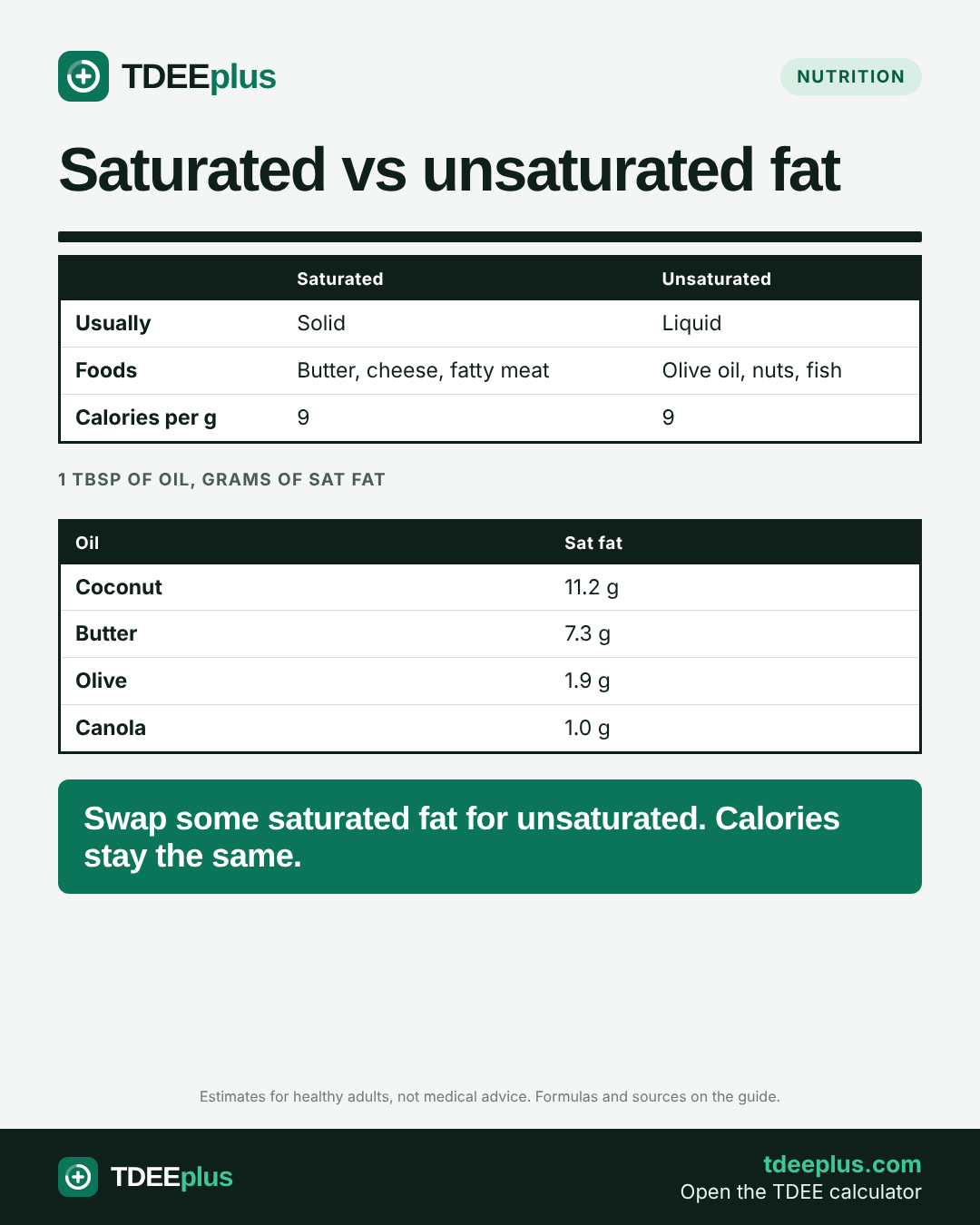
Saturated fat has no double bonds in its chemical structure and is usually solid at room temperature, like butter. Unsaturated fat has one or more double bonds and is usually liquid, like olive oil. Both have about 9 calories per gram, but unsaturated fats are generally better for cholesterol and heart health. Set your total fat with the macro calculator, based on your calories from the TDEE calculator, then choose the types.
At a glance
| Saturated | Monounsaturated | Polyunsaturated | |
|---|---|---|---|
| Structure | No double bonds | One double bond | Two or more double bonds |
| Usually at room temperature | Solid | Liquid | Liquid |
| Example foods | Butter, cheese, fatty meat, coconut oil | Olive oil, avocado, almonds | Fish, walnuts, sunflower and canola oil |
| Calories per gram | 9 | 9 | 9 |
| Effect on LDL when it replaces saturated fat | Reference | Lowers | Lowers |
Most foods contain a mix. Butter is mainly saturated but not only; olive oil is mainly monounsaturated but contains some saturated fat.
What a tablespoon of common fats contains
| Fat or oil (1 tbsp) | Saturated | Mono | Poly | Calories |
|---|---|---|---|---|
| Coconut oil | about 11.2 g | about 0.8 g | about 0.2 g | about 121 |
| Butter | about 7.3 g | about 3.0 g | about 0.4 g | about 102 |
| Olive oil | about 1.9 g | about 10 g | about 1.4 g | about 119 |
| Canola oil | about 1.0 g | about 8.9 g | about 4.1 g | about 124 |
Values are rounded from USDA data and vary slightly by source. Notice that the calories are similar; the difference is the mix. A tablespoon of olive oil uses less than a tenth of a 22 g saturated fat limit, while a tablespoon of coconut oil uses about half. See the full list in foods high in saturated fat.
What the evidence says
Saturated fat raises LDL ("bad") cholesterol compared with unsaturated fat, which is why guidelines advise limits. A 2020 Cochrane review of 15 randomised trials covering about 56,700 adults found that cutting saturated fat lowered combined cardiovascular events by about 17 percent, with effects on total mortality small or absent. The benefit appeared when saturated fat was replaced with polyunsaturated fat or carbohydrate rather than with other saturated or unclear sources.
- US Dietary Guidelines: under 10% of calories from saturated fat.
- American Heart Association: under 6% of calories.
- Trans fat: eliminate industrial trans fats (WHO).
The practical lesson is about swaps: the quality of what replaces saturated fat matters. See how much saturated fat per day is OK.
Plan your fat macros
- Set total fat from your macro split. If you are unsure, see macro splits explained.
- Cap saturated fat at your chosen limit.
- Fill the rest with mono- and polyunsaturated sources, including oily fish twice a week.
- Read labels for the saturated line (how to read a nutrition facts label).
Common myths
- "Fat makes you fat." Calories do. Fat is calorie-dense, so portions matter (portion control).
- "Low fat is always better." You need some fat for health, and very low-fat diets are hard to sustain.
- "Coconut oil is a health food." It is high in saturated fat and counts toward the limit.
Start with what are macros if you are new to fat targets.
Set your total fat grams, then choose mostly unsaturated sources.
Open the macro calculatorFrequently asked questions
What is the difference between saturated and unsaturated fat?
Which is healthier?
Are all saturated fats bad?
Are trans fats unsaturated?
Do I need both?
Keep reading
Sources
- Hooper L, Martin N, Jimoh OF, Kirk C, Foster E, Abdelhamid AS. Reduction in saturated fat intake for cardiovascular disease. Cochrane Database Syst Rev. 2020;(8):CD011737. cochrane.org/evidence/CD011737.
- American Heart Association. Saturated fats. heart.org.
- U.S. Department of Agriculture and U.S. Department of Health and Human Services. Dietary Guidelines for Americans, 2025–2030. Released January 2026. dietaryguidelines.gov.
- World Health Organization. Healthy diet (fact sheet). who.int/health-topics/healthy-diet.
- U.S. Department of Agriculture, Agricultural Research Service. FoodData Central. fdc.nal.usda.gov. Values in this guide are rounded from USDA entries for the foods named; brands and preparation change them.