US guidelines say to keep saturated fat under 10 percent of your daily calories, about 22 g on a 2,000-calorie diet. The American Heart Association recommends under 6 percent, about 13 g. Your own number depends on how much you eat, so start by finding your calories with the TDEE calculator and your fat target with the macro calculator.
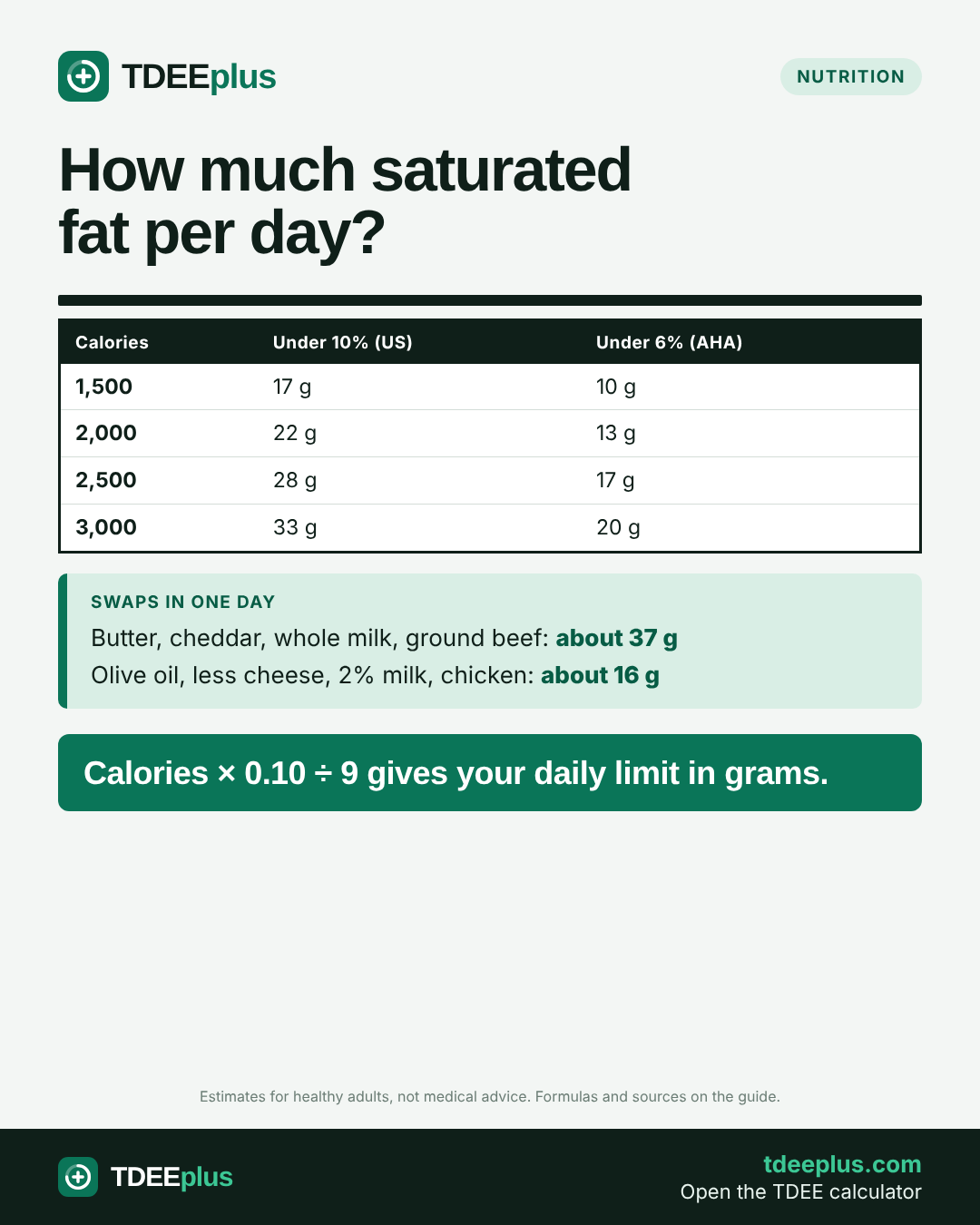
The formula
Divide by 9 because fat has about 9 calories per gram. Here are the limits for common calorie levels:
| Daily calories | Under 10% (US guidelines) | Under 6% (AHA) |
|---|---|---|
| 1,500 | 17 g | 10 g |
| 1,800 | 20 g | 12 g |
| 2,000 | 22 g | 13 g |
| 2,500 | 28 g | 17 g |
| 3,000 | 33 g | 20 g |
The 2025–2030 Dietary Guidelines for Americans keep the 10 percent ceiling. The FDA's Daily Value on labels is 20 g, based on a 2,000-calorie diet. Other bodies, including the WHO, also advise staying under 10 percent. Choose the limit your doctor or dietitian suggests if you have a heart condition or high LDL cholesterol.
How fast it adds up: two days compared
| Day A | Sat fat | Day B (swaps) | Sat fat |
|---|---|---|---|
| 2 eggs | 3.2 g | 2 eggs in 1 tsp olive oil | 3.8 g |
| 1 tbsp butter | 7.3 g | (oil used above) | included |
| 2 oz cheddar | 10.8 g | 1 oz cheddar | 5.4 g |
| 1 cup whole milk | 4.6 g | 1 cup 2% milk | 3.1 g |
| 150 g ground beef, 80% lean, cooked | about 11.3 g | 150 g cooked chicken breast | about 1.5 g |
| (no added oil) | 0 | 1 tbsp olive oil on vegetables | 1.9 g |
| Total | about 37 g | Total | about 16 g |
Day A is above both limits for most people; Day B is within the 10 percent limit for 2,000 calories and close to the 6 percent one. Values are rounded from USDA data (see foods high in saturated fat for more foods). The swaps change little about the volume of food, but a lot about the fat type.
Where it sits in your fat target
Your saturated fat limit is a cap inside your total fat, not a separate budget. At 2,000 calories and 30 percent fat, you get 2,000 × 0.30 ÷ 9 = 67 g of fat a day, of which no more than about 22 g (a third) should be saturated under the US limit. Industrial trans fat is different: it is not part of a budget at all, and the WHO recommends eliminating it. Many countries have restricted it in packaged foods, but check labels on baked goods and fried snacks.
How to keep within your limit
- Know your number. Use the formula once and write it down.
- Check the label. The saturated line is on every US panel (how to read a nutrition facts label). Five percent DV or less per serving is low.
- Swap fats. Use olive or canola oil instead of butter or coconut oil.
- Pick lean proteins such as fish, skinless poultry, beans and lentils more often.
- Watch dairy. Lower-fat versions and smaller portions of strong cheeses help.
- Average over the week, not the day.
Why a limit at all?
Saturated fat raises LDL cholesterol, which is a risk factor for heart disease. A Cochrane review of 15 randomised trials found that reducing saturated fat lowered combined cardiovascular events by about 17 percent, with the clearest benefit when it was replaced by polyunsaturated fat. Deaths from all causes changed little in those trials. The point is a sensible limit and good swaps, not eliminating a food group. Read saturated vs unsaturated fat for how the types differ, and what are macros for the bigger picture.
If you track macros, your saturated fat limit sits inside your fat goal. Choose a split with macro splits explained, and keep the extra fat unsaturated. For a balanced pattern overall, see what is a balanced diet.
Get your fat grams, then keep saturated fat to your limit.
Open the macro calculatorFrequently asked questions
How many grams of saturated fat per day is OK?
How do I calculate my saturated fat limit?
Is the limit the same for everyone?
Does one high day matter?
Does saturated fat on food labels count total fat?
Keep reading
Sources
- U.S. Department of Agriculture and U.S. Department of Health and Human Services. Dietary Guidelines for Americans, 2025–2030. Released January 2026. dietaryguidelines.gov.
- American Heart Association. Saturated fats. heart.org.
- Hooper L, Martin N, Jimoh OF, Kirk C, Foster E, Abdelhamid AS. Reduction in saturated fat intake for cardiovascular disease. Cochrane Database Syst Rev. 2020;(8):CD011737. cochrane.org/evidence/CD011737.
- U.S. Food and Drug Administration. How to understand and use the Nutrition Facts label. fda.gov.
- U.S. Department of Agriculture, Agricultural Research Service. FoodData Central. fdc.nal.usda.gov. Values in this guide are rounded from USDA entries for the foods named; brands and preparation change them.