The best high protein groceries are chicken breast, fish and shellfish, eggs, plain Greek yoghurt, cottage cheese, lentils, beans, tofu and milk. Pick a few from each group and keep them in rotation. Find your daily protein target first with the macro calculator, and see the full calorie picture on the TDEE calculator.
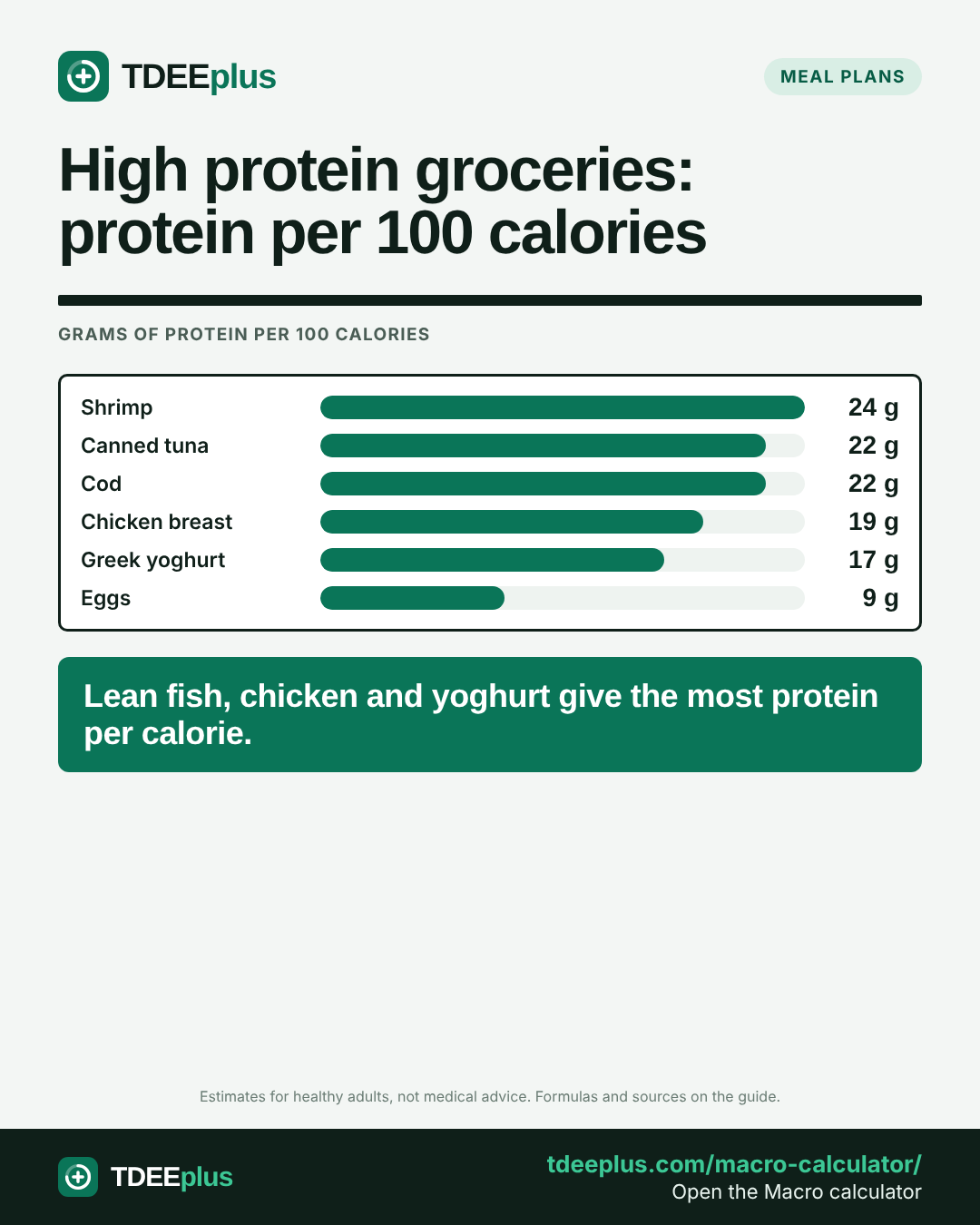
How much protein to shop for
The 2025–2030 US Dietary Guidelines recommend 1.2 to 1.6 g of protein per kg of body weight a day for adults. Sports nutrition research commonly points to 1.4 to 2.0 g per kg for people who train, with higher intakes during a calorie deficit to protect muscle. The working-out is on our page about how much protein you need. As an example, an 80 kg person at 1.6 g per kg needs about 128 g a day.
Protein per serving and per 100 calories
| Food | Serving | Protein | Calories | Protein per 100 cal |
|---|---|---|---|---|
| Shrimp, cooked | 100 g | 24 g | 99 | 24 g |
| Chicken breast, cooked | 100 g | 31 g | 165 | 19 g |
| Canned tuna in water | 100 g | 26 g | 116 | 22 g |
| Cod, cooked | 100 g | 23 g | 105 | 22 g |
| Greek yoghurt, nonfat | 170 g | 17 g | 100 | 17 g |
| Cottage cheese, low-fat | 113 g | 14 g | 81 | 17 g |
| Eggs, large | 2 | 12.6 g | 144 | 9 g |
| Edamame, shelled | 1 cup | about 18 g | about 188 | about 10 g |
| Lentils, cooked | 1 cup | about 18 g | about 230 | about 8 g |
| Milk, 2% | 1 cup | 8 g | 122 | 7 g |
| Peanut butter | 2 tbsp | about 8 g | 188 | 4 g |
The last column is a quick way to see which foods are "efficient". Seafood, chicken and nonfat dairy give the most protein per calorie, while nuts and peanut butter give very little but add healthy fats. Protein per 100 calories is a tool, not a rule: lentils are lower, yet they bring fibre and keep you full, as covered in what is satiety.
Protein per dollar
Prices vary by country, store and season, so a fixed ranking would go out of date quickly. Use this method instead: divide the grams of protein per package by the price. A 1 kg bag of dried lentils has roughly 250 g of protein, a dozen large eggs about 75 g and a 1 kg tub of nonfat Greek yoghurt about 100 g. Compare the cost of 100 g of protein for your usual store. Dried beans, lentils, eggs, canned fish, frozen chicken and milk tend to win.
A simple weekly list
- Meat and fish: chicken breast or thighs, canned tuna, a frozen white fish or shrimp.
- Dairy and eggs: eggs, plain Greek yoghurt, cottage cheese, milk.
- Plant proteins: lentils, black beans, chickpeas, edamame, firm tofu.
- Carbs and fibre: oats, rice, potatoes, whole-wheat bread, fruit.
- Extras: vegetables, olive oil, nuts or seeds, spices.
For a macro-by-macro version of this list, see our macro counting grocery list.
Spread it across the day
Research on muscle building suggests about 0.4 g of protein per kg of body weight per meal across at least four meals gets most of the benefit. For an 80 kg person that is about 32 g a meal. In practice, aim for 25 to 40 g at each main meal and some at snacks. Egg- and yoghurt-based breakfasts help (how many calories are in an egg), and post-training meals are covered in what to eat after a workout.
Mistakes to avoid
- Relying on bars and shakes. They are convenient but pricier and often include added sugar.
- Forgetting the fat. A "high protein" food such as sausage or fatty cuts can still be calorie-heavy. Read the label (how to read a nutrition facts label).
- Ignoring vegetables and fibre. Protein alone does not make a diet balanced; see what is a balanced diet.
Find the protein, fat and carb grams that match your calories.
Open the macro calculatorFrequently asked questions
What are the best high protein foods to buy?
How much protein do I need?
How do I get high protein on a budget?
Can I get enough protein without meat?
Is protein powder necessary?
Keep reading
Sources
- U.S. Department of Agriculture, Agricultural Research Service. FoodData Central. fdc.nal.usda.gov. Values in this guide are rounded from USDA entries for the foods named; brands and preparation change them.
- U.S. Department of Agriculture and U.S. Department of Health and Human Services. Dietary Guidelines for Americans, 2025–2030. Released January 2026. dietaryguidelines.gov.
- Jäger R, Kerksick CM, Campbell BI, et al. International Society of Sports Nutrition Position Stand: protein and exercise. J Int Soc Sports Nutr. 2017;14:20. PubMed 28642676
- Schoenfeld BJ, Aragon AA. How much protein can the body use in a single meal for muscle-building? Implications for daily protein distribution. J Int Soc Sports Nutr. 2018;15:10.