High volume, low calorie foods are foods rich in water and fibre that fill a lot of plate for few calories: vegetables, fruit, broth-based soup, boiled potatoes and plain yoghurt. The idea is energy density, which means calories per gram. Pick low-density foods for most of your meal and a deficit feels easier. Set your own calorie target with the cutting calculator and the TDEE calculator.
What energy density means
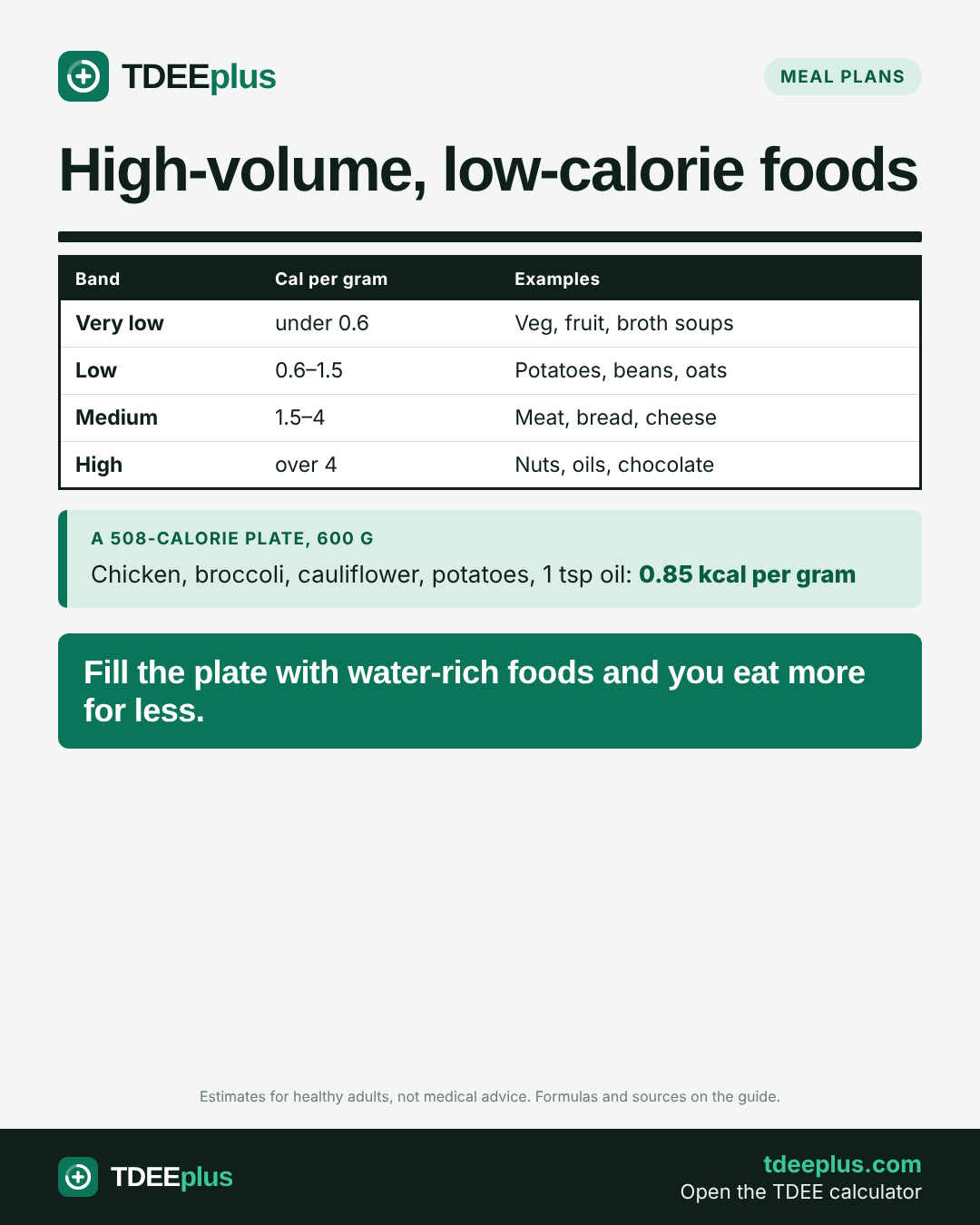
Energy density is calories divided by grams. Water has none, which is why watery foods score low. Barbara Rolls, a nutrition scientist at Penn State, groups foods into bands in her Volumetrics approach:
| Category | Calories per gram | Examples |
|---|---|---|
| Very low | under 0.6 | Most vegetables and fruit, broth-based soups, skim milk |
| Low | 0.6 to 1.5 | Potatoes, beans and lentils, oatmeal, plain nonfat yoghurt, lean fish |
| Medium | 1.5 to 4 | Chicken breast, meat, bread, cheese, pasta (dry-weight foods are higher) |
| High | over 4 | Nuts, chocolate, crackers, oils, butter |
Foods by calories per 100 g
Values are rounded from USDA FoodData Central.
| Food | Calories per 100 g | Calories per typical serving |
|---|---|---|
| Cucumber | 15 | 16 per cup sliced |
| Lettuce, iceberg | 14 | about 10 per cup shredded |
| Tomato | 18 | about 22 for a medium one |
| Watermelon | 30 | 46 per cup diced |
| Strawberries | 32 | 49 per cup halves |
| Cauliflower, boiled | about 23 | about 29 per cup |
| Broccoli, boiled | 35 | about 55 per cup |
| Apple | 52 | 95 for a medium one |
| Greek yoghurt, nonfat | 59 | about 100 per 170 g |
| Potato, boiled | 87 | about 130 per 150 g |
| Lentils, cooked | 116 | about 230 per cup |
| Chicken breast, cooked | 165 | 165 per 100 g |
Compare these with almonds at about 579 calories per 100 g or olive oil at 884. That is why a tablespoon of oil (119 calories) holds the same energy as about 800 g of cucumber.
What the research shows
In a Penn State study, adding 300 g of salad worth about 100 calories to a pasta meal lowered the meal's total calories by about 11 percent (57 calories), and the average energy density of the meal fell from 1.51 to 0.85 kcal per gram (Roe, Meengs and Rolls, 2012). The results come from a single lab study with a small number of meals, so treat them as supportive, not a guarantee. Read more in what is satiety.
A high-volume plate, worked out
Cooking tricks
- Bulk up soups and stews with extra vegetables, beans or lentils.
- Grate courgette or cauliflower into mince dishes, rice and sauces.
- Use broth as a base instead of cream.
- Roast or steam vegetables with a measured teaspoon of oil rather than pouring it.
Easy swaps
- Start with soup or salad before a meal (watch the dressing).
- Replace half the pasta or rice with vegetables such as courgette (zucchini), cauliflower or spinach.
- Choose whole fruit over juice. You chew more and drink fewer calories.
- Use plain yoghurt instead of cream or mayonnaise in dips.
- Choose potatoes or beans over refined snacks as a base.
- Measure oil. It is the highest-density item in the kitchen (portion control).
Caveats
Low density should not mean low nutrition. Keep protein high so you hold on to muscle in a deficit (high protein grocery list), and include fibre (highest fibre foods). If you are underweight or trying to gain, do the reverse (high calorie snacks). For a snack list, see zero calorie snacks.
Set a moderate deficit, then fill your plate with high-volume foods.
Open the cutting calculatorFrequently asked questions
What are high volume, low calorie foods?
What is energy density?
Does eating high volume foods help weight loss?
Can I eat unlimited vegetables?
Are low-calorie foods always healthy?
Keep reading
Sources
- Roe LS, Meengs JS, Rolls BJ. Salad and satiety: the effect of timing of salad consumption on meal energy intake. Appetite. 2012;58(1):242–248.
- Rolls BJ. The relationship between dietary energy density and energy intake. Physiol Behav. 2009;97(5):609–615.
- U.S. Department of Agriculture, Agricultural Research Service. FoodData Central. fdc.nal.usda.gov. Values in this guide are rounded from USDA entries for the foods named; brands and preparation change them.