Almost no food has zero calories, but plenty have so few that they barely register: cucumber, celery, radishes, berries, pickles and air-popped popcorn. In the US, "calorie free" on a label means fewer than 5 calories per serving, which is not the same as none. Use these snacks to make a deficit easier, after setting your target with the cutting calculator and the TDEE calculator.
What "zero calorie" really means
FDA rules let a food be labelled "calorie free" if it has fewer than 5 calories per serving, and "low calorie" if it has 40 or fewer per serving. A serving is whatever the maker says, so a small serving can hide calories. Plain water, black coffee and unsweetened tea are effectively zero. Everything else, including fruit and vegetables, has some energy; the snacks below are simply very low (see how to read a nutrition facts label).
Very low calorie snacks, by serving
Values are rounded from USDA FoodData Central.
| Snack | Serving | Calories | Why it works |
|---|---|---|---|
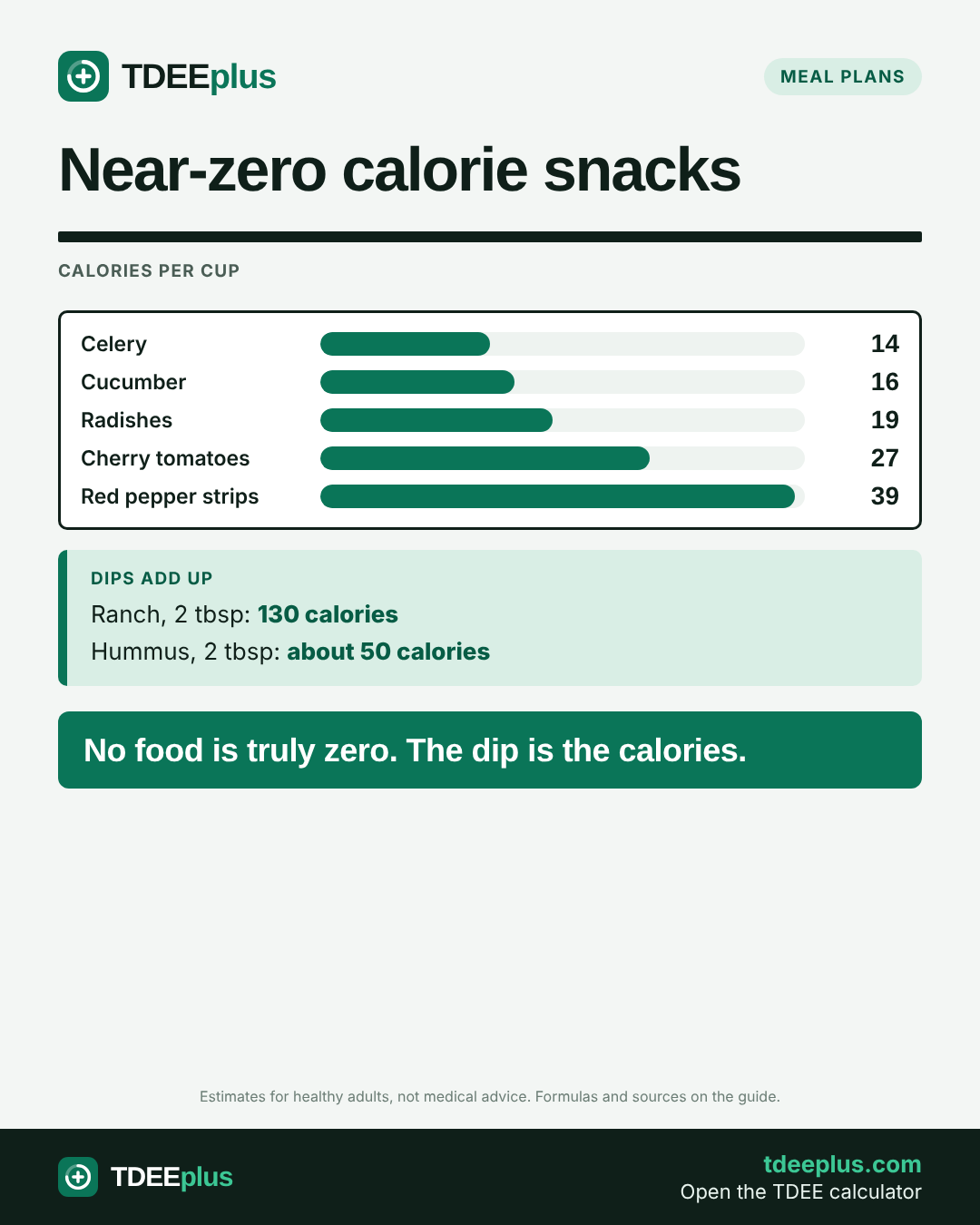
| Celery sticks | 1 cup chopped (101 g) | 14 | Crunchy, mostly water |
| Cucumber slices | 1 cup (104 g) | 16 | Refreshing, big volume |
| Radishes | 1 cup sliced (116 g) | 19 | Sharp flavour, crisp |
| Dill pickle | 1 medium (65 g) | about 7 | Salty, so mind sodium |
| Cherry tomatoes | 1 cup (149 g) | 27 | Sweet, easy to eat |
| Red bell pepper strips | 1 cup (149 g) | 39 | Sweet crunch, vitamin C |
| Watermelon | 1 cup diced (152 g) | 46 | Sweet and hydrating |
| Strawberries | 1 cup halves (152 g) | 49 | Sweet, some fibre |
| Air-popped popcorn | 3 cups (24 g) | 93 | A whole-grain, high-volume snack |
| Black coffee or plain tea | 1 cup | 2 or under | Warm and filling for the moment |
The ordering is by calories, not by taste. What counts is that you actually enjoy the choice, since a snack you dislike will not stick.
The "negative calorie" myth
Some websites claim that celery or grapefruit burn more calories to digest than they contain. They do not. Digesting food uses about 5 to 10 percent of its calories for carbohydrate-rich foods, more for protein. Celery has about 14 calories per 100 g, so digesting it uses a fraction of a calorie at best. No food has a negative energy balance. These foods are low, not negative, which is still useful.
Snack plates under 100 calories
| Snack plate | Calories |
|---|---|
| 1 cup cucumber slices + 2 tbsp hummus | about 66 |
| 1 cup strawberries + 1 tbsp plain Greek yoghurt | about 58 |
| 1 cup cherry tomatoes + 1 small pickle | about 32 |
| 3 cups air-popped popcorn, plain | about 93 |
| 1 cup celery sticks + 1 tsp peanut butter | about 45 |
Each plate is a few minutes of crunching, which many people find more satisfying than a single biscuit. If your snacks keep drifting above 100 calories, that is fine within your target; the plates just show what is possible.
Where calories hide
| Add-on | Typical amount | Calories |
|---|---|---|
| Ranch dressing | 2 tbsp | about 130 |
| Hummus | 2 tbsp | about 50 |
| Peanut butter on celery | 1 tbsp | about 94 |
| Butter on popcorn | 1 tbsp | about 100 |
A plate of raw vegetables is about 50 calories. With ranch dressing it is about 180. Dips and toppings are fine, but measure them. Our portion control guide shows how.
Use them well
- Pair with protein such as Greek yoghurt or a boiled egg to last longer (what is satiety).
- Plan them. Pre-wash and cut vegetables so they are the easy choice.
- Do not skip real meals to eat only low-calorie snacks. You still need protein and enough energy (calorie restriction).
- Watch for compulsive grazing. If snacks are a response to boredom or stress, a different strategy may help.
For more foods that fill you up on few calories, see high volume, low calorie foods. If you are trying to gain instead, read high calorie snacks for gaining weight.
Set a modest deficit so low-calorie snacks work for you.
Open the cutting calculatorFrequently asked questions
Are there any truly zero-calorie foods?
What are the best very low calorie snacks?
Are 'negative calorie' foods real?
Will low-calorie snacks make me lose weight?
Is it okay to snack a lot on vegetables?
Keep reading
Sources
- U.S. Food and Drug Administration. 21 CFR 101.60: nutrient content claims for the calorie content of foods (calorie free: fewer than 5 calories per reference amount and per labeled serving; low calorie: 40 calories or less).
- U.S. Department of Agriculture, Agricultural Research Service. FoodData Central. fdc.nal.usda.gov. Values in this guide are rounded from USDA entries for the foods named; brands and preparation change them.
- Roe LS, Meengs JS, Rolls BJ. Salad and satiety: the effect of timing of salad consumption on meal energy intake. Appetite. 2012;58(1):242–248.