Satiety is the feeling of fullness that lasts after a meal and holds back the next urge to eat. It is the difference between a deficit that feels manageable and one that feels like a fight. Protein, fibre, water-rich foods and slower eating all increase it. Set your calories first with the cutting calculator and the TDEE calculator, then use the ideas below to make them easier to stick to.
Satiation versus satiety
- Satiation is what makes you stop eating during a meal.
- Satiety is how long you stay full afterwards.
Both depend on the stomach stretching, hormones released by the gut, and signals to the brain, plus habits, taste and attention. That is why the same calories can feel very different depending on the food.
What research says about filling foods
In 1995, researchers at the University of Sydney fed volunteers 38 foods in portions of equal energy (1,000 kJ, about 240 calories) and measured fullness over the next two hours. White bread was the reference at 100. Boiled potatoes scored about three times higher, with fish, porridge, oranges and apples also scoring well above white bread, while the croissant scored lowest at about half. The study was small and short-term, but it matches what many people notice: foods that are heavy, high in water, protein or fibre fill you up on fewer calories (Holt and colleagues, 1995).
What boosts satiety
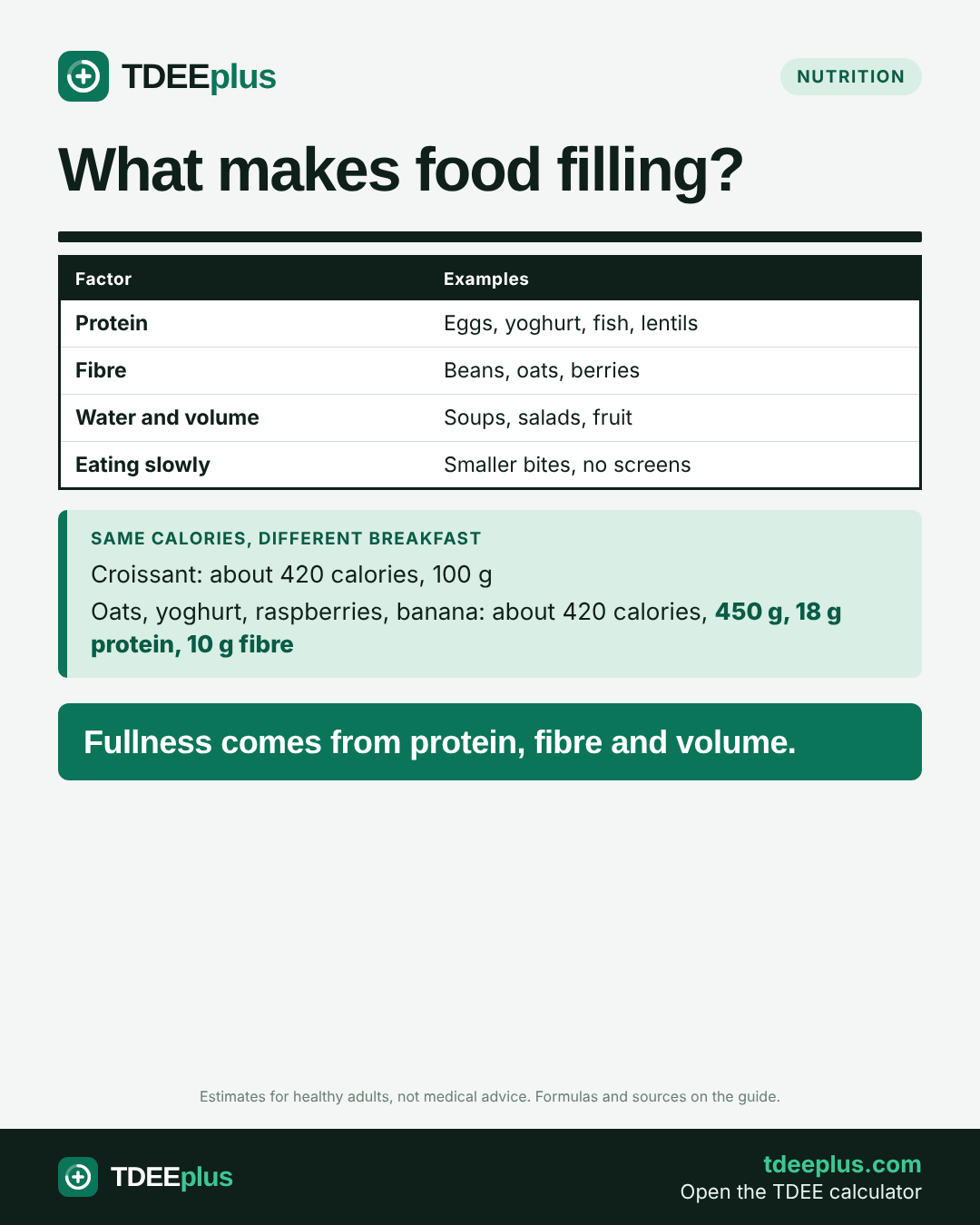
| Factor | Why it helps | Examples |
|---|---|---|
| Protein | More satiating per calorie than carbohydrate or fat in most studies | Eggs, Greek yoghurt, fish, chicken, lentils |
| Fibre | Adds bulk and slows digestion | Beans, oats, berries, vegetables |
| Water and volume | Fills the stomach with few calories | Soups, salads, fruit, vegetables |
| Eating slowly | Gives time for fullness signals | Smaller bites, no screens |
| Solid food | Usually fills more than the same calories as a drink | Fruit instead of juice |
Using satiety in a deficit
- Anchor meals on protein. Aim for 25 to 40 g per meal. See the high protein grocery list.
- Add fibre. Beans, oats and fruit raise fullness; the highest fibre foods list shows amounts.
- Fill half the plate with vegetables. See high volume, low calorie foods.
- Start with soup or salad. They add volume before the main course.
- Eat sitting down, without a screen, and slow your pace.
- Sleep. Short sleep increases hunger for many people.
Keep the deficit modest. A very large deficit makes hunger harder to manage, which is one reason moderate calorie restriction works better than crash dieting.
The limits of fullness hacks
Fullness is only one driver of eating. Habit, stress, social settings and tasty food can override it, and calories still count. Highly processed foods can be easy to overeat even when they contain some protein. If hunger is constant or you are preoccupied with food, your deficit may be too big or too long. A short break at maintenance (maintenance calories calculator) can help, and a doctor or dietitian can support you if the problem persists.
Set a moderate deficit so your plan stays satisfying.
Open the cutting calculatorFrequently asked questions
What is satiety?
Which foods are most filling?
Does protein keep you full?
Why do I feel hungry soon after a meal?
Is feeling hungry a sign my diet is failing?
Keep reading
Sources
- Holt SH, Miller JC, Petocz P, Farmakalidis E. A satiety index of common foods. Eur J Clin Nutr. 1995;49(9):675–690.
- Roe LS, Meengs JS, Rolls BJ. Salad and satiety: the effect of timing of salad consumption on meal energy intake. Appetite. 2012;58(1):242–248.
- Jäger R, Kerksick CM, Campbell BI, et al. International Society of Sports Nutrition Position Stand: protein and exercise. J Int Soc Sports Nutr. 2017;14:20. PubMed 28642676
- Jensen MD, Ryan DH, Apovian CM, et al. 2013 AHA/ACC/TOS guideline for the management of overweight and obesity in adults. Circulation. 2014;129(25 Suppl 2):S102–S138. PubMed 24222017