A pound of body fat holds roughly 3,500 calories, or about 7,700 calories per kilogram. So a 500-calorie daily deficit adds up to 3,500 a week and about a pound of fat. The rule is a good starting point but it overstates long-term loss, because your energy needs fall as you shrink. Work out your own deficit with the TDEE calculator and the cutting calculator.
Where 3,500 comes from
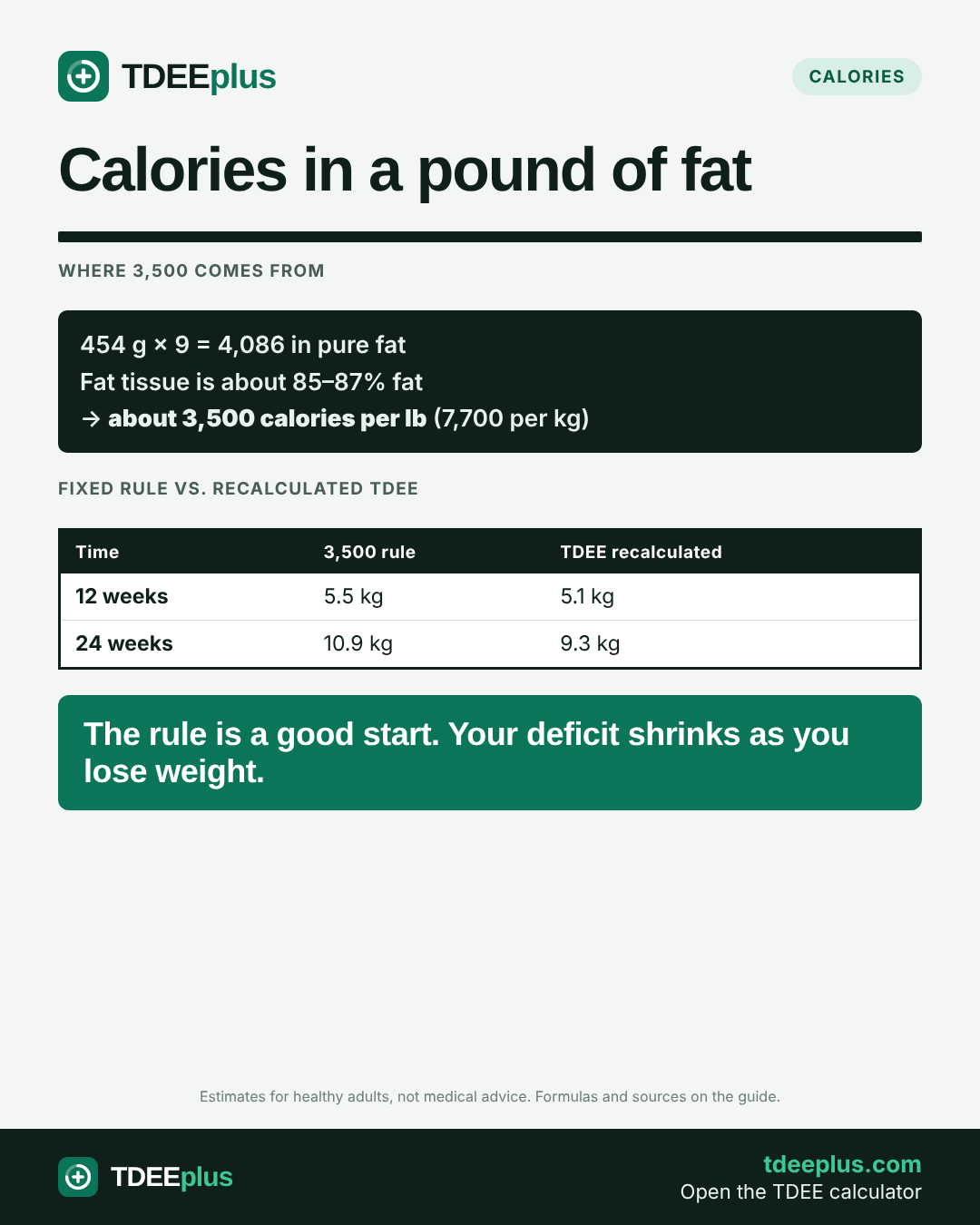
Pure fat provides about 9 calories per gram. A pound is about 454 g, so pure fat would hold 454 × 9 = 4,086 calories. Body fat tissue is not pure fat: it is roughly 85 to 87 percent lipid, with the rest water and cell structure. Multiply 4,086 by 0.85 to 0.87 and you get about 3,470 to 3,550, which rounds to 3,500. Physician Max Wishnofsky published the figure in 1958, and it has been repeated ever since. In metric terms, about 9,400 calories per kg for pure fat becomes roughly 7,700 per kg for adipose tissue.
A worked example
A 30-year-old man, 178 cm and 80 kg, with moderate activity has a TDEE of about 2,740 calories. If he eats 2,240 a day, the deficit is 500 and the rule predicts 3,500 per week, or about 0.45 kg (1 lb) a week.
| Time | Simple 3,500 rule (fixed TDEE) | With TDEE recalculated as weight falls |
|---|---|---|
| 12 weeks | 5.5 kg lost | 5.1 kg lost |
| 24 weeks | 10.9 kg lost | 9.3 kg lost |
The second column uses the Mifflin-St Jeor equation and recalculates his TDEE each week. Each kilogram lost lowers his maintenance by about 15.5 calories (10 per kg in the equation, multiplied by the 1.55 activity factor), so after 10 kg his deficit has shrunk from 500 to about 345. This simple model does not even include adaptive effects like reduced spontaneous movement, so real results can slow more. That is why a plateau is normal, and why a calculator that updates with your weight is more useful than a fixed number.
Why the rule overestimates
- Your energy needs fall. A lighter body burns less (why your TDEE drops).
- Early loss is not all fat. The first week is largely water and stored carbohydrate. See where does fat go when you lose weight.
- You lose some lean tissue. Lean mass holds far fewer calories per kilogram than fat, roughly 1,800 per kg (about 800 per lb) in modelling work by Kevin Hall, so the mix of fat and lean you lose changes the arithmetic.
- Everything has error. Logged intake and activity are estimates, which is covered in TDEE calculator mistakes.
The Lancet paper by Hall and colleagues (2011) showed that dynamic models fit real weight change better than the fixed rule, and the NIH Body Weight Planner is built on that work.
What it means for weight gain
The same logic applies upward, with caution. A 500-calorie surplus a day does not make a pound of fat a week, because some of the gain is lean mass, water and glycogen, and your expenditure rises as you gain. Plan a gradual surplus using the bulking calculator and read bulking vs cutting.
How to use the rule sensibly
- Use 500 calories a day as a starting deficit for about 1 lb a week, or 250 for a gentler pace (how big should your deficit be).
- Expect the first two to three weeks to show faster loss because of water.
- Weigh daily or a few times a week and judge by the weekly average.
- Recalculate your TDEE every 4 to 5 kg (about 10 lb) lost.
- If the average has stopped for about three weeks, make a small adjustment of 100 to 150 calories or about 2,000 extra steps (track and adjust calories).
Use the weight loss percentage calculator to see how much of your body weight you have lost, and check body composition with the body fat calculator.
Set a calorie target for the pace you want, then adjust as you lose.
Open the cutting calculatorFrequently asked questions
How many calories are in a pound of fat?
Does a 500 calorie deficit really mean 1 pound a week?
Why is a pound of body fat not 4,000 calories?
How many calories are in a pound of muscle?
Is there a better rule than 3,500?
Keep reading
Sources
- Wishnofsky M. Caloric equivalents of gained or lost weight. Am J Clin Nutr. 1958;6(5):542–546.
- Hall KD. What is the required energy deficit per unit weight loss? Int J Obes. 2008;32(3):573–576.
- Hall KD, Sacks G, Chandramohan D, et al. Quantification of the effect of energy imbalance on bodyweight. Lancet. 2011;378(9793):826–837. PubMed 21872751
- National Institute of Diabetes and Digestive and Kidney Diseases. Body Weight Planner. niddk.nih.gov