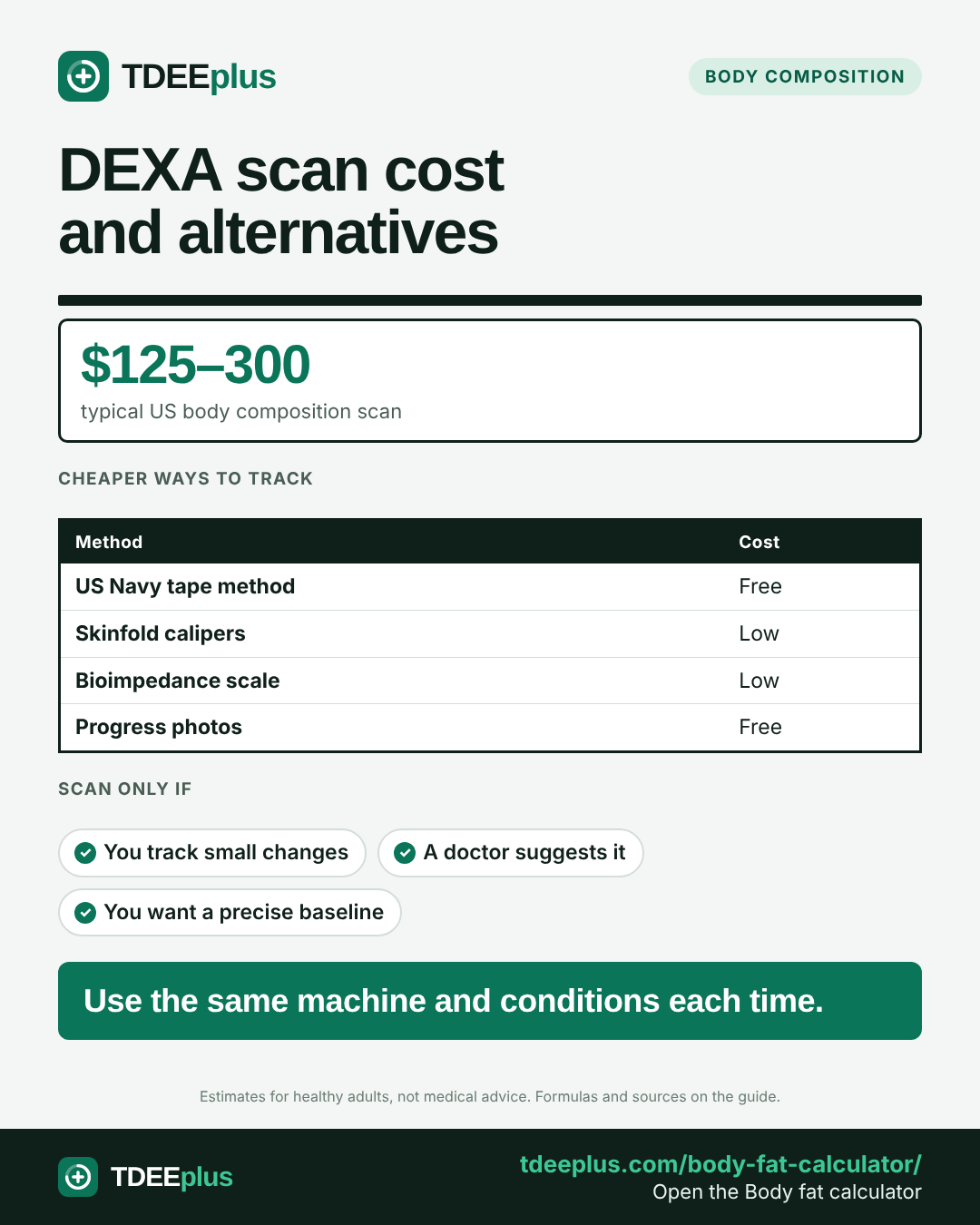
A DEXA (dual-energy X-ray absorptiometry) scan for body composition typically costs about $125 to $300 in the United States, though prices vary by location, provider and whether you pay for extras. It measures body fat, lean mass and bone mineral content. For many people a free estimate from the body fat calculator is enough to start, and a scan makes sense when you want precise tracking or have a medical reason.
What it costs
| Situation | Typical cost |
|---|---|
| Single body composition scan (private clinic or fitness centre) | About $125 to $300 |
| Doctor-ordered bone density scan | Often covered by insurance when criteria are met; otherwise varies |
| Package of several scans over months | Sometimes discounted per scan |
| Extra services (detailed report, coaching) | Can add to the price |
These figures are rough market observations, not fixed prices. Get a quote before you book, and ask what is included. Prices outside the US vary widely.
What a DEXA scan measures
- Fat mass and body fat percentage for the whole body.
- Lean mass (muscle and other soft tissue), often broken down by arms, legs and trunk.
- Bone mineral content and density.
- Regional fat, including visceral fat estimates on some machines (how to burn visceral fat).
You lie still on a table for about 10 minutes while a scanner arm passes over you. The X-ray dose is low, comparable to a very small fraction of a chest X-ray, but it is not zero, and the scan is normally avoided during pregnancy.
How accurate is it?
DEXA is widely regarded as a reference method for body composition and is more consistent than most home devices. It is not perfect. Different machines and software can give different numbers, and hydration, recent food or exercise and positioning change results. The scan assumes certain properties for different tissues, which is where errors can creep in. Treat a single value as an estimate, and compare scans taken on the same machine, under the same conditions.
How to prepare
- Follow your clinic's instructions. Common advice is to arrive in a similar hydration state each time and to avoid heavy exercise beforehand.
- Fast for a few hours if told to, and avoid a large meal just before.
- Wear clothing without metal (zips, underwire, jewellery).
- Book at the same time of day for repeat scans.
Is it worth it?
Worth considering when: you are an athlete or lifter tracking small changes, your weight is not changing but your shape is, you want a baseline for a long project, or a doctor suggests bone density testing.
Probably not needed when: you are starting out and want a general sense of progress. A weekly average weight, a waist measurement every few weeks and photos will tell you most of what you need (how to measure your waist).
Cheaper alternatives
| Method | Cost | Notes |
|---|---|---|
| US Navy tape method | Free once you own a tape | Our body fat calculator; good for trends |
| Skinfold calipers | Low | Technique-dependent |
| Bioimpedance scale | Low | Sensitive to hydration; track trends only |
| Progress photos | Free | Pair with a note of weight and waist |
| FFMI | Free | FFMI calculator uses body fat to estimate lean mass |
To turn body fat into calorie targets, use the TDEE calculator. To know what your result means, see what 15% body fat looks like, 12% body fat and normal body fat for women. Not sure whether your weight or your fat is the issue? Check does muscle weigh more than fat.
Get a free body fat estimate before you pay for a scan.
Open the body fat calculatorFrequently asked questions
How much does a DEXA scan cost?
Does insurance cover a DEXA scan?
Is a DEXA scan safe?
How accurate is DEXA for body fat?
Is there a cheaper alternative?
Keep reading
Sources
- Spren. How much does a DEXA scan cost? spren.com/blog/how-much-does-a-dexa-scan-cost (typical range of $125 to $300; prices vary by provider).
- International Society for Clinical Densitometry. Official Positions: body composition. iscd.org.
- Gallagher D, Heymsfield SB, Heo M, et al. Healthy percentage body fat ranges: an approach for developing guidelines based on body mass index. Am J Clin Nutr. 2000;72(3):694–701. PubMed 10966886