To count calories, set a daily target from your TDEE, weigh and log what you eat, and compare the weekly average of your weight with your plan. Keep it light: precise enough to guide you, relaxed enough to last. You can start in two minutes with the TDEE calculator, then split calories into protein, carbs and fat with the macro calculator.
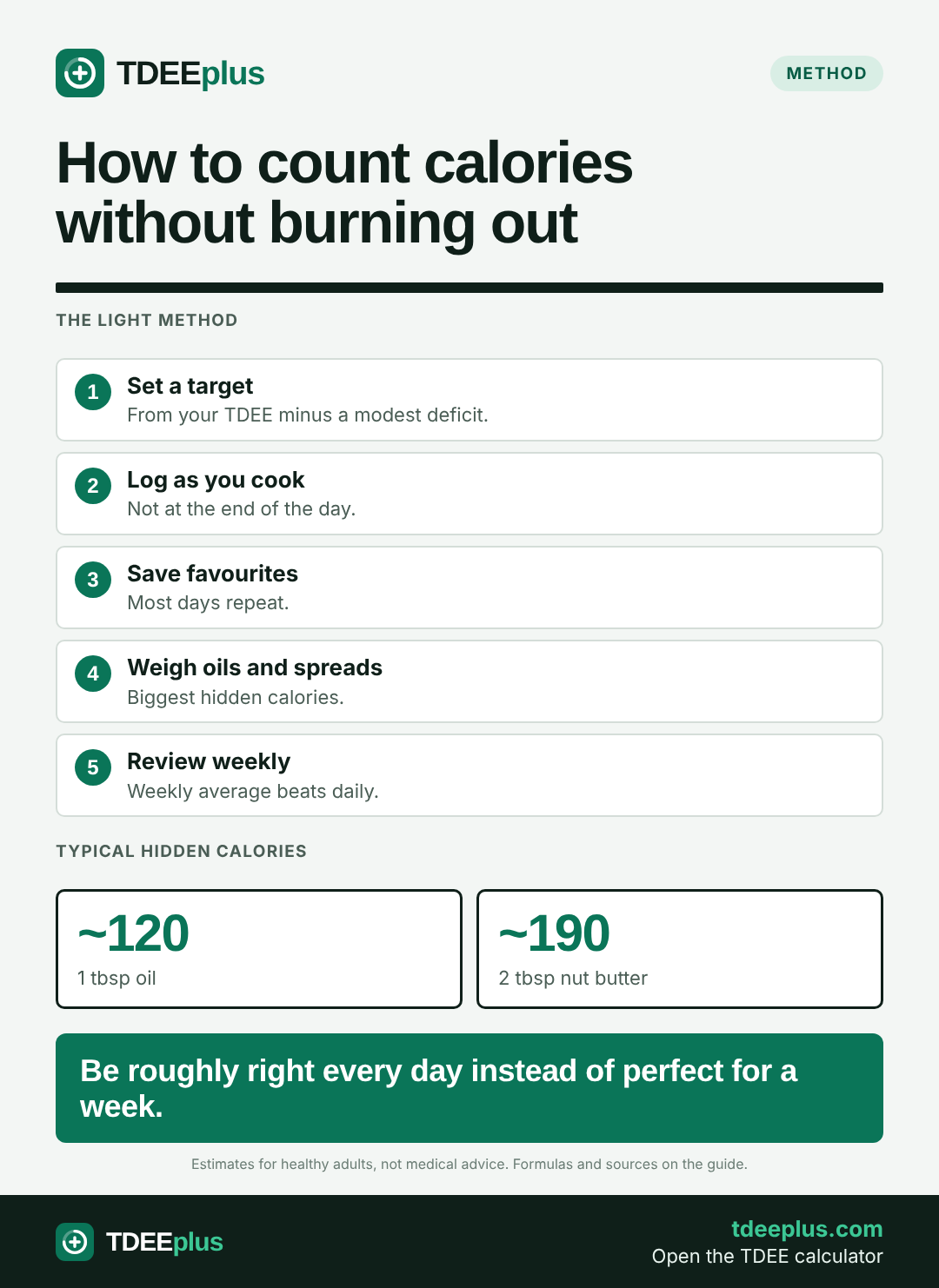
The method in six steps
- Set your target. Estimate your maintenance calories and subtract a modest deficit for fat loss, or add a surplus for gain. For example, a 35-year-old woman, 165 cm and 65 kg, moderately active: BMR 1,345, maintenance about 2,085, and a 400-calorie deficit gives about 1,685.
- Pick one tool. An app with a barcode scanner, or a notebook. Our free calorie counter app comparison helps you choose.
- Weigh your food for two weeks. A digital scale beats eyeballing. After two weeks you will know what your usual portions look like.
- Log as you go. Record before or just after eating, not at night from memory. Include oils, sauces, drinks and bites.
- Judge by weekly averages. Daily weight and intake bounce around; average them.
- Adjust slowly. If the average does not move after two to three weeks, change calories by 100 to 150 (track and adjust).
How accurate does it need to be?
Counting is never exact. Labels carry some tolerance, home cooking varies, and restaurant portions are guesses. In a small study of 10 people who said they could not lose weight, participants under-reported their food intake by about 47 percent (Lichtman and colleagues, 1992). That sample was tiny and unusual, but the lesson holds: the most common errors are unlogged extras, rough portions and weekends.
| Common error | Typical size | Fix |
|---|---|---|
| Cooking oil not measured | 1 tbsp = about 120 calories | Measure with a spoon |
| Nut butter "a spoonful" | 2 tbsp = about 190 calories | Level spoon or scale |
| Weekend eating and drinks | Often 300 to 600 extra a day | Log weekends too |
| Wrong database entry | Varies | Prefer barcode or verified entries |
If your results do not match your log, read TDEE calculator mistakes before assuming something is wrong with your metabolism.
Staying power: how not to burn out
- Aim for good enough. Within 5 to 10 percent on most days is fine.
- Plan the day in the morning. Log meals in advance so decisions are already made.
- Use repeat meals. Eating the same breakfast and lunch makes logging quick.
- Track protein first. If a full log feels like too much, log protein and calories only.
- Take breaks. A week at maintenance every few months can help both mind and hunger.
- Stop if it hurts. If counting causes guilt, anxiety or rigid rules, stop and talk to a professional. Tracking is a tool, not a measure of your worth.
Add macros once calories feel easy
When calorie logging is routine, add protein, then fat and carbs. See what are macros and the macro counting grocery list. To read labels quickly, use how to read a nutrition facts label.
Alternatives to counting
Hand portions, plate models and "eat until 80% full" can work. Read portion control for weight loss and what is a balanced diet. For many people a short counting period to calibrate, followed by looser habits, is the best of both.
Start with a calorie target based on your age, size and activity.
Open the TDEE calculatorFrequently asked questions
Do I need to count calories to lose weight?
How accurate is calorie counting?
How long should I count calories for?
Is calorie counting safe for everyone?
Is a free calorie counter app good enough?
Keep reading
Sources
- Lichtman SW, Pisarska K, Berman ER, et al. Discrepancy between self-reported and actual caloric intake and exercise in obese subjects. N Engl J Med. 1992;327(27):1893–1898.
- Hall KD, Sacks G, Chandramohan D, et al. Quantification of the effect of energy imbalance on bodyweight. Lancet. 2011;378(9793):826–837. PubMed 21872751
- Mifflin MD, St Jeor ST, Hill LA, Scott BJ, Daugherty SA, Koh YO. A new predictive equation for resting energy expenditure in healthy individuals. Am J Clin Nutr. 1990;51(2):241–247. PubMed 2305711
- U.S. Food and Drug Administration. How to understand and use the Nutrition Facts label. fda.gov.