A large egg has about 72 calories, 6.3 g of protein and 4.8 g of fat. The number rises with egg size and with whatever fat you cook it in. To see where eggs fit in your day, start from your own calorie target with the TDEE calculator, then split it with the macro calculator.
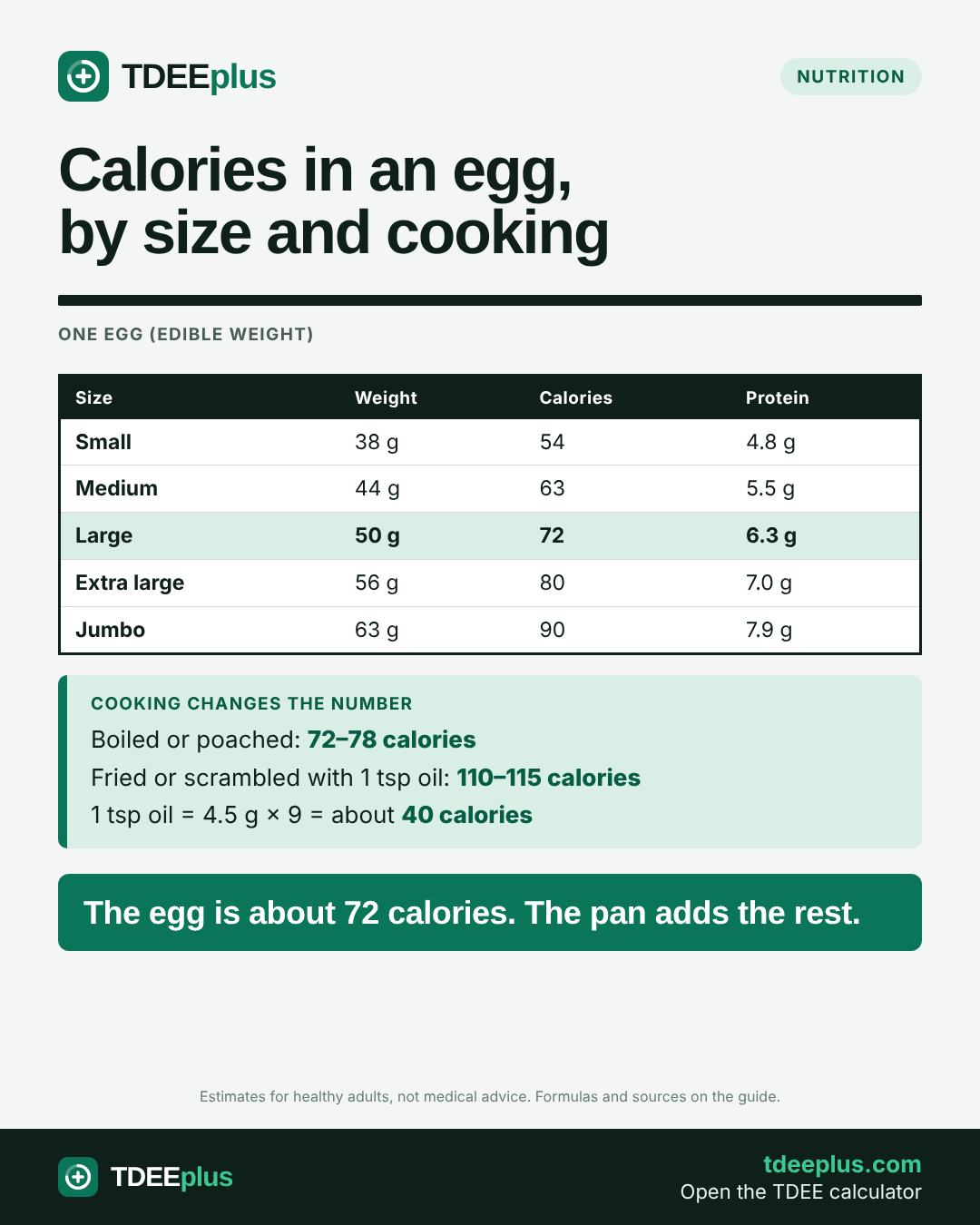
Calories by egg size
US eggs are graded by the minimum weight of a dozen in the shell. The edible portion is smaller, and the figures below are rounded from USDA values of 143 calories per 100 g of whole raw egg.
| Egg size | Edible weight | Calories | Protein | Fat |
|---|---|---|---|---|
| Small | about 38 g | 54 | 4.8 g | 3.6 g |
| Medium | about 44 g | 63 | 5.5 g | 4.2 g |
| Large | about 50 g | 72 | 6.3 g | 4.8 g |
| Extra large | about 56 g | 80 | 7.0 g | 5.3 g |
| Jumbo | about 63 g | 90 | 7.9 g | 6.0 g |
Most recipes and nutrition databases assume a large egg. If you buy another size, adjust the count rather than assuming they are all the same. Two jumbo eggs are about 180 calories, while two small ones are about 108.
What cooking adds
An egg itself changes very little when it is heated. The difference is the fat in the pan.
| Preparation (1 large egg) | Approx. calories | Why |
|---|---|---|
| Hard-boiled or soft-boiled | about 78 | No added fat |
| Poached | about 72 | No added fat |
| Fried in 1 tsp (5 g) oil or butter | about 110 to 115 | Oil is 9 calories per gram, so a teaspoon adds about 40 |
| Scrambled with a splash of milk and 1 tsp fat | about 105 to 115 | Same fat effect, plus a little milk |
Egg white versus yolk
- White (about 33 g): about 17 calories, 3.6 g protein, almost no fat.
- Yolk (about 17 g): about 55 calories, 2.7 g protein, 4.5 g fat, plus most of the vitamins A, D, E and the choline.
Using only whites cuts calories but also removes nutrients. A common middle path is one whole egg plus extra whites. For example, one whole egg and three whites is about 72 + 51 = 123 calories and 17 g of protein.
Where eggs fit in your macros
Eggs give a lot of high-quality protein for the calories: about 8.8 g of protein per 100 calories. If your goal is 120 g of protein a day, three large eggs cover about 19 g, or roughly 16 percent of it. See how much protein you need for your own target and how much protein is in an egg for a size-by-size breakdown.
For fat loss, eggs can help you feel full. They pair well with fibre-rich foods such as vegetables, beans or whole-grain toast; our guide to the highest fibre foods has ideas. If you are tracking, read how to read a nutrition facts label to log eggs and add-ins correctly.
Eggs and cholesterol
One large egg has about 185 to 210 mg of cholesterol, nearly all in the yolk. Earlier guidance capped dietary cholesterol at 300 mg a day. Since 2015 the US Dietary Guidelines have not carried a numeric daily limit, and the current edition says to keep saturated fat under 10 percent of calories (see how much saturated fat per day is OK). A large egg has about 1.6 g of saturated fat, so frying it in butter matters more than the egg itself. If you have heart disease, diabetes or high LDL cholesterol, your own limit may be lower, so ask your doctor.
How to log eggs accurately
- Check the carton for the size and use the table above.
- Log the cooking fat separately and measure it. A pan "glug" can be 100 calories or more.
- For scrambles and omelettes, add the cheese, milk and fillings as their own lines.
- If you eat eggs most days, weigh a few once to confirm your size, then reuse that entry. Accuracy habits like this are covered in TDEE calculator mistakes.
Set your daily protein, fat and carbs, then see how many eggs fit.
Open the macro calculatorFrequently asked questions
How many calories are in one large egg?
Does boiling an egg change the calories?
How many calories are in an egg white and a yolk?
How many eggs can I eat a day?
Are brown eggs lower in calories than white eggs?
Keep reading
Sources
- U.S. Department of Agriculture, Agricultural Research Service. FoodData Central. fdc.nal.usda.gov. Values in this guide are rounded from USDA entries for the foods named; brands and preparation change them.
- U.S. Department of Agriculture and U.S. Department of Health and Human Services. Dietary Guidelines for Americans, 2025–2030. Released January 2026. dietaryguidelines.gov.
- U.S. Food and Drug Administration. Nutrition labeling of food, 21 CFR 101.9(c)(1): calorie conversion factors of 4, 4 and 9 per gram for protein, carbohydrate and fat.